


Parental post-traumatic stress, overprotective parenting, and emotional and behavioural problems for children with critical congenital heart disease
- PMID: 34365986
- PMCID: PMC8825886
- DOI: 10.1017/S1047951121002912
Parental post-traumatic stress, overprotective parenting, and emotional and behavioural problems for children with critical congenital heart disease
Abstract
Objective: To examine relationships amongst parental post-traumatic stress symptoms, parental post-traumatic growth, overprotective parenting, and child emotional/behavioural problems in families of children with critical CHD.
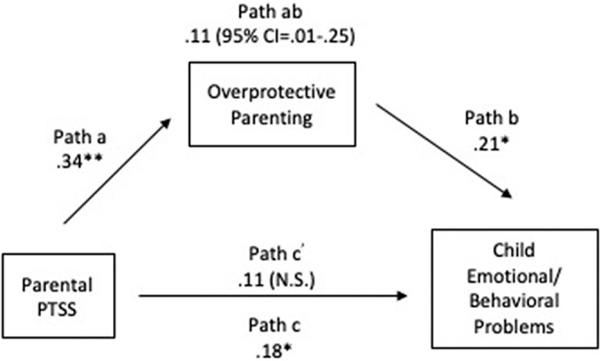
Method: Sixty parents (15 fathers) of children aged 1-6 completed online questionnaires assessing parental post-traumatic stress symptoms and post-traumatic growth, overprotective parenting, and child emotional/behavioural problems. Bivariate correlations and mediational analyses were conducted to evaluate overprotective parenting as a mediator of the association between parental post-traumatic stress symptoms and child emotional/behavioural problems.
Results: Parents reported significant post-traumatic stress symptoms, with over 18% meeting criteria for post-traumatic stress disorder and 70% meeting criteria in one or more clusters. Parental post-traumatic growth was positively correlated with intrusion (r = .32, p = .01) but it was not associated with other post-traumatic stress symptom clusters. Parental post-traumatic stress symptoms were positively associated with overprotective parenting (r = .37, p = .008) and total child emotional/behavioural problems (r = .29, p = .037). Overprotective parenting was positively associated with total child emotional/behavioural problems (r = .45, p = .001) and fully mediated the relationship between parental post-traumatic stress symptoms and child emotional/behavioural problems.
Conclusion: Overprotective parenting mediates the relationship between parental post-traumatic stress symptoms and child emotional and behavioural problems in families of children with CHD. Both parental post-traumatic stress symptoms and overprotective parenting may be modifiable risk factors for poor child outcomes. This study highlights the need for interventions to prevent or reduce parental post-traumatic stress symptoms and to promote effective parenting following a diagnosis of CHD.
Keywords: Congenital heart disease; neurodevelopmental outcomes; overprotective parenting; post-traumatic stress; post-traumatic stress disorder.
Conflict of interest statement
Figures
References
-
- Hoffman JL, Kaplan S. The incidence of congenital heart disease. J Am Coll Cardiol 2002; 39: 1890–1900. - PubMed
-
- Marino BS, Lipkin PH, Nideewburger JW et al. Neurodevelopmental outcomes in children with congenital heart disease: evaluation and management: A scientific statement from the American Heart Association. Circulation 2012; 126: 1143–1172. - PubMed
-
- Wray J, Cassedy A, Ernst MM et al. Psychosocial functioning of parents of children with heart disease—Describing the landscape. Eur J Pediatr 2018; 177: 1811–1821. - PubMed
