


Telehealth delivery of motivational interviewing for diabetes management: A systematic review of randomized controlled trials
- PMID: 34366228
- PMCID: PMC8912910
- DOI: 10.1016/j.pec.2021.07.036
Telehealth delivery of motivational interviewing for diabetes management: A systematic review of randomized controlled trials
Abstract
Objectives: The objective of this systematic review was to explore and report the evidence and gaps in the literature for randomized controlled trials (RCTs) studying the effects of motivational interviewing (MI)-based telehealth interventions on outcomes among persons with diabetes (PWD) or prediabetes.
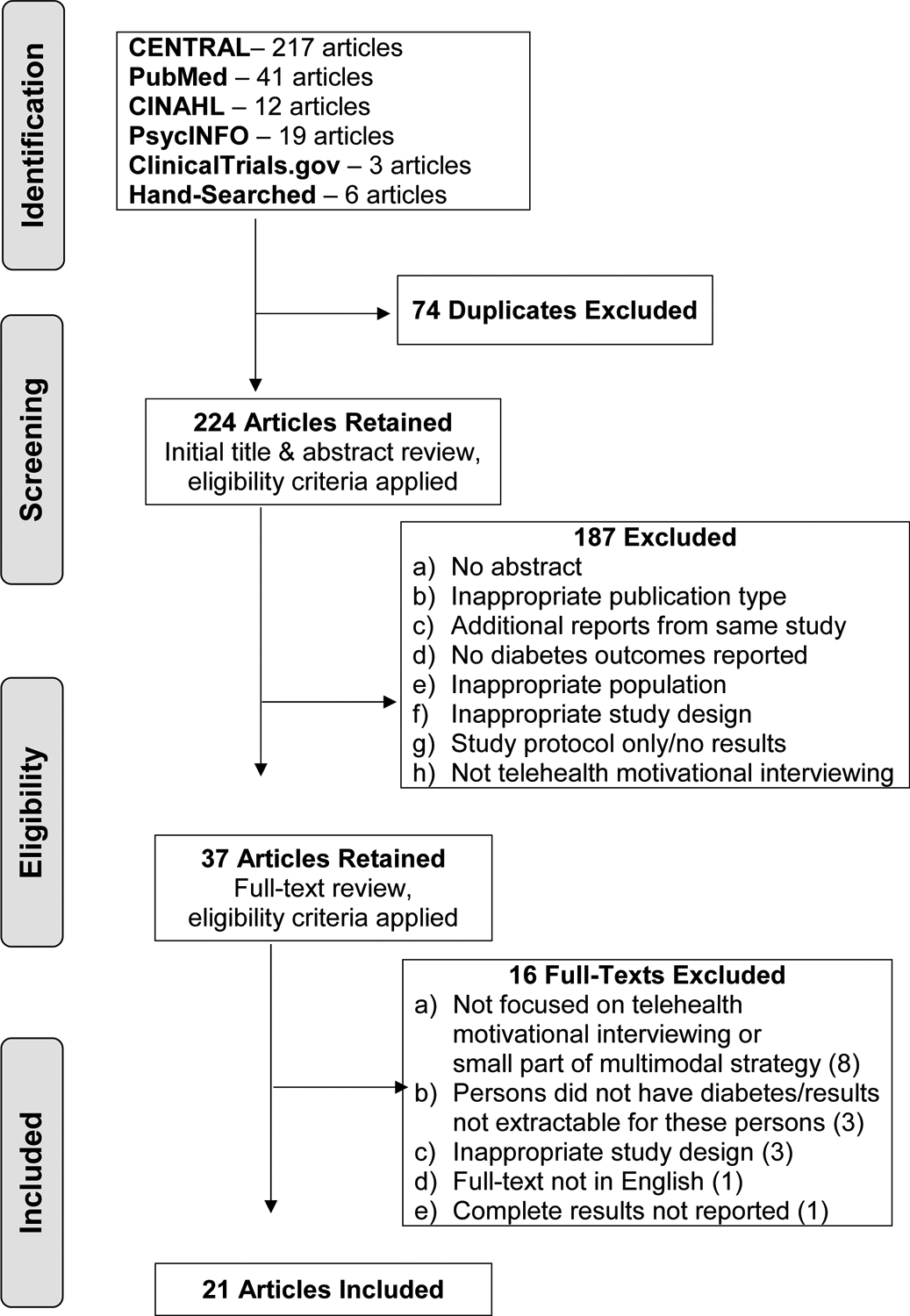
Methods: Following a modified Cochrane approach, we searched Pubmed, CENTRAL, CINAHL, PsycINFO, and Clinicaltrials.gov. Included studies were RCTs published in English before March 25, 2021 evaluating MI-based telehealth on outcomes for adults with diabetes or prediabetes.
Results: A total of 21 retained articles captured results for 6436 PWD. Among the most commonly investigated outcomes, 60% of articles documented A1C reductions (ranging from<1% to>3%), 56% documented systolic blood pressure reductions, 57% documented diabetes self-efficacy/empowerment improvements, and 40% documented physical activity improvements. Conversely, diastolic blood pressure, lipid panels, body mass index, depressive symptoms, and quality of life were frequently measured outcomes, where MI-based telehealth yielded minor effects (<30% of articles demonstrating improvements).
Conclusions: MI-based telehealth seems most effective for improving A1C, systolic blood pressure, diabetes self-efficacy, and physical activity behaviors. Variability in outcome assessment and intervention heterogeneity were key challenges impeding comparisons across retained articles.
Practice implications: MI-based telehealth interventions demonstrate promising results for improving outcomes in PWD.
Keywords: Diabetes; Motivational interviewing; Outcomes; Review; Telehealth.
Copyright © 2021 Elsevier B.V. All rights reserved.
Conflict of interest statement
Declaration of Interest:
McDaniel: Cassidi C. McDaniel was supported by the National Center for Advancing Translational Sciences of the National Institutes of Health under award number TL1TR003106. The content is solely the responsibility of the authors and does not necessarily represent the official views of the National Institutes of Health. McDaniel was also supported by the American Foundation for Pharmaceutical Education (AFPE) under the AFPE Pre-Doctoral Fellowship.
Kavookjian: Dr. Kavookjian discloses that she is on the Merck Speakers Bureau for non-product medical education for the topics of motivational interviewing, shared decision-making, and health literacy communication; she also served as a consultant for Merck as motivational interviewing content expert in the person-centered communication line of education materials; she also consults for MediMergent, LLC for its US Food and Drug Administration (FDA)- funded project in training pharmacists in motivational interviewing for medication taking in diabetes.
Whitley: Nothing to disclose.
References
-
- Centers for Disease Control and Prevention, National diabetes statistics report, 2020. Atlanta, GA: Centers for Disease Control and Prevention. (https://www.cdc.gov/diabetes/data/statistics/statistics-report.html) (accessed October 25, 2020).
-
- Intensive blood-glucose control with sulphonylureas or insulin compared with conventional treatment and risk of complications in patients with type 2 diabetes (UKPDS 33). UK Prospective Diabetes Study (UKPDS) Group, Lancet. 352 (1998) 837–53. - PubMed
Publication types
MeSH terms
Substances
Grants and funding
LinkOut - more resources
Full Text Sources
Medical
