


Comparing a Single Clinician Versus a Multidisciplinary Consensus Conference Approach for Dementia Diagnostics
- PMID: 34366342
- PMCID: PMC8543265
- DOI: 10.3233/JAD-210278
Comparing a Single Clinician Versus a Multidisciplinary Consensus Conference Approach for Dementia Diagnostics
Abstract
Background: Evidence-based recommendations on the optimal evaluation approach for dementia diagnostics are limited. This impedes a harmonized workup across clinics and nations.
Objective: To evaluate the diagnostic performance of a multidisciplinary consensus conference compared to a single clinician approach.
Methods: In this prospective study, we enrolled 457 patients with suspected cognitive decline, from two European memory clinics. A diagnostic evaluation was performed at baseline independently in two ways: 1) by a single clinician and 2) at a multidisciplinary consensus conference. A syndrome diagnosis and an etiological diagnosis was made. The confidence in the diagnosis was recorded using a visual analogue scale. An expert panel re-evaluation diagnosis served as reference for the baseline syndrome diagnosis and a 12-24-month follow-up diagnosis for the etiological diagnosis.
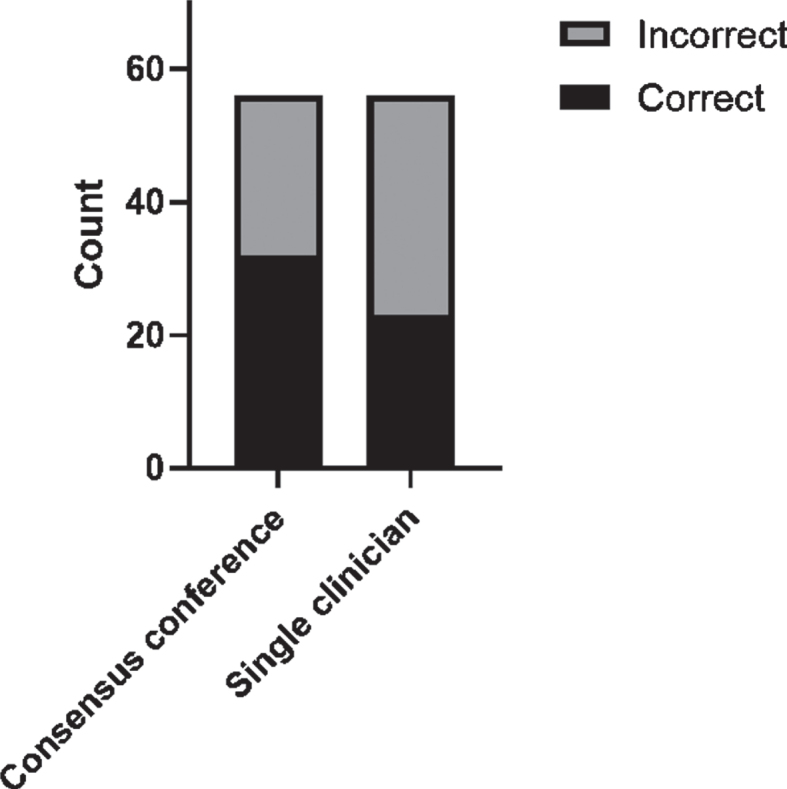
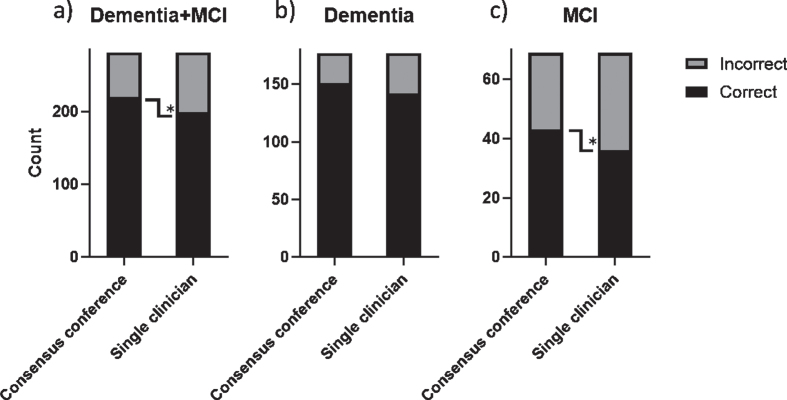
Results: 439 patients completed the study. We observed 12.5%discrepancy (k = 0.81) comparing the baseline syndrome diagnoses of the single clinician to the consensus conference, and 22.3%discrepancy (k = 0.68) for the baseline etiological diagnosis. The accuracy of the baseline etiological diagnosis was significantly higher at the consensus conference and was driven mainly by increased accuracy in the MCI group. Confidence in the etiological diagnosis at baseline was significantly higher at the consensus conference (p < 0.005), especially for the frontotemporal dementia diagnosis.
Conclusion: The multidisciplinary consensus conference performed better on diagnostic accuracy of disease etiology and increased clinicians' confidence. This highlights the importance of a multidisciplinary diagnostic evaluation approach for dementia diagnostics, especially when evaluating patients in the MCI stage.
Keywords: Alzheimer disease; Lewy body disease; clinical decision-making; dementia; differential diagnosis; frontotemporal dementia; vascular dementia.
Conflict of interest statement
Authors’ Competings available online (
Figures
References
-
- World Health Organization (2020) Dementia Fact sheet.
-
- Schoonenboom NS, Reesink FE, Verwey NA, Kester MI, Teunissen CE, van de Ven PM, Pijnenburg YA, Blankenstein MA, Rozemuller AJ, Scheltens P, van der Flier WM (2012) Cerebrospinal fluid markers for differential dementia diagnosis in a large memory clinic cohort. Neurology 78, 47–54. - PubMed
-
- Albert MS, DeKosky ST, Dickson D, Dubois B, Feldman HH, Fox NC, Gamst A, Holtzman DM, Jagust WJ, Petersen RC, Snyder PJ, Carrillo MC, Thies B, Phelps CH (2011) The diagnosis of mild cognitive impairment due to Alzheimer’s disease: Recommendations from the National Institute on Aging-Alzheimer’s Association workgroups on diagnostic guidelines for Alzheimer’s disease. Alzheimers Dement 7, 270–279. - PMC - PubMed
-
- Rabins PV, Blacker D, Rovner BW, Rummans T, Schneider LS, Tariot PN, Blass DM, McIntyre JS, Charles SC, Anzia DJ, Cook IA, Finnerty MT, Johnson BR, Nininger JE, Schneidman B, Summergrad P, Woods SM, Berger J, Cross CD, Brandt HA, Margolis PM, Shemo JP, Blinder BJ, Duncan DL, Barnovitz MA, Carino AJ, Freyberg ZZ, Gray SH, Tonnu T, Kunkle R, Albert AB, Craig TJ, Regier DA, Fochtmann LJ (2007) American Psychiatric Association practice guideline for the treatment of patients with Alzheimer’s disease and other dementias. Second edition. Am J Psychiatry 164, 5–56. - PubMed
Publication types
MeSH terms
LinkOut - more resources
Full Text Sources
Medical
