. 2020 Jul-Dec:43:817-850.
doi: 10.4054/demres.2020.43.28. Epub 2020 Sep 11.

Explaining the MENA Paradox: Rising Educational Attainment, Yet Stagnant Female Labor Force Participation

Affiliations

Explaining the MENA Paradox: Rising Educational Attainment, Yet Stagnant Female Labor Force Participation

Ragui Assaad et al. Demogr Res. 2020 Jul-Dec.

Abstract

Background: Despite rapidly rising female educational attainment and the closing, if not reversal, of the gender gap in education, female labor force participation rates in the Middle East and North Africa (MENA) region remain low and stagnant. This is a phenomenon that has come to be known as the "MENA paradox". Even if increases in participation are observed, they are typically in the form of rising unemployment rather than employment.

Methods: We use multinomial logit models estimated, by country, on annual labor force survey data for four MENA countries - Algeria, Egypt, Jordan and Tunisia - to simulate trends in female participation in different labor market states (public sector, private wage work, non-wage work, unemployment and non-participation) for married and unmarried women and men, of a given educational and age profile.

Results: Our results confirm that the decline in the probability of public sector employment for educated women is associated with either an increase in unemployment or a decline in participation.

Conclusions: We argue that failure of employment rates to increase in line with women's rapidly rising educational attainment - the so-called MENA paradox -- can be primarily attributed to the change in opportunity structures facing educated women in the MENA region in the 2000s, rather than the supply-side factors traditionally emphasized in the literature to explain low female participation in MENA.

Contribution: We argue that female labor force participation among educated women in four MENA countries - Algeria, Egypt, Jordan and Tunisia -- is constrained by adverse developments in the structure of employment opportunities on the demand side. Specifically, the contraction in public sector employment opportunities has not been made up by a commensurate increase in opportunities in the formal private sector, leading to increases in female unemployment or declines in participation.

Keywords: J16; J21; J22; J82; MENA region; female labor force participation; human capital; public employment; sectoral choice.


Figures

Figure 1.
Figure 1.. Proportion with Above Secondary and Secondary Education by Country, Gender and Year of Birth
Source: Computed by the authors using the official labor surveys of Algeria (2001-2007, 2010), Egypt (2008-2014), Jordan (2000-2014) and Tunisia (2005, 2006, 2008, 2010, 2013). Note: Curves are smoothed using a 5-period moving average trendline.
Figure 2.
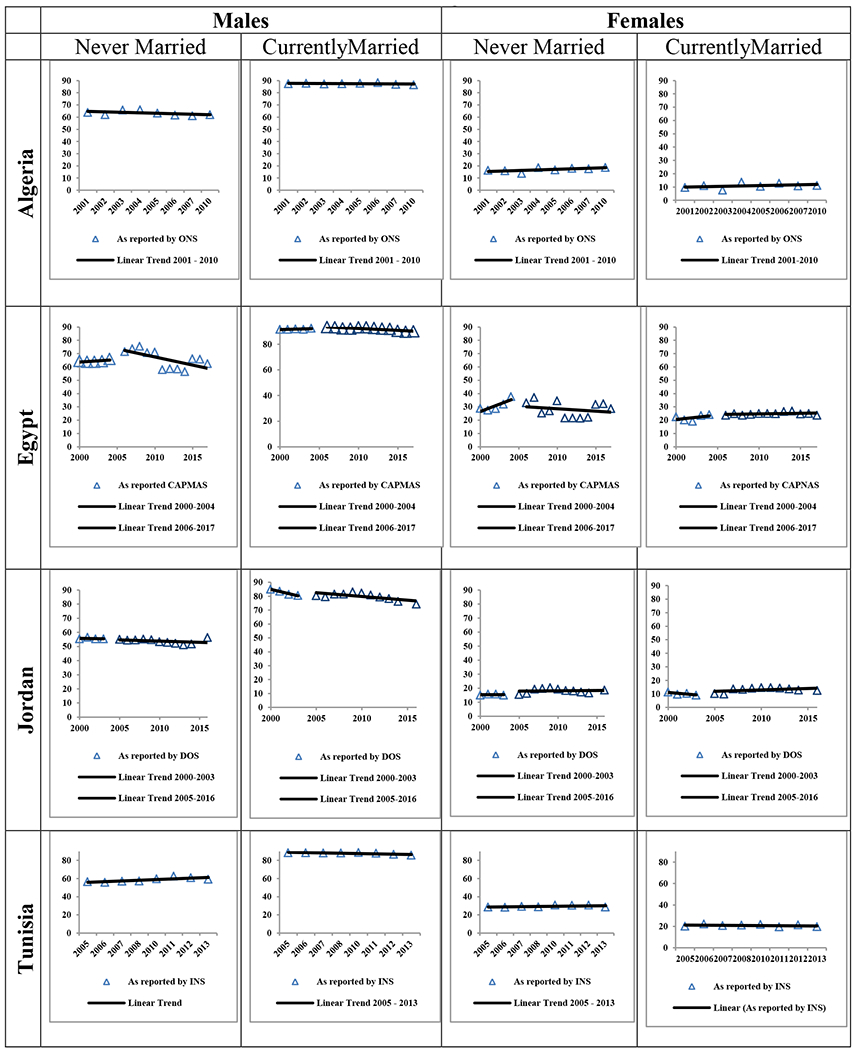
Figure 2.. Trends in Average Male and Female Participation Rates by Country and Marital Status, Ages 15-64
Source: Computed by the authors using data from official labor force surveys in each of the four countries. See data section in text for more details.
Figure 3.
Figure 3.. Proportion of Employment in Different Sectors for the First Job by Year of Entry and Country (Individuals with Secondary Education or Above)
Source: Computed by the authors using data from the official labor force survey in Algeria (2010), the Egypt Labor Market Panle Survey of 2012 for Egypt, the Jordan Labor Market Panel Survey of 2010 for Jordan and the Tunisia Labor Market Panel Survey of 2014 for Tunisia. SeeOAMDI, http://www.erf.org.eg/cms.php?id=erfdataportal. Economic Research Forum (ERF). Note: A six-period moving average trend line is used to smooth the fluctuations in the data.
Figure 4:
Figure 4:
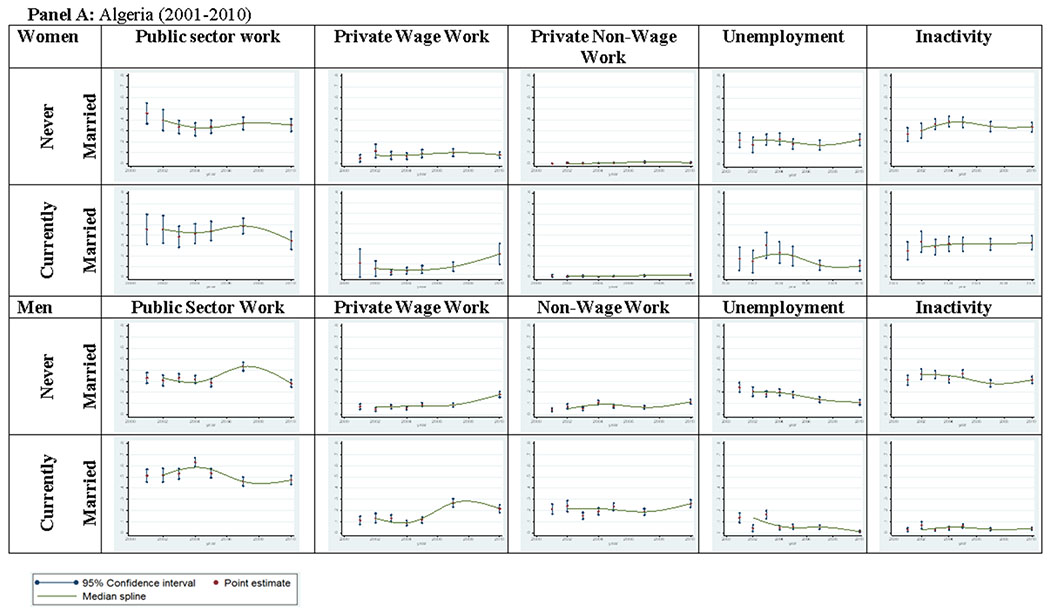
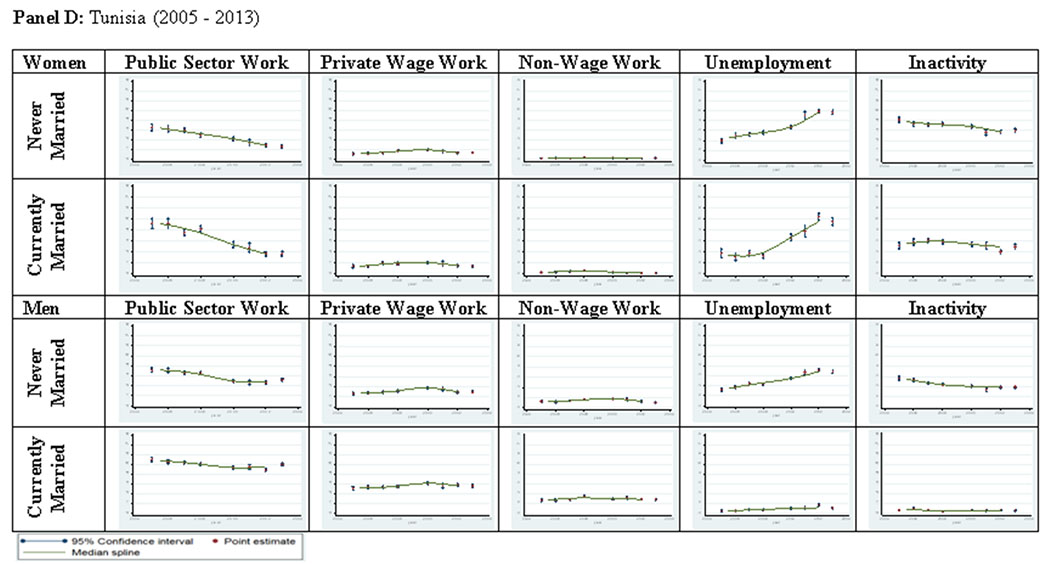
Simulated Probabilities of Labor Market States for a 25-Year Old University Educated Female and Male, by Marital Status and Country Source: Based on simulations conducted using multinomial logit models on data from official labor force surveys in each of the four countries. See data and methods section in text for details. Note: Simulations are carried out for a 30-year old university-educated female or male residing in an urban area in the region of her/his country that includes the capital city. Four-period splines are used to smooth fluctuations in the simulation results.
Figure 4:
Figure 4:
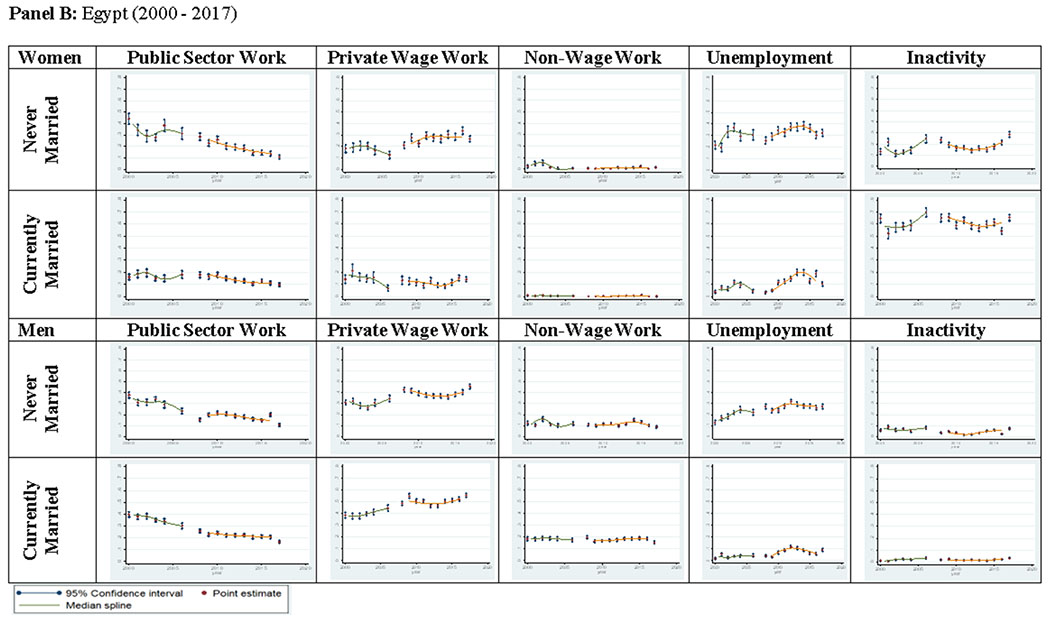
Simulated Probabilities of Labor Market States for a 25-Year Old University Educated Female and Male, by Marital Status and Country Source: Based on simulations conducted using multinomial logit models on data from official labor force surveys in each of the four countries. See data and methods section in text for details. Note: Simulations are carried out for a 30-year old university-educated female or male residing in an urban area in the region of her/his country that includes the capital city. Four-period splines are used to smooth fluctuations in the simulation results.
Figure 4:
Figure 4:
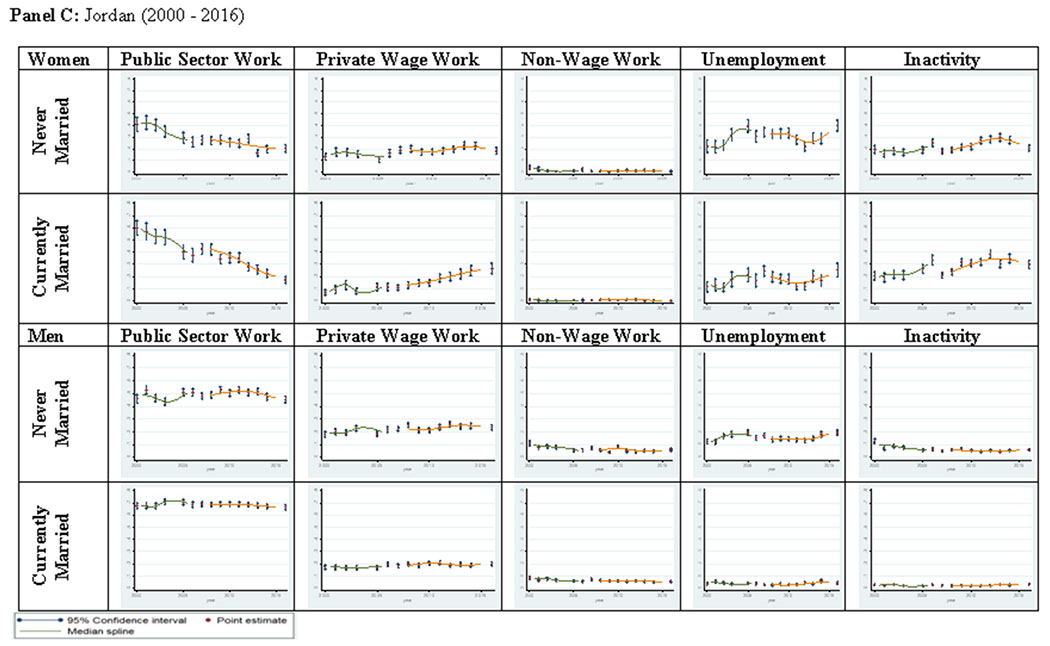
Simulated Probabilities of Labor Market States for a 25-Year Old University Educated Female and Male, by Marital Status and Country Source: Based on simulations conducted using multinomial logit models on data from official labor force surveys in each of the four countries. See data and methods section in text for details. Note: Simulations are carried out for a 30-year old university-educated female or male residing in an urban area in the region of her/his country that includes the capital city. Four-period splines are used to smooth fluctuations in the simulation results.
Figure 4:
Figure 4:
Simulated Probabilities of Labor Market States for a 25-Year Old University Educated Female and Male, by Marital Status and Country Source: Based on simulations conducted using multinomial logit models on data from official labor force surveys in each of the four countries. See data and methods section in text for details. Note: Simulations are carried out for a 30-year old university-educated female or male residing in an urban area in the region of her/his country that includes the capital city. Four-period splines are used to smooth fluctuations in the simulation results.
Figure 5.
Figure 5.
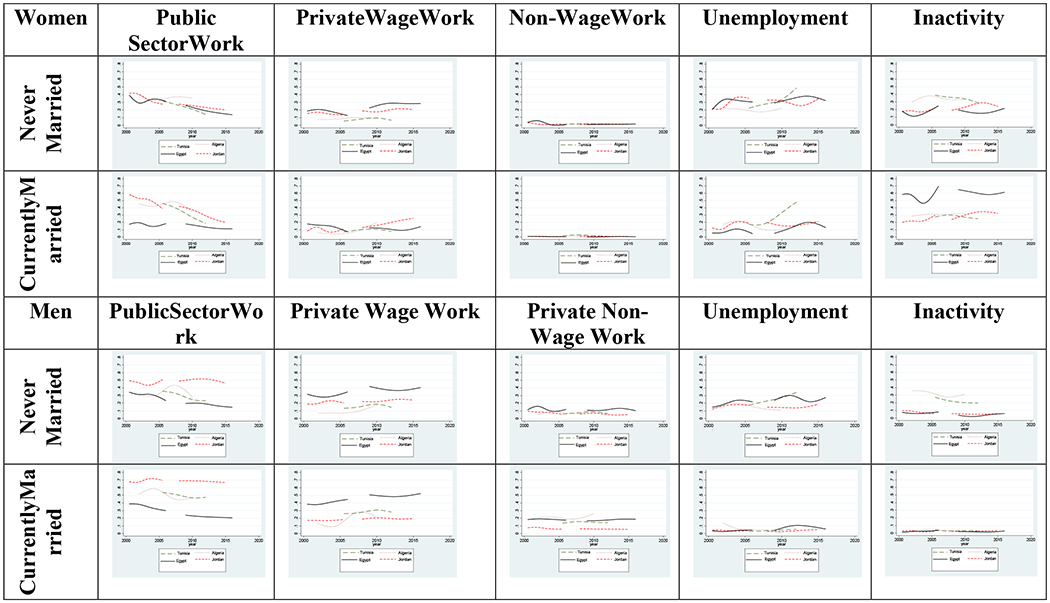
Simulations of the Probability of Participation by Type for Never Married and Currently Married Women in Algeria, Egypt, Jordan and Tunisia Source: Based on simulations conducted using multinomial logit models on data from official labor force surveys in each of the four countries. See data and methods section in text for details. Note: Simulation are carried out for a 30-year old never married and currently married university-educated female and male residing in an urban area in the region of her/his country that includes the capital city. Four-period splines are used to smooth fluctuations in the simulation results.

References

    1. Akerlof George A., and Kranton Rachel E.. 2009. “Economics and Identity.” The Quarterly Journal of Economics CXV (3): 715–53.
    1. Albanesi Stefania, and Olivetti Claudia. 2016. “Gender Roles and Medical Progress.” Journal of Political Economy 124 (3): 650–95. 10.1086/686035. - DOI
    1. Assaad Ragui. 2014. “Making Sense of Arab Labor Markets: The Enduring Legacy of Dualism.” IZA Journal of Labor {&} Development 3 (1): 1–25. 10.1186/2193-9020-3-6. - DOI
    1. Assaad Ragui, and Mongi Boughzala, eds. 2018. The Tunisian Labor Market in an Era of Transition. Oxford: Oxford University Press.
    1. Assaad Ragui, and Fatma El-Hamidi. 2001. “Is All Work the Same? A Comparison of the Determinants of Female Participation and Hours of Work in Various Employment States in Egypt.” In The Economics of Women and Work in the Middle East and North Africa. Research in Middle East Economics, edited by Cinar Mine. Vol. 4. Greenwich, CT: JAI press.

LinkOut - more resources