


Lipidomics of Environmental Microbial Communities. I: Visualization of Component Distributions Using Untargeted Analysis of High-Resolution Mass Spectrometry Data
- PMID: 34367080
- PMCID: PMC8343106
- DOI: 10.3389/fmicb.2021.659302
Lipidomics of Environmental Microbial Communities. I: Visualization of Component Distributions Using Untargeted Analysis of High-Resolution Mass Spectrometry Data
Abstract
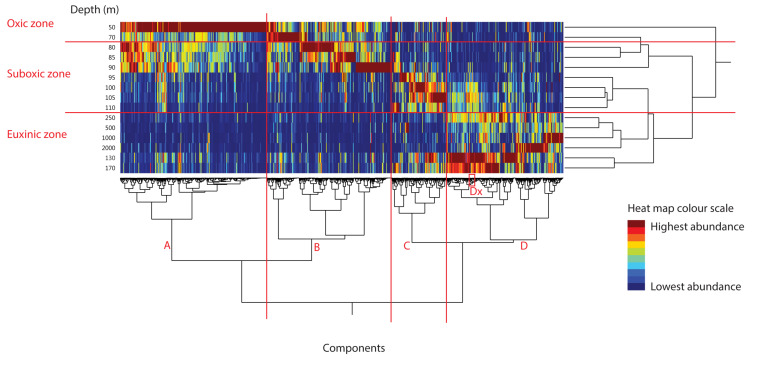
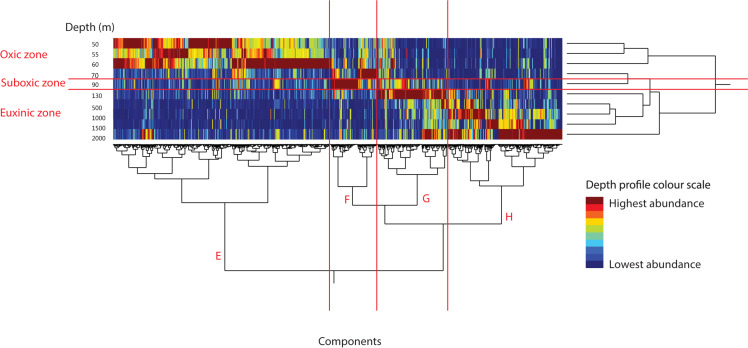
Lipids, as one of the main building blocks of cells, can provide valuable information on microorganisms in the environment. Traditionally, gas or liquid chromatography coupled to mass spectrometry (MS) has been used to analyze environmental lipids. The resulting spectra were then processed through individual peak identification and comparison with previously published mass spectra. Here, we present an untargeted analysis of MS1 spectral data generated by ultra-high-pressure liquid chromatography coupled with high-resolution mass spectrometry of environmental microbial communities. Rather than attempting to relate each mass spectrum to a specific compound, we have treated each mass spectrum as a component, which can be clustered together with other components based on similarity in their abundance depth profiles through the water column. We present this untargeted data visualization method on lipids of suspended particles from the water column of the Black Sea, which included >14,000 components. These components form clusters that correspond with distinct microbial communities driven by the highly stratified water column. The clusters include both known and unknown compounds, predominantly lipids, demonstrating the value of this rapid approach to visualize component distributions and identify novel lipid biomarkers.
Keywords: Black Sea; MZmine; lipidome; lipidomics; lipids; liquid chromatography mass spectrometry.
Copyright © 2021 Bale, Ding, Hopmans, Arts, Villanueva, Boschman, Haas, Schouten and Sinninghe Damsté.
Conflict of interest statement
The authors declare that the research was conducted in the absence of any commercial or financial relationships that could be construed as a potential conflict of interest.
Figures
References
-
- Bale N. J., Airs R. L., Llewellyn C. A. (2011). Type I and Type II chlorophyll-a transformation products associated with algal senescence. Org. Geochem. 42 451–464. 10.1016/j.orggeochem.2011.03.016 - DOI
-
- Bale N. J., Hopmans E. C., Schoon P. L., de Kluijver A., Downing J. A., Middelburg J. J., et al. (2016). Impact of trophic state on the distribution of intact polar lipids in surface waters of lakes. Limnol. Oceanogr. 61 1065–1077. 10.1002/lno.10274 - DOI
-
- Bale N. J., Koenen M., Yadav S., Hopmans E. C., Villanueva L., Sinninghe Damsté J. S., et al. (2020). Diagnostic amide products of amino lipids detected in the microaerophilic bacteria Lutibacter during routine fatty acid analysis using gas chromatography. Organic Geochem. 144:104027. 10.1016/j.orggeochem.2020.104027 - DOI
-
- Bale N. J., Palatinszky M., Rijpstra W. I. C., Herbold C. W., Wagner M., Sinninghe Damsté J. S. (2019a). Membrane Lipid Composition of the Moderately Thermophilic Ammonia-Oxidizing Archaeon “Candidatus Nitrosotenuis uzonensis” at Different Growth Temperatures. Appl. Environ. Microbiol. 85 1332–1319. 10.1128/AEM.01332-19 - DOI - PMC - PubMed
LinkOut - more resources
Full Text Sources
