


How Trust Makes a Difference: The Impact of the First Wave of the COVID-19 Pandemic on Life Satisfaction in Germany
- PMID: 34367359
- PMCID: PMC8326641
- DOI: 10.1007/s11482-021-09956-0
How Trust Makes a Difference: The Impact of the First Wave of the COVID-19 Pandemic on Life Satisfaction in Germany
Abstract
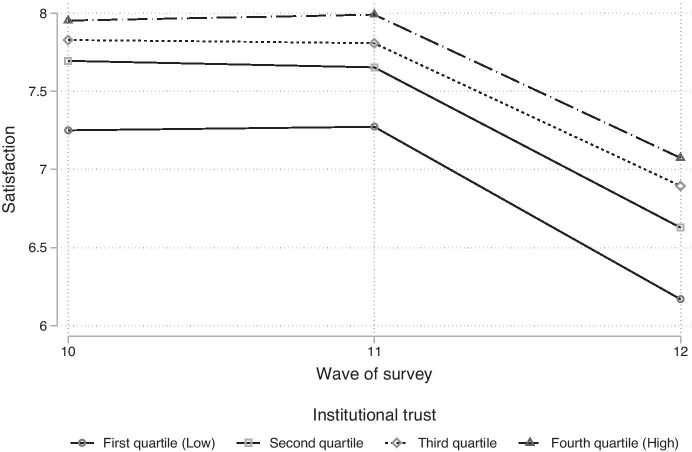
The extraordinary COVID-19 pandemic is one of the most severe disruptions of human life since the end of World War II, even in rich and industrialized countries like Germany. The introduction of a rather comprehensive "lockdown" and the restriction of multiple basic civil rights have affected the population in many areas of life, like employment, economic prosperity, health and trust in public institutions. The question arises how life satisfaction is influenced by these measures in detail and whether there are interactions between institutional trust, life satisfaction and time of crisis. Fixed-effect regression analyses using German National Educational Panel Study (NEPS) data demonstrate that life satisfaction has fallen sharply after the onset of the crisis and that interaction effects with institutional trust are present. Individuals with low levels of pre-crisis trust in institutions like the government, courts or the media report a stronger decrease of satisfaction than individuals with higher levels of trust. We believe that these results are relevant to explain the role of institutions in times of crisis and might serve as foundations for interventions to strengthen trust and increase overall satisfaction.
Keywords: COVID-19 lockdown; Germany; Institutional trust; Life satisfaction.
© The Author(s) 2021.
Conflict of interest statement
Conflict of InterestThe author declares that he has no conflict of interest.
Figures
References
-
- Allison P. Missing Data. Sage; 2002.
-
- Bartram, D. (2019). Life Satisfaction and Age: Getting Control Variables under Control. Working Paper, Leicester.
-
- Beierlein, C., Kemper, C. J., Kovaleva, A., & Rammstedt, B. (2012). Ein Messinstrument zur Erfassung politischer Kompetenz-und Einflussüberzeugungen: Political Efficacy Kurzskala (PEKS). https://nbn-resolving.org/urn:nbn:de:0168-ssoar-292361. Accessed 28 Nov 2020
-
- Blasco-Belled A, Tejada-Gallardo C, Torrelles-Nadal C, Alsinet C. The costs of the COVID-19 on subjective well-being: An analysis of the outbreak in Spain. Sustainability. 2020;12(15):6243. doi: 10.3390/su12156243. - DOI
LinkOut - more resources
Full Text Sources