


Performance of five pulse oximeters to detect hypoxaemia as an indicator of severe illness in children under five by frontline health workers in low resource settings - A prospective, multicentre, single-blinded, trial in Cambodia, Ethiopia, South Sudan, and Uganda
- PMID: 34368660
- PMCID: PMC8326731
- DOI: 10.1016/j.eclinm.2021.101040
Performance of five pulse oximeters to detect hypoxaemia as an indicator of severe illness in children under five by frontline health workers in low resource settings - A prospective, multicentre, single-blinded, trial in Cambodia, Ethiopia, South Sudan, and Uganda
Abstract
Background: Low blood oxygen saturation (SpO2), or hypoxaemia, is an indicator of severe illness in children. Pulse oximetry is a globally accepted, non-invasive method to identify hypoxaemia, but rarely available outside higher-level facilities in resource-constrained countries. This study aims to evaluate the performance of different types of pulse oximeters amongst frontline health workers in Cambodia, Ethiopia, South Sudan, and Uganda.
Methods: Five pulse oximeters (POx) which passed laboratory testing, out of an initial 32 potential pulse oximeters, were evaluated by frontline health workers for performance, defined as agreement between the SpO2 measurements of the test device and the reference standard. The study protocol is registered with the Australia New Zealand Clinical Trials Registry (Ref: ACTRrn12615000348550).
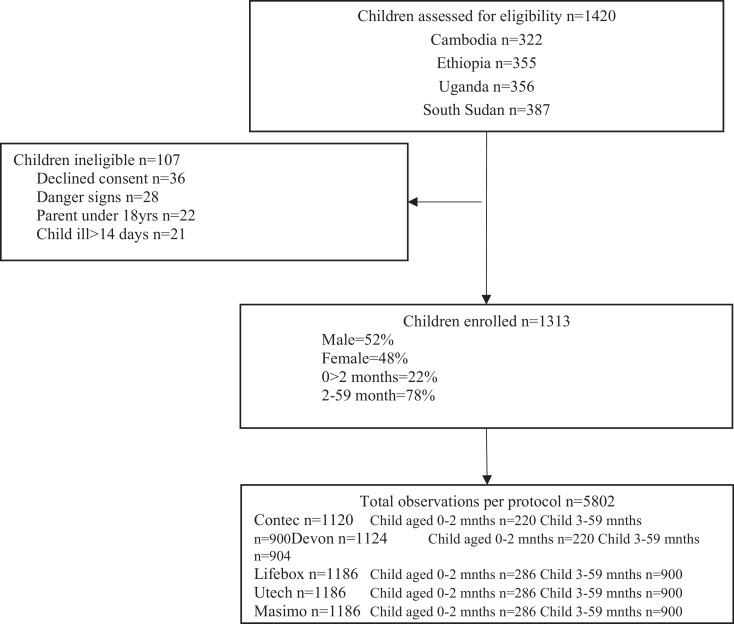
Findings: Two finger-tip pulse oximeters (Contec and Devon), two handheld pulse oximeters (Lifebox and Utech), and one phone pulse oximeter (Masimo) passed the laboratory testing. They were evaluated for performance on 1,313 children under five years old by 207 frontline health workers between February and May 2015. Phone and handheld pulse oximeters had greater overall agreement with the reference standard (56%; 95% CI 0.52 - 0.60 to 68%; 95% CI 0.65 - 0.71) than the finger-tip POx (31%; 95% CI 0.26 to 0.36 and 47%; 95% CI 0.42 to 0.52). Fingertip POx performance was substantially lower in the 0-2 month olds; having just 17% and 25% agreement. The finger-tip devices more often underreported SpO2 readings (mean difference -7.9%; 95%CI -8.6,-7.2 and -3.9%; 95%CI -4.4,-3.4), and therefore over diagnosed hypoxaemia in the children assessed.
Interpretation: While the Masimo phone pulse oximeter performed best, all handheld POx with age-specific probes performed well in the hands of frontline health workers, further highlighting their suitability as a screening tool of severe illness. The poor performance of the fingertip POx suggests they should not be used in children under five by frontline health workers. It is essential that POx are performance tested on children in routine settings (in vivo), not only in laboratories or controlled settings (in vitro), before being introduced at scale.
Funding: Bill & Melinda Gates Foundation [OPP1054367].
Keywords: Childhood pneumonia; Diagnostic aids; Health worker performance; Low-income country; Pulse oximeter; Severe illness.
© 2021 The Author(s).
Conflict of interest statement
All authors had full access to all the data in the study and accept responsibility to submit for publication. None of the authors has any conflict of interest to declare and all authors have completed the ICMJE form.
Figures
References
-
- Subhi R., Adamson M., Campbell H. The prevalence of hypoxaemia among ill children in developing countries: a systematic review. Lancet Infect Dis. 2009;9(4):219–227. - PubMed
-
- Usen S., Webert M. Clinical signs of hypoxaemia in children with acute lower respiratory infection: indicators of oxygen therapy. Int J Tubercul Lung Disease. 2001;5(6):505–510. - PubMed
-
- Duke T., Subhi R., Peel D., Frey B. Pulse oximetry: technology to reduce child mortality in developing countries. Ann Trop Paediatr. 2009;29(3):165–175. - PubMed
LinkOut - more resources
Full Text Sources
