


Effect of co-infection with intestinal parasites on COVID-19 severity: A prospective observational cohort study
- PMID: 34368662
- PMCID: PMC8324426
- DOI: 10.1016/j.eclinm.2021.101054
Effect of co-infection with intestinal parasites on COVID-19 severity: A prospective observational cohort study
Abstract
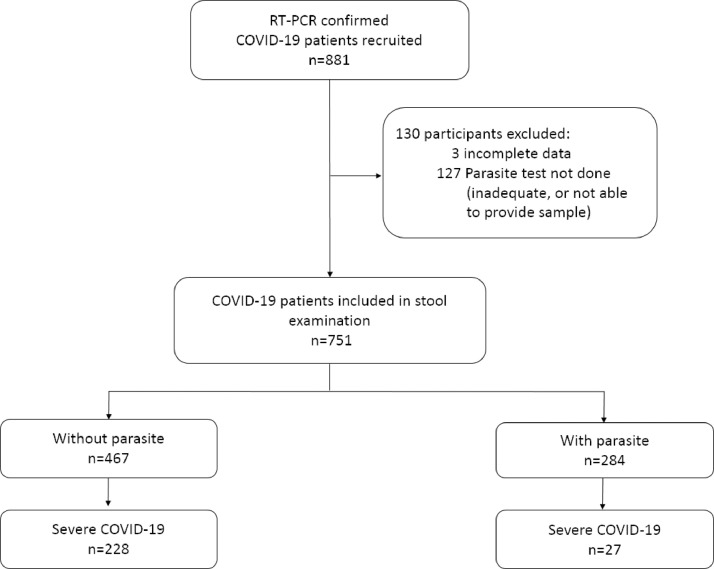
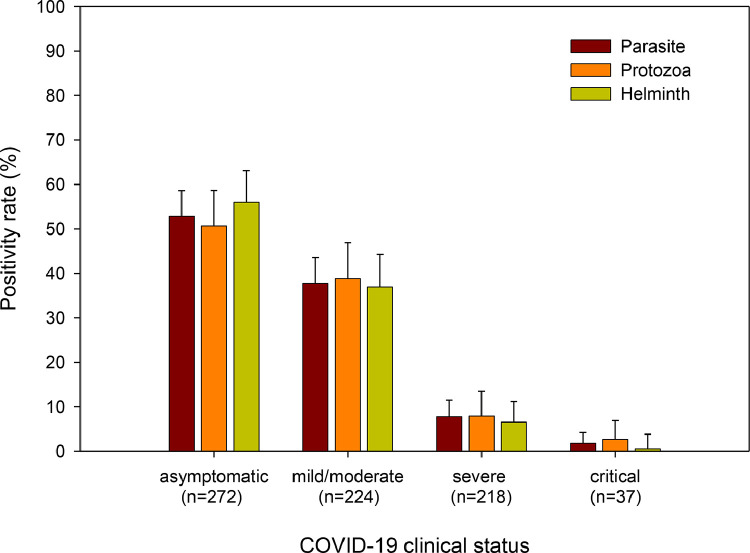
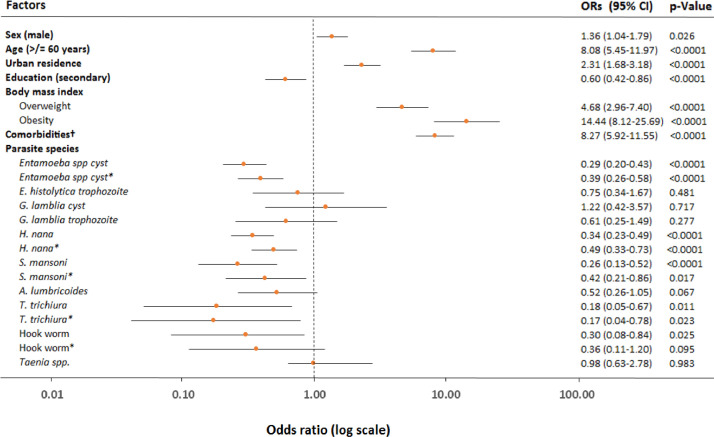
Background: Severe acute respiratory syndrome coronavirus 2 (SARS-CoV-2) infection results in a spectrum of clinical presentations. Evidence from Africa indicates that significantly less COVID-19 patients suffer from serious symptoms than in the industrialized world. We and others previously postulated a partial explanation for this phenomenon, being a different, more activated immune system due to parasite infections. Here, we aimed to test this hypothesis by investigating a potential correlation of co-infection with parasites with COVID-19 severity in an endemic area in Africa. Methods: Ethiopian COVID-19 patients were enrolled and screened for intestinal parasites, between July 2020 and March 2021. The primary outcome was the proportion of patients with severe COVID-19. Ordinal logistic regression models were used to estimate the association between parasite infection, and COVID-19 severity. Models were adjusted for sex, age, residence, education level, occupation, body mass index, and comorbidities. Findings: 751 SARS-CoV-2 infected patients were enrolled, of whom 284 (37.8%) had intestinal parasitic infection. Only 27/255 (10.6%) severe COVID-19 patients were co-infected with intestinal parasites, while 257/496 (51.8%) non-severe COVID-19 patients were parasite positive (p<0.0001). Patients co-infected with parasites had lower odds of developing severe COVID-19, with an adjusted odds ratio (aOR) of 0.23 (95% CI 0.17-0.30; p<0.0001) for all parasites, aOR 0.37 ([95% CI 0.26-0.51]; p<0.0001) for protozoa, and aOR 0.26 ([95% CI 0.19-0.35]; p<0.0001) for helminths. When stratified by species, co-infection with Entamoeba spp., Hymenolepis nana, Schistosoma mansoni, and Trichuris trichiura implied lower probability of developing severe COVID-19. There were 11 deaths (1.5%), and all were among patients without parasites (p = 0.009). Interpretation: Parasite co-infection is associated with a reduced risk of severe COVID-19 in African patients. Parasite-driven immunomodulatory responses may mute hyper-inflammation associated with severe COVID-19. Funding: European and Developing Countries Clinical Trials Partnership (EDCTP) - European Union, and Joep Lange Institute (JLI), The Netherlands. Trial registration: Clinicaltrials.gov: NCT04473365.
Keywords: COVID-19; Severity; africa; co-infection; parasite.
© 2021 The Author(s).
Conflict of interest statement
DW is European and Developing Countries Clinical Trials Partnership (EDCTP) Senior Research Fellow, and received funding for EvaLAMP project on Leishmaniasis Diagnostics; he serves as Strategic and Scientific Advisory Board of the Research Networks for Health Innovations in Sub-Saharan Africa (German Federal Ministry of Education and Research), and has received an honorarium for lectures and presentations from the Ethiopian Ministry of Science and Higher Education. VH received grants from Netherlands organization for Health Research and Development, VaillantFonds, and she serves as Gilead advisory board, and has received an honorarium from Medtalks, and Gilead. In addition, she serves as head of expertise group for Federal Medical Specialists, and is reviewer for COVID-19 grants for Netherlands organization for Health Research and Development. TRW is employee of PharmAccess Foundation, is Board Member of Mondial Diagnostics, and Advisory Board member of Healthinc, The Netherlands. All other authors have no declarations to disclose.
Figures
Comment in
-
Parasites Protect from Severe COVID-19. Myth or Reality?Int J Infect Dis. 2022 Jun;119:117-118. doi: 10.1016/j.ijid.2022.03.027. Epub 2022 Mar 22. Int J Infect Dis. 2022. PMID: 35331930 Free PMC article. No abstract available.
References
Associated data
LinkOut - more resources
Full Text Sources
Medical
Miscellaneous
