


Vitamin K Intake and Atherosclerotic Cardiovascular Disease in the Danish Diet Cancer and Health Study
- PMID: 34369182
- PMCID: PMC8475061
- DOI: 10.1161/JAHA.120.020551
Vitamin K Intake and Atherosclerotic Cardiovascular Disease in the Danish Diet Cancer and Health Study
Abstract
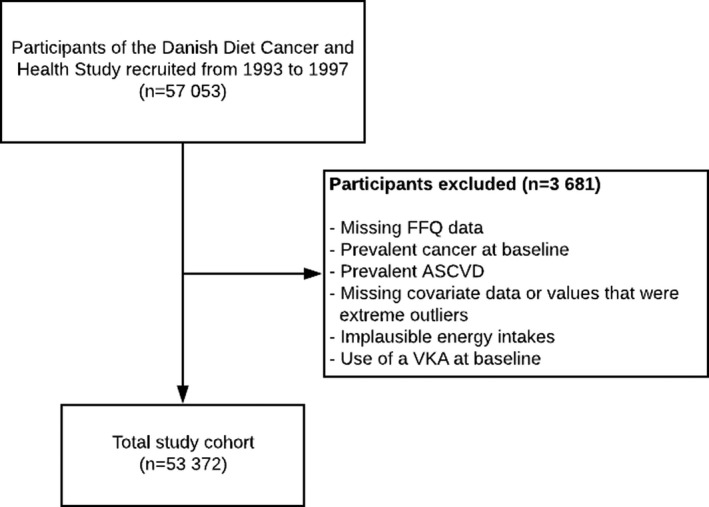
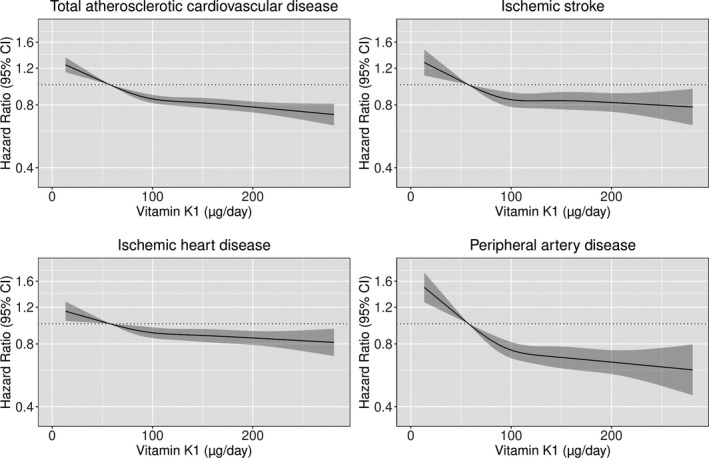
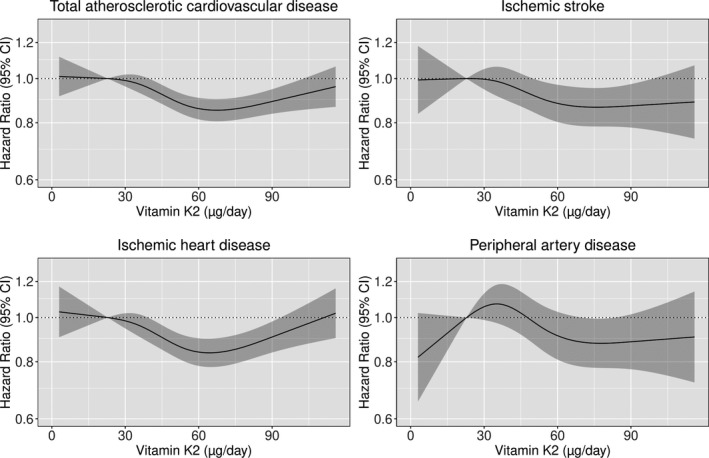
Background Dietary vitamin K (K1 and K2) may reduce atherosclerotic cardiovascular disease (ASCVD) risk via several mechanisms. However, studies linking vitamin K intake with incident ASCVD are limited. We aimed to determine the relationship between dietary vitamin K intake and ASCVD hospitalizations. Methods and Results In this prospective cohort study, participants from the Danish Diet, Cancer, and Health Study, with no prior ASCVD, completed a food-frequency questionnaire at baseline and were followed up for hospital admissions of ASCVD; ischemic heart disease, ischemic stroke, or peripheral artery disease. Intakes of vitamin K1 and vitamin K2 were estimated from the food-frequency questionnaire, and their relationship with ASCVD hospitalizations was determined using Cox proportional hazards models. Among 53 372 Danish citizens with a median (interquartile range) age of 56 (52-60) years, 8726 individuals were hospitalized for any ASCVD during 21 (17-22) years of follow-up. Compared with participants with the lowest vitamin K1 intakes, participants with the highest intakes had a 21% lower risk of an ASCVD-related hospitalization (hazard ratio, 0.79; 95% CI: 0.74-0.84), after multivariable adjustments for relevant demographic covariates. Likewise for vitamin K2, the risk of an ASCVD-related hospitalization for participants with the highest intakes was 14% lower than participants with the lowest vitamin K2 intake (hazard ratio, 0.86; 95% CI, 0.81-0.91). Conclusions Risk of ASCVD was inversely associated with diets high in vitamin K1 or K2. The similar inverse associations with both vitamin K1 and K2, despite very different dietary sources, highlight the potential importance of vitamin K for ASCVD prevention.
Keywords: atherosclerotic cardiovascular disease; dietary vitamin K; menaquinone; phylloquinone; primary prevention; prospective cohort study.
Conflict of interest statement
Dr Gislason: has received grants from Bristol‐Myers Squibb, Pfizer, Boehringer Ingelheim, and Bayer outside the submitted work. Dr. Torp‐Pedersen reports grants from Bayer and Novo Nordisk outside the submitted work. Dr. Schultz reports grants and personal fees from Abbott Vascular outside the submitted work. The remaining authors have no disclosures to report.
Figures
References
-
- World Health Organisation . Global Atlas on cardiovascular disease prevention and control. Geneva: World Health Organisation; 2011: Cited 14 May 2020 http://www.who.int/cardiovascular_diseases/publications/atlas_cvd/en.
Publication types
MeSH terms
Substances
LinkOut - more resources
Full Text Sources
Medical
