Association Between Prison Crowding and COVID-19 Incidence Rates in Massachusetts Prisons, April 2020-January 2021
- PMID: 34369964
- PMCID: PMC8353573
- DOI: 10.1001/jamainternmed.2021.4392
Association Between Prison Crowding and COVID-19 Incidence Rates in Massachusetts Prisons, April 2020-January 2021
Abstract
Importance: COVID-19 incidence and mortality are higher among incarcerated persons than in the general US population, but the extent to which prison crowding contributes to their COVID-19 risk is unknown.
Objective: To estimate the associations between prison crowding, community COVID-19 transmission, and prison incidence rates of COVID-19.
Design, setting, and participants: This was a longitudinal ecological study among all incarcerated persons in 14 Massachusetts state prisons between April 21, 2020, and January 11, 2021.
Exposures: The primary exposure of interest was prison crowding, measured by (1) the size of the incarcerated population as a percentage of the prison's design capacity and (2) the percentage of incarcerated persons housed in single-cell units. The analysis included the weekly COVID-19 incidence in the county where each prison is located as a covariate.
Main outcomes and measures: The primary outcome was the weekly COVID-19 incidence rate as determined by positive SARS-CoV-2 tests among incarcerated persons at each prison over discrete 1-week increments.
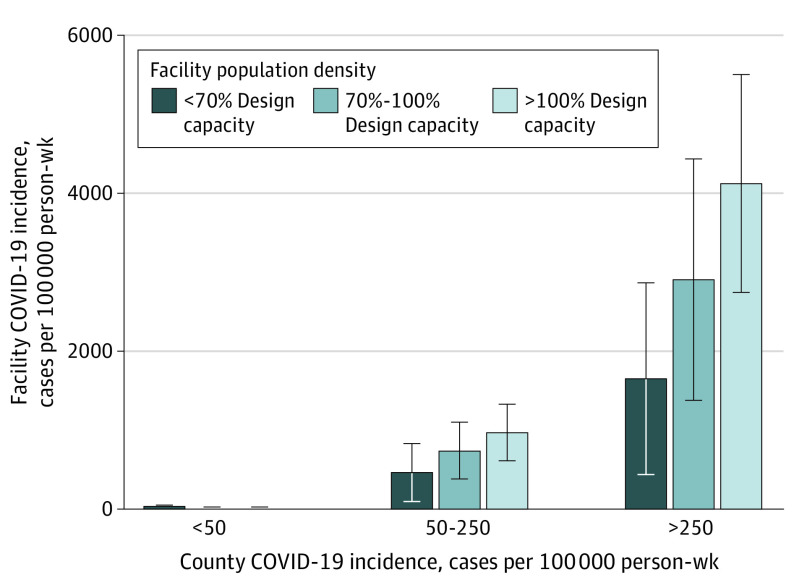
Results: There was on average 6876 people incarcerated in 14 prisons during the study period. The median level of crowding during the observation period ranged from 25% to 155% of design capacity. COVID-19 incidence was significantly higher in prisons where the incarcerated population was a larger percentage of the prison's design capacity (incidence rate ratio [IRR] per 10-percentage-point difference, 1.14; 95% CI, 1.03-1.27). COVID-19 incidence was lower in prisons where a higher proportion of incarcerated people were housed in single-cell units (IRR for each 10-percentage-point increase in single-cell units, 0.82; 95% CI, 0.73-0.93). COVID-19 transmission in the surrounding county was consistently associated with COVID-19 incidence in prisons (IRR [for each increase of 10 cases per 100 000 person-weeks in the community], 1.06; 95% CI, 1.05-1.08).
Conclusions and relevance: This longitudinal ecological study found that within 14 Massachusetts state prisons, increased crowding was associated with increased incidence rates of COVID-19. Researchers and policy makers should explore strategies that reduce prison crowding, such as decarceration, as potential ways to mitigate COVID-19 morbidity and mortality among incarcerated persons.
Conflict of interest statement
Figures
Comment in
-
Avoiding COVID-19 Outbreaks in Carceral Settings.JAMA Intern Med. 2021 Oct 1;181(10):1322-1323. doi: 10.1001/jamainternmed.2021.4389. JAMA Intern Med. 2021. PMID: 34369968 No abstract available.
References
-
- Walmsley R. World prison population list (12th edition). Accessed July 8, 2021. https://www.prisonstudies.org/sites/default/files/resources/downloads/wp...
-
- Schnepel K. COVID-19 in US state and federal prisons: December 2020 update. Accessed December 22, 2020. https://cdn.ymaws.com/counciloncj.org/resource/resmgr/covid_commission/C...
Publication types
MeSH terms
Grants and funding
LinkOut - more resources
Full Text Sources
Medical
Miscellaneous