Review
. 2022 Jan;42(1):295-321.
doi: 10.1007/s10792-021-01994-9. Epub 2021 Aug 9.

Ocular toxoplasmosis: a review of the current diagnostic and therapeutic approaches

Affiliations
Review

Ocular toxoplasmosis: a review of the current diagnostic and therapeutic approaches

Dimitrios Kalogeropoulos et al. Int Ophthalmol. 2022 Jan.

Abstract

Purpose: This review aims to summarize the current knowledge concerning the clinical features, diagnostic work-up and therapeutic approach of ocular toxoplasmosis focusing mainly on the postnatally acquired form of the disease.

Methods: A meticulous literature search was performed in the PubMed database. A supplementary search was made in Google Scholar to complete the collected items.

Results: Ocular toxoplasmosis is one of the most frequent infectious etiologies of posterior uveitis. It typically presents with retinochoroiditis. Setting an accurate diagnosis depends to a considerable degree on detecting characteristic clinical characteristics. In addition to the evaluation of clinical features, the diagnosis of toxoplasmosis relies at a large degree on serologic testing. The detection of the parasite DNA in the aqueous or vitreous humor can provide evidence for a definitive diagnosis. The current mainstay for the treatment, if necessary, is the use of oral antibiotic with systemic corticosteroids. Recent evidence suggests other therapeutic approaches, such as intravitreal antibiotics can be used.

Conclusion: Recent developments in the diagnostic and therapeutic approach have contributed to preventing or limiting vision loss of patients suffering from ocular toxoplasmosis. Further studies are required to provide a better understanding of epidemiology, pathogenesis, diagnosis, and treatment with a significant impact on the management of this challenging clinical entity.

Keywords: Ocular toxoplasmosis; Posterior uveitis; Retinochoroiditis; Toxoplasma gondii.


Conflict of interest statement

The authors declare that they have no conflict of interest.

Figures
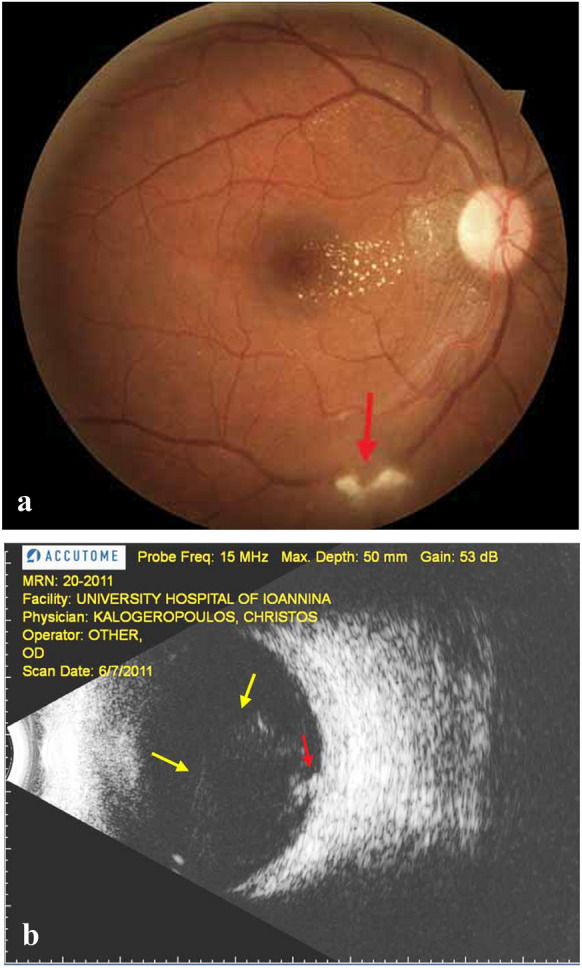
Fig. 1
Fig. 1
a Active toxoplasmic retinitis (red arrow) with a slightly hazed overlying vitreous. Note the presence of a mild neuroretinitis. b B-Mode of the same patient showing focal vitritis (yellow arrows) near the active lesion (red arrow)
Fig. 2
Fig. 2
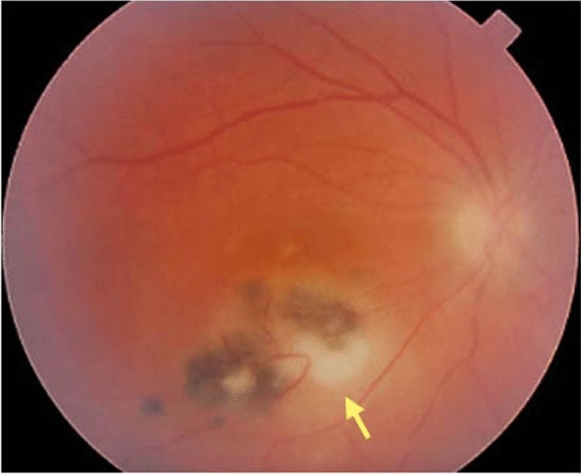
A new active lesion of retinitis (yellow arrow) due to recurrence of toxoplasmic retinochoroiditis, adjacent to older lesions (scarred areas with pigmentation)
Fig. 3
Fig. 3
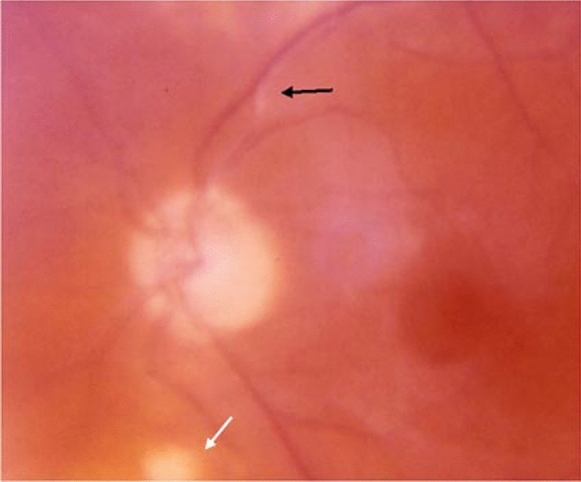
Kyrieleis arteritis in toxoplasmic retinochoroiditis presenting as a segmental intravascular white plaque (black arrow). The active retinochoroidal lesion is indicated by the white arrow
Fig. 4
Fig. 4
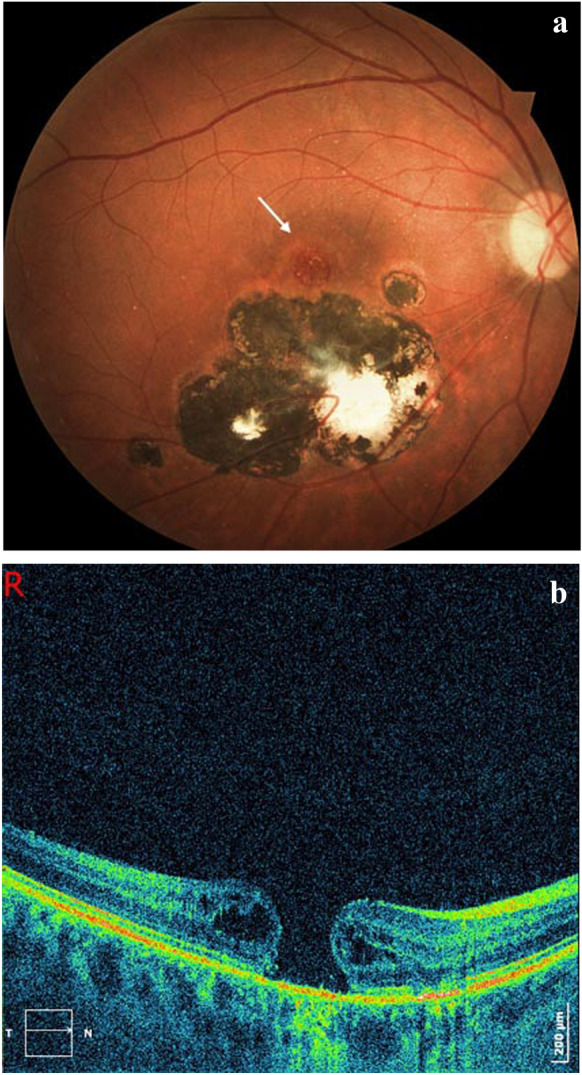
Patient of Fig. 2, 8 years after the last recurrence of toxoplasmic retinochoroiditis. a Macular hole (white arrow) adjacent to severe old lesions. b Optical coherence tomography (OCT) scan with a characteristic imaging of a full-thickness macular hole
Fig. 5
Fig. 5
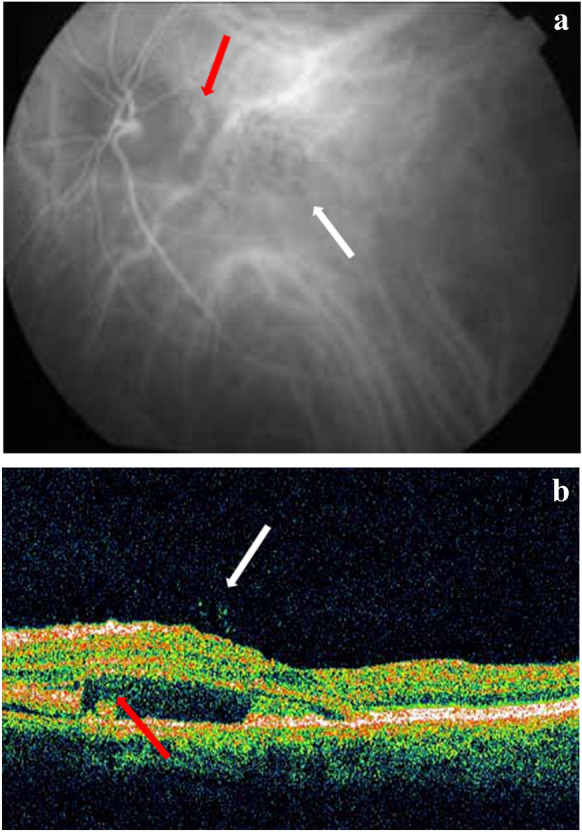
a Indocyanine green angiography (ICGA) of a patient with punctate outer retinal toxoplasmosis (significantly elevated IgG titers). Note the hypofluorescent punctate lesions (white arrow) and the neovascular choroidal membrane (red arrow) as a complication of the inflammatory process. b Optical coherence tomography (OCT) of the same patient with vitreous hyperreflective spots or hyaloid bodies (white arrow) and subretinal exudative fluid (red arrow) due to the adjacent neovascular membrane
Fig. 6
Fig. 6
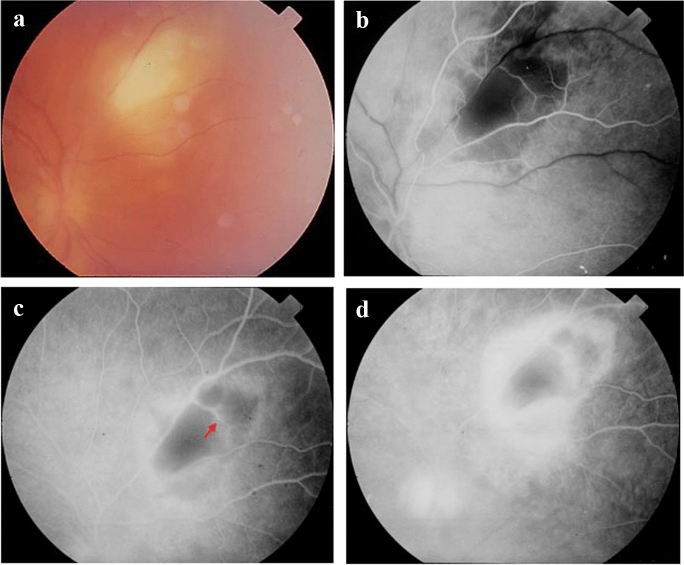
Retinal imaging in a patient with ocular toxoplasmosis. a Primary acute toxoplasmic retinitis without other lesions in the surrounding area. b In the arterial phase of fluoroangiography (FA) a masking effect corresponds to the inflamed retina. c In the mid-venous FA phase vasculitis is indicated by a red arrow. d Hyperfluorescence of the inflammatory lesion during the transit FA phase (leakage from the dilated vessels in the area of the lesion). Note that the optic disk is also involved
Fig. 7
Fig. 7
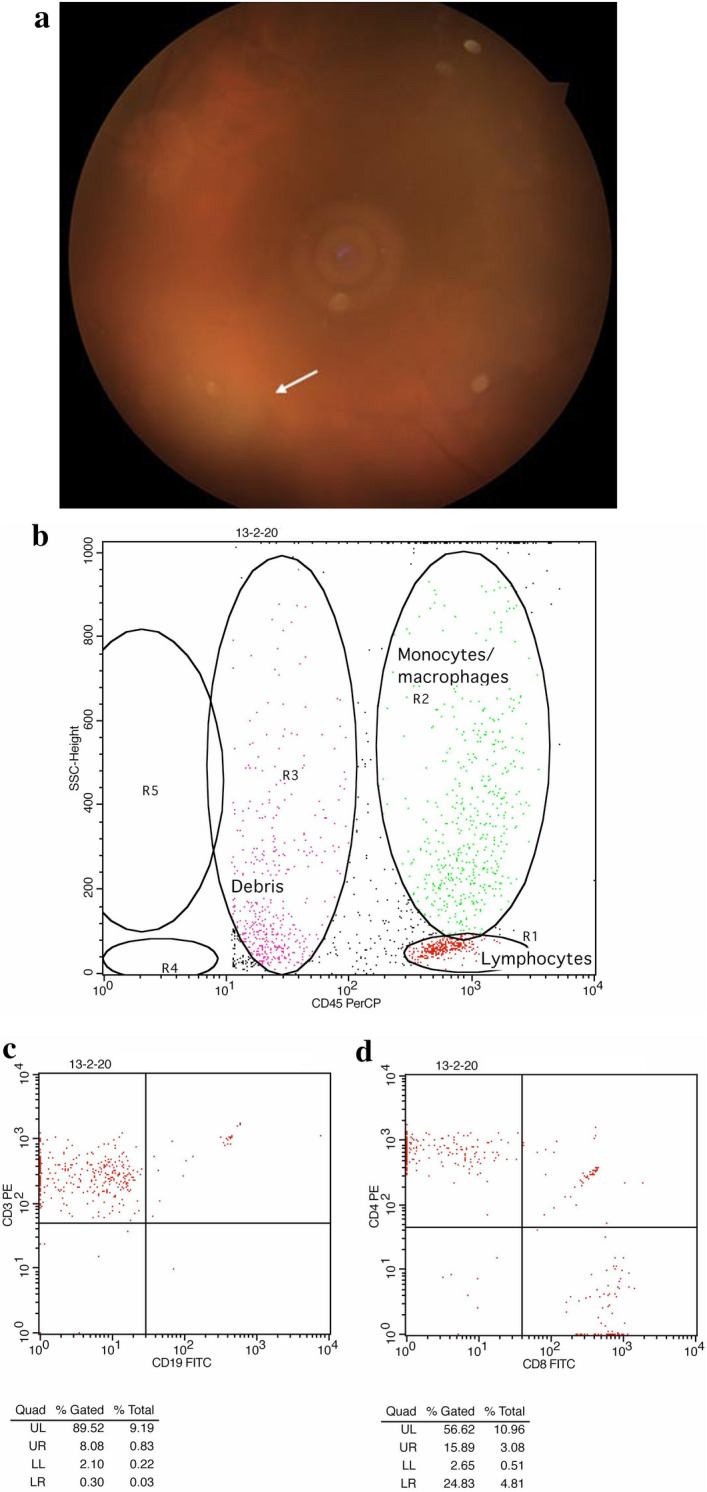
A 67-year-old lady with positive serology for toxoplasma (IgM and IgG both positive) with intense and resistant to the treatment inflammation. Taking into consideration the age of the patient the possibility of primary vitreoretinal lymphoma was ruled out using vitreous flow cytometry. a Lesion of acute toxoplasmic retinochoroiditis (white arrow) and dense vitritis obscuring the fundus details. bd Representative plots of immunophenotyping by three color analysis flow cytometry. It is possible accurately to distinguish lymphocytes from other leukocyte and other cells populations in vitreous humor using the combination of fluorescence associated with CD45 PerCP/SSC and orthogonal light scatter. By identifying the cell population of interest based on immunofluorescence, a light scattering window can then be drawn to include all (≥ 95%) of the lymphocytes (Gate 1). In this manner, maximal recovery of the lymphocytes within a sample can be consistently obtained. The combination of light scattering and immunofluorescence can also be used to define the purity of the gate. The identification of non-lymphocytes (CD45PerCP negative) within the light scattering gate can then be used to establish an accurate denominator for the percent lymphocytes stained with CDs. b Bivariate histogram CD45/SSC with three gates: gate R1 including lymphocytes (red), gate R2 monocytes and macrophages (green), gate R3 Debris (non-leukocytes, apoptotic /necrotic cells) (purple). c Bivariate histogram CD3 PE/CD19 FITC in the R1 gate of Lymphocytes: T-Lymphocytes CD3 + (95%), B- Lymphocytes CD19 + (00%). d Bivariate histogram CD4 PE/CD8 FITC in the R1 gate of Lymphocytes: T helper cells (Th cells) CD4 + (57%), T cytotoxic (Tc cells) CD8 + (25%), and double positive T-cells CD4 + CD8 + (14%)

References

    1. Delair E, Latkany P et al (2011) Clinical manifestations of ocular toxoplasmosis. Ocul Immunol Inflamm 19(2):91–102. - PubMed
    1. Vallochi AL et al (2008) Molecular markers of susceptibility to ocular toxoplasmosis, host and guest behaving badly. Clin Ophthalmol 2(4):837–48. - PMC - PubMed
    1. Soheilian M, Heidari K, Yazdani S, et al. Patterns of uveitis in a tertiary eye care center in Iran. Ocul Immunol Inflamm. 2004;12(4):297–310. doi: 10.1080/092739490500174. - DOI - PubMed
    1. Balasundaram MB, Andavar R, Palaniswamy M, et al. Outbreak of acquired ocular toxoplasmosis involving 248 patients. Arch Ophthalmol. 2010;128(1):28–32. doi: 10.1001/archophthalmol.2009.354. - DOI - PubMed
    1. Atmaca LS, Simsek T, Batioglu F. Clinical features and prognosis in ocular toxoplasmosis. Jpn J Ophthalmol. 2004;48(4):386–391. doi: 10.1007/s10384-003-0069-0. - DOI - PubMed

LinkOut - more resources