


Barrett's oesophagus and oesophageal cancer following oesophageal atresia repair: a systematic review
- PMID: 34370830
- PMCID: PMC8405903
- DOI: 10.1093/bjsopen/zrab069
Barrett's oesophagus and oesophageal cancer following oesophageal atresia repair: a systematic review
Abstract
Background: Concern exists that patients born with oesophageal atresia (OA) may be at high risk for Barrett's oesophagus (BO), a known malignant precursor to the development of oesophageal adenocarcinoma. Screening endoscopy has a role in early BO identification but is not universal in this population. This study aimed to determine prevalence of BO after OA repair surgery, to quantify the magnitude of this association and inform the need for screening and surveillance.
Methods: A systematic review, undertaken according to PRISMA guidelines, was preregistered on PROSPERO (CRD42017081001). PubMed and EMBASE were interrogated using a standardized search strategy on 31 July 2020. Included papers, published in English, reported either: one or more patients with either BO (gastric/intestinal metaplasia) or oesophageal cancer in patients born with OA; or long-term (greater than 2 years) follow-up after OA surgery with or without endoscopic screening or surveillance.
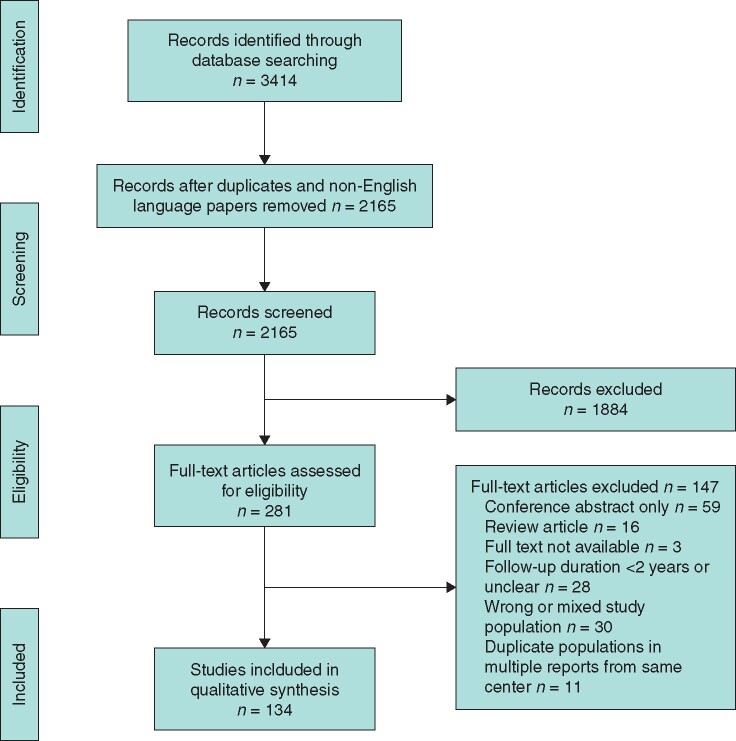
Results: Some 134 studies were identified, including 19 case reports or series and 115 single- or multi-centre cohort studies. There were 13 cases of oesophageal cancer (9 squamous cell carcinoma, 4 adenocarcinoma) with a mean age at diagnosis of 40.5 (range 20-47) years. From 6282 patients under long-term follow-up, 317 patients with BO were reported. Overall prevalence of BO was 5.0 (95 per cent c.i. 4.5 to 5.6) per cent, with a mean age at detection of 13.8 years (range 8 months to 56 years). Prevalence of BO in series reporting endoscopic screening or surveillance was 12.8 (95 per cent c.i. 11.3 to 14.5) per cent.
Conclusion: Despite a limited number of cancers, the prevalence of BO in patients born with OA is relatively high. While limited by the quality of available evidence, this review suggests endoscopic screening and surveillance may be warranted, but uncertainties remain over the design and effectiveness of any putative programme.
© The Author(s) 2021. Published by Oxford University Press on behalf of BJS Society Ltd.
References
-
- Pultrum BB, Bijleveld CM, de Langen ZJ, Plukker JTM. Development of an adenocarcinoma of the esophagus 22 years after primary repair of a congenital atresia. J Pediatr Surg 2005;40:e1–e4 - PubMed
-
- Alfaro L, Bermas H, Fenoglio M, Parker R, Janik JS. Are patients who have had a tracheoesophageal fistula repair during infancy at risk for esophageal adenocarcinoma during adulthood? J Pediatr Surg 2005;40:719–720 - PubMed
-
- Adzick NS, Fisher JH, Winter HS, Sandler RH, Hendren WH. Esophageal adenocarcinoma 20 years after esophageal atresia repair. J Pediatr Surg 1989;24:741–744 - PubMed
-
- Jayasekera CS, Desmond PV, Holmes JA, Kitson M, Taylor ACF. Cluster of 4 cases of esophageal squamous cell cancer developing in adults with surgically corrected esophageal atresia – time for screening to start. J Pediatr Surg 2012;47:646–651 - PubMed
Publication types
MeSH terms
LinkOut - more resources
Full Text Sources
Medical
