


Anti-SARS-CoV-2 and anti-cytokine storm neutralizing antibody therapies against COVID-19: Update, challenges, and perspectives
- PMID: 34371330
- PMCID: PMC8330556
- DOI: 10.1016/j.intimp.2021.108036
Anti-SARS-CoV-2 and anti-cytokine storm neutralizing antibody therapies against COVID-19: Update, challenges, and perspectives
Abstract
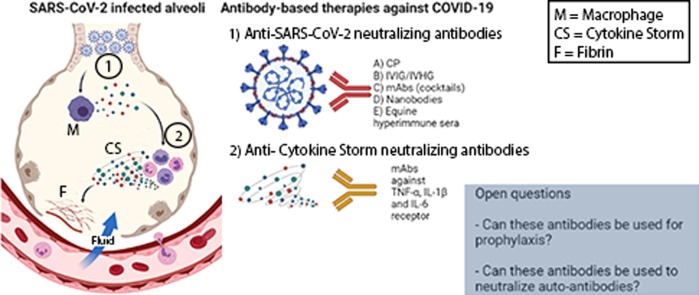
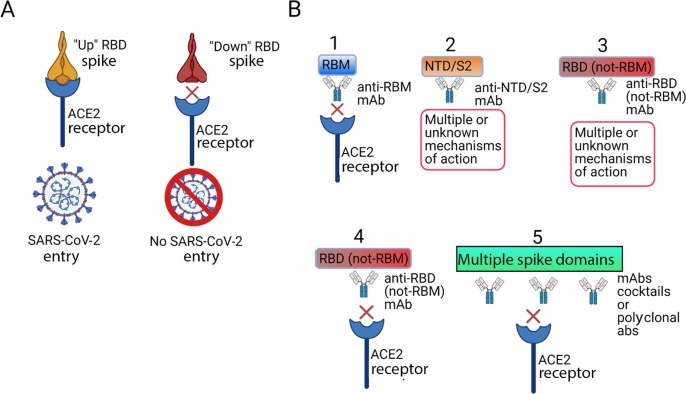
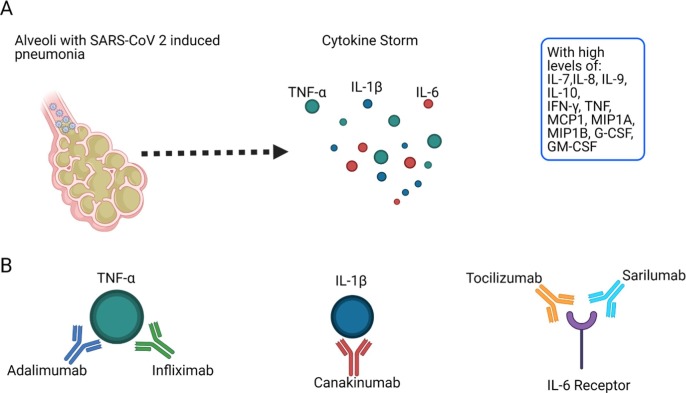
Coronavirus disease 2019 (COVID-19) has been declared by the World Health Organization (WHO) as a pandemic since March 2020. This disease is caused by severe acute respiratory syndrome coronavirus 2 (SARS-CoV-2). The only available tools to avoid contamination and transmission of this virus are physical distancing, the use of N95 and surgical masks, and hand hygiene. Vaccines are another essential tool to reduce the impact of the pandemic, though these present challenges in terms of production and logistics, particularly in underdeveloped and developing countries. One of the critical early research findings is the interaction of the spike virus protein with the angiotensin-converting enzyme 2 (ACE2) human receptor. Developing strategies to block this interaction has therefore been identified as a way to treat this infection. Neutralizing antibodies (nAbs) have emerged as a therapeutic approach since the pandemic started. Infected patients may be asymptomatic or present with mild symptoms, and others may evolve to moderate or severe disease, leading to death. An immunological phenomenon known as cytokine storm has been observed in patients with severe disease characterized by a proinflammatory cytokine cascade response that leads to lung injury. Thus, some treatment strategies focus on anti-cytokine storm nAbs. This review summarizes the latest advances in research and clinical trials, challenges, and perspectives on antibody-based treatments (ABT) as therapies against COVID-19.
Keywords: Antibody-based treatments; COVID-19; Cytokine storm; Neutralizing; Passive immunotherapy; SARS-CoV-2; Spike.
Copyright © 2021 Elsevier B.V. All rights reserved.
Conflict of interest statement
The authors declare that they have no known competing financial interests or personal relationships that could have appeared to influence the work reported in this paper.
Figures
References
-
- Chan J.F., Lau S.K., To K.K., et al. Middle East respiratory syndrome coronavirus: another zoonotic betacoronavirus causing SARS-like disease. Clin. Microbiol. Rev. 2015;28:465–522. https://cmr.asm.org/content/28/2/465 - PMC - PubMed
-
- Zaki A.M., van Boheemen S., Bestebroer T.M., Osterhaus A.D., et al. Isolation of a novel coronavirus from a man with pneumonia in Saudi Arabia. N. Engl. J. Med. 2012;367:1814–1820. https://www.nejm.org/doi/full/10.1056/NEJMoa1211721 - DOI - PubMed
-
- Central Disaster and Safety Countermeasure Headquarters of the Republic of Korea, Rules and guidelines for distancing in daily life to control coronavirus disease 2019 in Korea: 3rd version, announced on July 3, 2020, J. Educ. Eval. Health. Prof. (2020) 17-20. https://www.jeehp.org/DOIx.php?id=10.3352/jeehp.2020.17.20. - PMC - PubMed
Publication types
MeSH terms
Substances
LinkOut - more resources
Full Text Sources
Miscellaneous
