Review
. 2021 Jul 27;13(15):2464.
doi: 10.3390/polym13152464.

Advances in Functionalized Photosensitive Polymeric Nanocarriers

Affiliations
Review

Advances in Functionalized Photosensitive Polymeric Nanocarriers

Maritza Fernández et al. Polymers (Basel). .

Abstract

The synthesis of light-responsive nanocarriers (LRNs) with a variety of surface functional groups and/or ligands has been intensively explored for space-temporal controlled cargo release. LRNs have been designed on demand for photodynamic-, photothermal-, chemo-, and radiotherapy, protected delivery of bioactive molecules, such as smart drug delivery systems and for theranostic duties. LRNs trigger the release of cargo by a light stimulus. The idea of modifying LRNs with different moieties and ligands search for site-specific cargo delivery imparting stealth effects and/or eliciting specific cellular interactions to improve the nanosystems' safety and efficacy. This work reviews photoresponsive polymeric nanocarriers and photo-stimulation mechanisms, surface chemistry to link ligands and characterization of the resultant nanosystems. It summarizes the interesting biomedical applications of functionalized photo-controlled nanocarriers, highlighting the current challenges and opportunities of such high-performance photo-triggered delivery systems.

Keywords: functional nanoparticle; light-responsive drug delivery; photoresponsive nanoparticle; polymer nanocarrier.


Conflict of interest statement

The authors declare no conflict of interest.

Figures
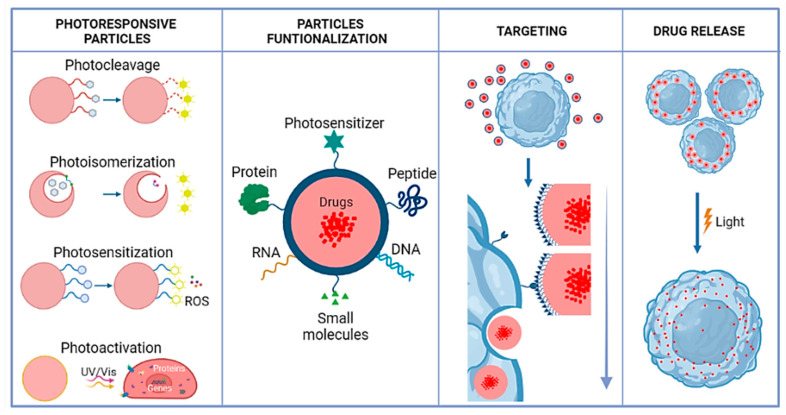
Figure 1
Figure 1
Schematic illustration of photosensitive polymeric nanocarriers: photosensitive mechanism, functional nanocarriers, nanocarriers targeting, and drug release.
Figure 2
Figure 2
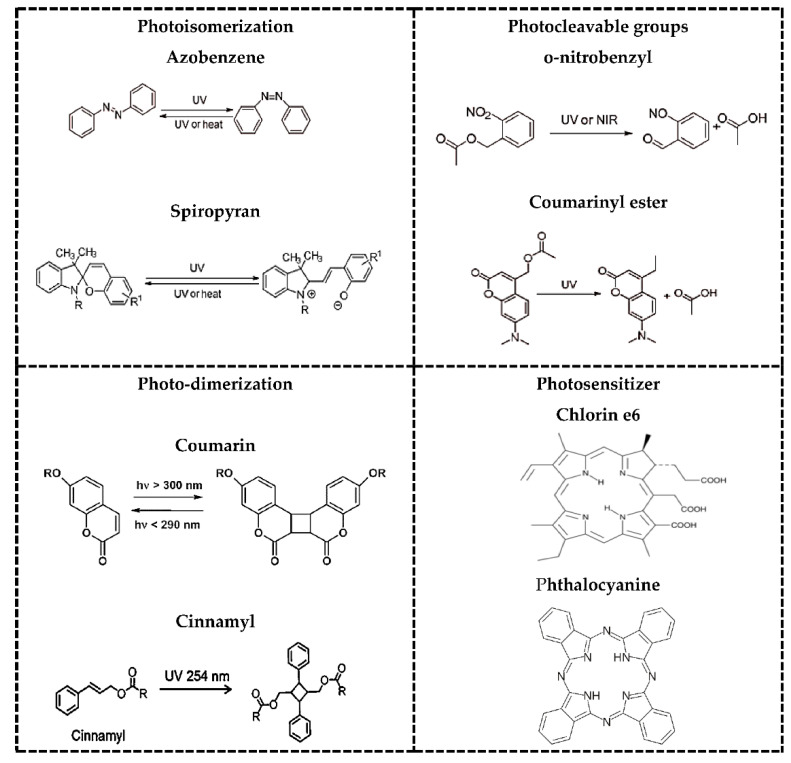
Photoresponsive molecules for phototriggered drug release.
Figure 3
Figure 3
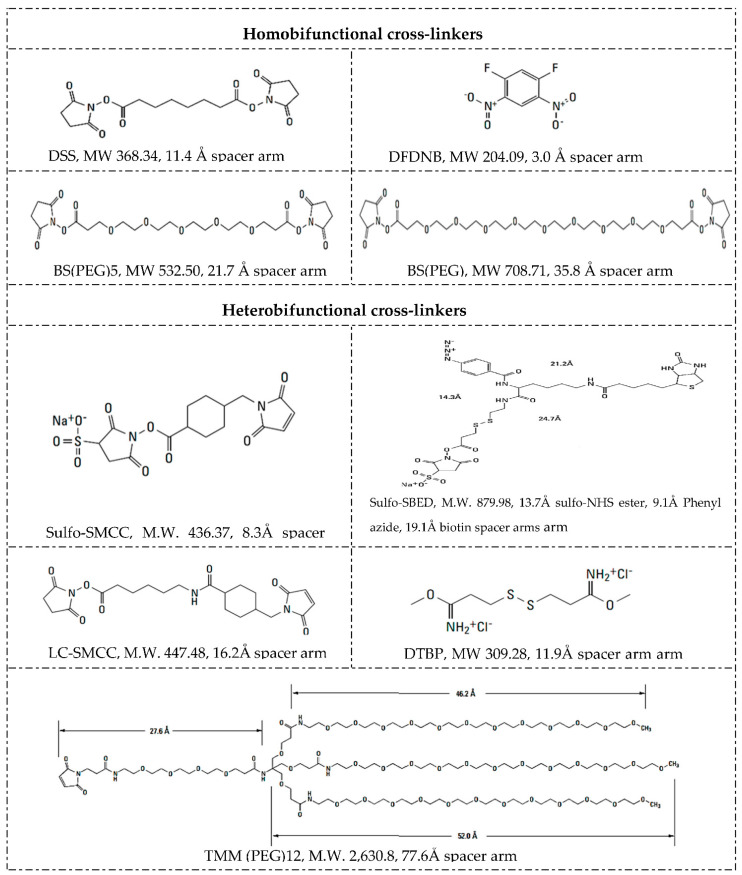
Structures and characteristics of some cross-linkers.
Figure 4
Figure 4
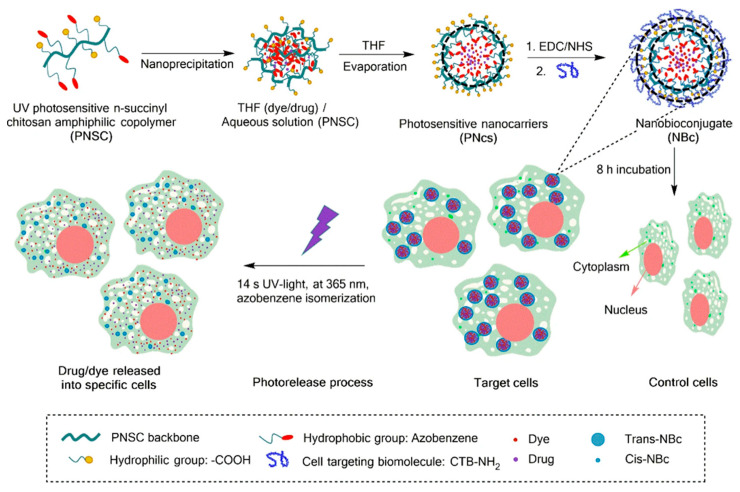
Illustration of PNc synthesis, nanocarrier self-assembly, cargo co-encapsulation, and further functionalization with the CTB. Selective uptake of the resultant nanobioconjugate and UV-light induced cargo release into cardiomyocytes by an isomerization process of the azobenzene photosensitive molecule-containing pothosensitive nanocarrier. Reprinted with permission from [99]. Copyright 2020 Springer Nature.
Figure 5
Figure 5
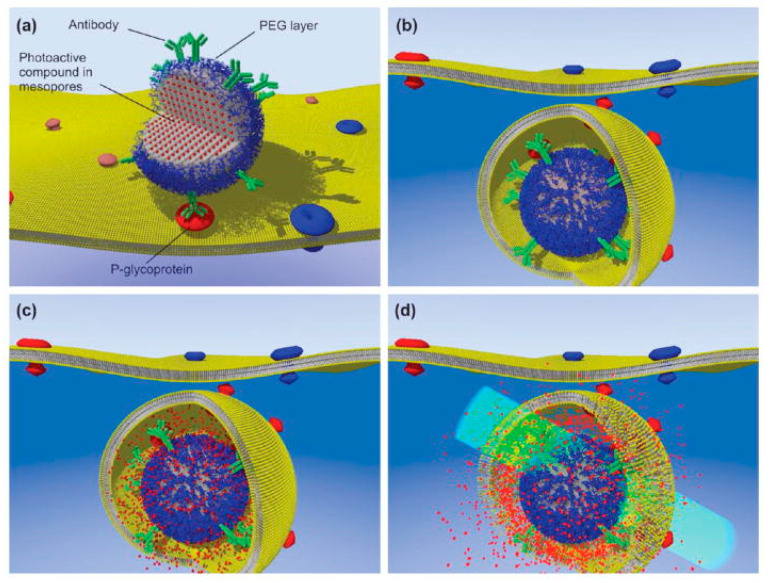
Schematic of light-activated and targeted cytosolic delivery of membrane-impermeable compounds. (a) Antibody-functionalized NPs are loaded with fluorescent Alexa546 model dye and targeted to cells expressing P-gp-green fluorescent protein (GFP bound to the P-glycoprotein transporter). After NPs endocytosis (b), the cargo was released in the endosome (c). Exposure to light at the dye’s excitation wavelength (546 nm) promoted ROS-mediated membrane damage (d) with cytosolic delivery of Alexa546 exclusively in the P-gp expressing cells. Reprinted with permission from [87]. Copyright 2010 American Chemical Society.
Figure 6
Figure 6
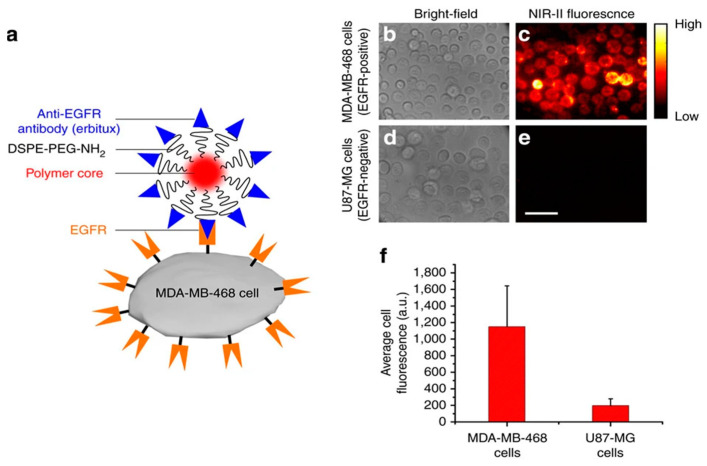
(a) Schematic illustration showing the structure of pDA-PEG-Erbitux bioconjugate, where the anti-EGFR antibody (Erbitux) selectively targets EGFR on the cell membrane of an MDA-MB-468 cell. White-light (b) and NIR-II (c) fluorescence images of EGFR-positive MDA-MB-468 cells incubated with the pDA-PEG-Erbitux bioconjugate, showing positive staining of cells. White-light (d) and NIR-II (e) fluorescence images of EGFR-negative U87-MG cells incubated with the pDA-PEG-Erbitux bioconjugate, without evident staining of the cells. The scale bar is 40 μm. (f) Average NIR-II fluorescence of EGFR-positive MDA-MB-468 cells and negative U87-MG cells, showing a positive/negative ratio of ~5.8. The error bars in f are the s.d. of average fluorescence intensity from 20 cells in each NIR-II fluorescence image. Reprinted with permission from [173]. Copyright 2014 Springer Nature.
Figure 7
Figure 7
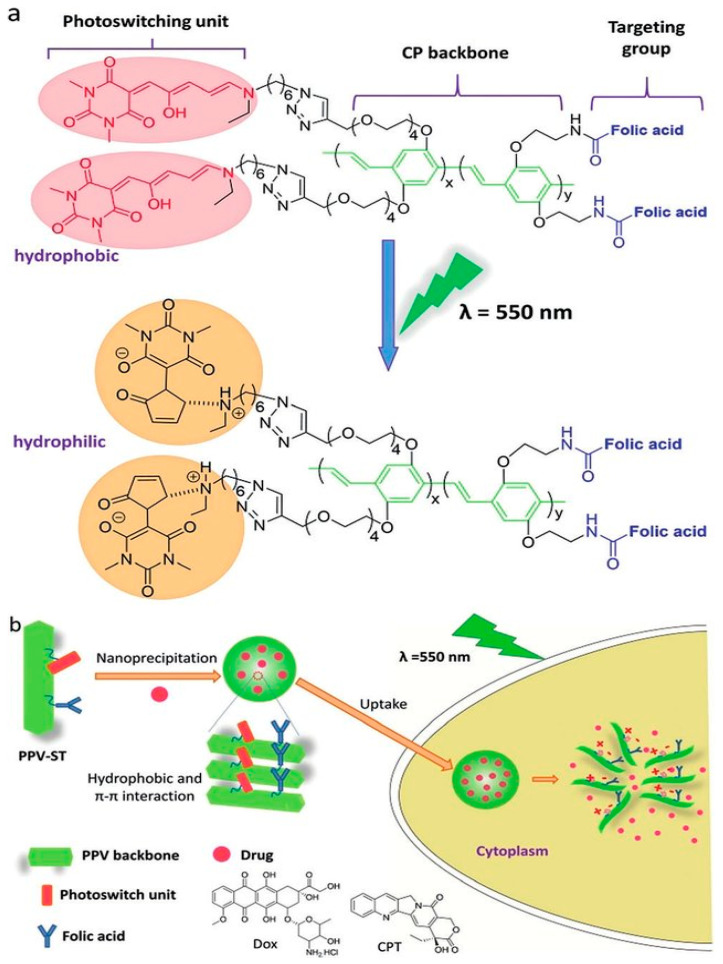
(a) The chemical structure of PPV-ST conjugated polymer and its structural change under visible light (λ = 550 nm) irradiation; (b) Schematic representation of the formation of drug-loaded PPV-ST-NP nanoparticles and structural change upon irradiation with visible light (λ = 550 nm) leading to the drug release in cells. Reprinted with permission from [184]. Copyright 2018 John Wiley and Son.

References

    1. Zhao W., Zhao Y., Wang Q., Liu T., Sun J., Zhang R. Remote Light-Responsive Nanocarriers for Controlled Drug Delivery: Advances and Perspectives. Small. 2019;15:1–34. doi: 10.1002/smll.201903060. - DOI - PubMed
    1. Hou W., Liu R., Bi S., He Q., Wang H., Gu J. Photo-Responsive Polymersomes as Drug Delivery. Molecules. 2020;25:5147. doi: 10.3390/molecules25215147. - DOI - PMC - PubMed
    1. Gai S., Yang G., Yang P., He F., Lin J., Jin D., Xing B. Recent Advances in Functional Nanomaterials for Light–Triggered Cancer Therapy. Nano Today. 2018;19:146–187. doi: 10.1016/j.nantod.2018.02.010. - DOI
    1. Avvakumova S., Colombo M., Tortora P., Prosperi D. Biotechnological Approaches toward Nanoparticle Biofunctionalization. Trends Biotechnol. 2014;32:11–20. doi: 10.1016/j.tibtech.2013.09.006. - DOI - PubMed
    1. Zhou Y., Chen R., Yang H., Bao C., Fan J., Wang C., Lin Q., Zhu L. Light-Responsive Polymersomes with a Charge-Switch for Targeted Drug Delivery. J. Mater. Chem. B. 2020;8:727–735. doi: 10.1039/C9TB02411E. - DOI - PubMed

LinkOut - more resources