Review
. 2021 Aug 9;14(1):121.
doi: 10.1186/s13045-021-01111-4.

MYC: a multipurpose oncogene with prognostic and therapeutic implications in blood malignancies

Affiliations
Review

MYC: a multipurpose oncogene with prognostic and therapeutic implications in blood malignancies

Seyed Esmaeil Ahmadi et al. J Hematol Oncol. .

Erratum in

Abstract

MYC oncogene is a transcription factor with a wide array of functions affecting cellular activities such as cell cycle, apoptosis, DNA damage response, and hematopoiesis. Due to the multi-functionality of MYC, its expression is regulated at multiple levels. Deregulation of this oncogene can give rise to a variety of cancers. In this review, MYC regulation and the mechanisms by which MYC adjusts cellular functions and its implication in hematologic malignancies are summarized. Further, we also discuss potential inhibitors of MYC that could be beneficial for treating hematologic malignancies.

Keywords: Apoptosis; Cell cycle; DNA damage response; Hematological malignancies; MYC; Oncogene; Prognostic importance; Regulation; Therapeutic implications.


Conflict of interest statement

The authors declare no conflict of interest.

Figures

Fig. 1
Fig. 1
Crystal structure of MYC/MAX heterodimer. MYC usually forms as a heterodimer with MAX (MYC/MAX) to bind to DNA in E-box region (CACGTG). This structure mainly contains the basic-region (BR), helix-loop-helix (HLH), and leucine-zipper (LZ), which are required for DNA binding
Fig. 2
Fig. 2
Schematics of MYC protein and its transcriptional activity. A: MYC gene on chromosome 8 alongside MYC protein (439 aa) that mainly contains the basic-region (BR), helix-loop-helix (HLH), and leucine-zipper (LZ) at C-terminal, and three extremely conserved regions called MYC boxes 1–3 (MB 1–3) at the N-terminal. B: The chromatin-modifying complex consisting of TIP60, TRRAP, TIP48, and GCN5 recruited by MYC/Max heterodimer propels transcription through binding to the E-box DNA region (CACGTG) within the regulatory domain of target genes. C: the accumulation of MYC at the promoter sequences of target genes increases the transcriptional activity. NLS nuclear localization sequence
Fig. 3
Fig. 3
A brief overview of MYC regulation. Multiple regulators from different classes are involved in MYC regulation. Red and green arrows point to the negative and positive regulatory effects of each factor on MYC, respectively
Fig. 4
Fig. 4
Diverse mechanisms are considered for MYC collaboration in cell cycle progression. The positive regulators of cell cycle are induced or activated by MYC. Through multiple mechanism, MYC blocks the activity of cell cycle regulators
Fig. 5
Fig. 5
MYC has multiple effects on the DNA damage response. MYC is essential for NBS1 expression and the activity of ATM and its downstream effectors such as p53. In turn, p53 suppresses MYC expression in a pulsatile pattern. MYC drives cell fate toward apoptosis and overrides cell cycle arrest. MYC also participates in the generation of DNA damage. DNA repair impairment, ROS generation, and increased replication stress are among other MYC-provoked DNA damage response mechanisms
Fig. 6
Fig. 6
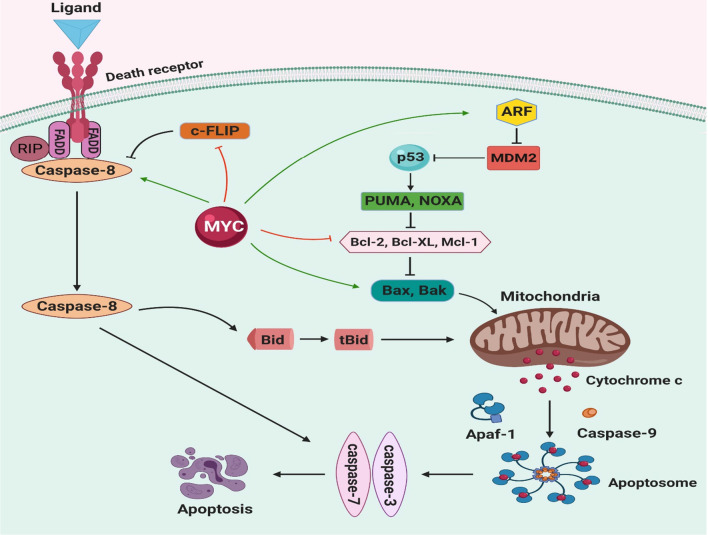
MYC and apoptotic pathway. Expression of MYC can sensitize cells to a broad range of proapoptotic stimuli such as DNA damage, death receptor, hypoxia, and nutrition deprivation. Through various pathways and possibly by inducing activation of Bax proapoptotic molecule, MYC promote the release of cytochrome c from mitochondria into the cytosol. Activation of Bax forming pores results in mitochondrial outer membrane permeabilization (MOMP). When cytochrome c releases into the cytoplasm, it interacts with APAF-1 and procaspase 9 to form apoptosome. Caspase 9 is activated in the presence of ATP, which in turn cleaves and activates caspase3 and 7, eventually triggering apoptosis. MYC is also involved in the death receptor pathway of apoptosis. Ligand-death receptor binding initiates interaction of adaptor molecules like FADD with death receptor. FADD auto-activates by recruiting procaspase 8. Caspase 8 can directly activate caspase3 and 7. Caspase 8 can also activate BH3-only protein BID, which stimulates MOMP. MYC induces apoptosis by p53dependent and independent mechanisms. Regulation of p53\MDM2\ARF by MYC, can stabilize p53and promote apoptosis
Fig. 7
Fig. 7
The interactions between BCR-ABL and MYC in B-cell lymphocytic leukemia with t(9;22). Dashed arrows represent an indirect pathway of action, and thick arrows show the mediator's direct effect. Both mature and immature BCR signaling cascades are able to increase the MYC expression. sIgM signaling increases the MYC mRNA stability, which results in a higher level of MYC, and increase the BCR-ABL expression. BCR-ABL can induce MYC expression. Pre-BCR signaling can increase MYC stability and expression. Inhibitors of these signaling mediators can significantly reduce the activity and expression of MYC

References

    1. Chen H, Liu H, Qing G. Targeting oncogenic Myc as a strategy for cancer treatment. Signal Transduct Target Ther. 2018;3:1–7. doi: 10.1038/s41392-017-0001-6. - DOI - PMC - PubMed
    1. Dang CV, O’Donnell KA, Zeller KI, Nguyen T, Osthus RC, Li F. The c-Myc target gene network. In: Seminars in cancer biology. 2006. - PubMed
    1. Meyer N, Penn LZ. Reflecting on 25 years with MYC. Nat Rev Cancer. 2008;8:976–990. doi: 10.1038/nrc2231. - DOI - PubMed
    1. Adhikary S, Eilers M. Transcriptional regulation and transformation by Myc proteins. Nat Rev Mol Cell Biol. 2005;6:635–645. doi: 10.1038/nrm1703. - DOI - PubMed
    1. Pelengaris S, Khan M, Evan G. c-MYC: more than just a matter of life and death. Nat Rev Cancer. 2002;2:764–776. doi: 10.1038/nrc904. - DOI - PubMed

MeSH terms

Substances

LinkOut - more resources