


The CAPACITI Decision-Support Tool for National Immunization Programs
- PMID: 34372981
- PMCID: PMC10563585
- DOI: 10.1016/j.jval.2021.04.1273
The CAPACITI Decision-Support Tool for National Immunization Programs
Abstract
Objectives: Immunization programs in low-income and middle-income countries (LMICs) are faced with an ever-growing number of vaccines of public health importance recommended by the World Health Organization, while also financing a greater proportion of the program through domestic resources. More than ever, national immunization programs must be equipped to contextualize global guidance and make choices that are best suited to their setting. The CAPACITI decision-support tool has been developed in collaboration with national immunization program decision makers in LMICs to structure and document an evidence-based, context-specific process for prioritizing or selecting among multiple vaccination products, services, or strategies.
Methods: The CAPACITI decision-support tool is based on multi-criteria decision analysis, as a structured way to incorporate multiple sources of evidence and stakeholder perspectives. The tool has been developed iteratively in consultation with 12 countries across Africa, Asia, and the Americas.
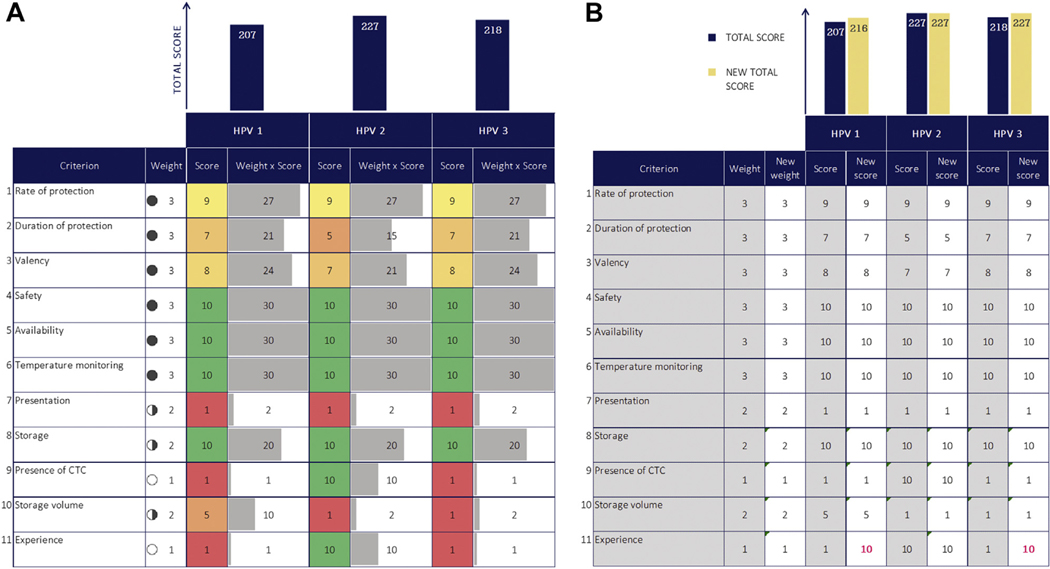
Results: The tool is flexible to existing country processes and can follow any type of multi-criteria decision analysis or a hybrid approach. It is structured into 5 sections: decision question, criteria for decision making, evidence assessment, appraisal, and recommendation. The Excel-based tool guides the user through the steps and document discussions in a transparent manner, with an emphasis on stakeholder engagement and country ownership.
Conclusions: Pilot countries valued the CAPACITI decision-support tool as a means to consider multiple criteria and stakeholder perspectives and to evaluate trade-offs and the impact of data quality. With use, it is expected that LMICs will tailor steps to their context and streamline the tool for decision making.
Keywords: HTA; LMIC; MCDA; decision-support; immunization; priority setting; vaccine.
Copyright © 2021 ISPOR–The Professional Society for Health Economics and Outcomes Research. Published by Elsevier Inc. All rights reserved.
Conflict of interest statement
Dr Giersing reported receiving grants to support the development of the CAPACITI decision support tool from World Health Organization during the conduct of the study. Dr Moore reported receiving personal fees from Pfizer and Sanofi Pasteur for service on external advisory boards regarding US-based vaccines, and personal fees for service on an external advisory board regarding US-based influenza vaccine from Seqirus outside the submitted work. No other disclosures were reported.
Figures

References
-
- Revill P, Glassman A, eds. Understanding the Opportunity Cost, Seizing the Opportunity: Report of the Working Group on Incorporating Economics and Modelling in Global Health Goals and Guidelines. Washington, DC: Center for Global Development; 2019.
-
- World Health Organization. In: From value for money to value-based health services: a twenty-first century shift. Geneva: World Health Organization; 2021:WHO Policy Brief.
-
- Kristensen F, Husereau D, Huic M, et al. Identifying the need for good practices in health technology assessment: summary of the ISPOR HTA council working group report on good practices in HTA. Value Health. 2019;22(1):13–20. - PubMed
Publication types
MeSH terms
Substances
Grants and funding
LinkOut - more resources
Full Text Sources
Medical
