. 2021 Aug 9;11(1):16060.
doi: 10.1038/s41598-021-95552-z.

Identification of Maturity-Onset-Diabetes of the Young (MODY) mutations in a country where diabetes is endemic

Affiliations

Identification of Maturity-Onset-Diabetes of the Young (MODY) mutations in a country where diabetes is endemic

Hessa Al-Kandari et al. Sci Rep. .

Abstract

Genetic variants responsible for Maturity-Onset-Diabetes of the Young (MODY) in Kuwait were investigated. A newly established a National Referral Clinic, the Dasman Diabetes Institute (DDI-NRC), assessed forty-five members from 31 suspected MODY families by whole exome sequencing. Thirty-three of the 45 samples were independently sequenced at the DDI-NRI, Exeter University, UK ( https://www.diabetesgenes.org/ ) using targeted 21-gene panel approach. Pathogenic mutations in GCK, HNF1A, HNF1B, HNF4A, and PDX1 confirmed MODY in 7 families, giving an overall positivity rate of 22.6% in this cohort. Novel variants were identified in three families in PDX1, HNF1B, and HNF1B. In this cohort, Multiplex Ligation-dependent Probe Amplification assay did not add any value to MODY variant detection rate in sequencing negative cases. In highly selected familial autoantibody negative diabetes, known MODY genes represent a minority and 77.3% of the familial cases have yet to have a causal variant described.


Conflict of interest statement

The authors declare no competing interests.

Figures
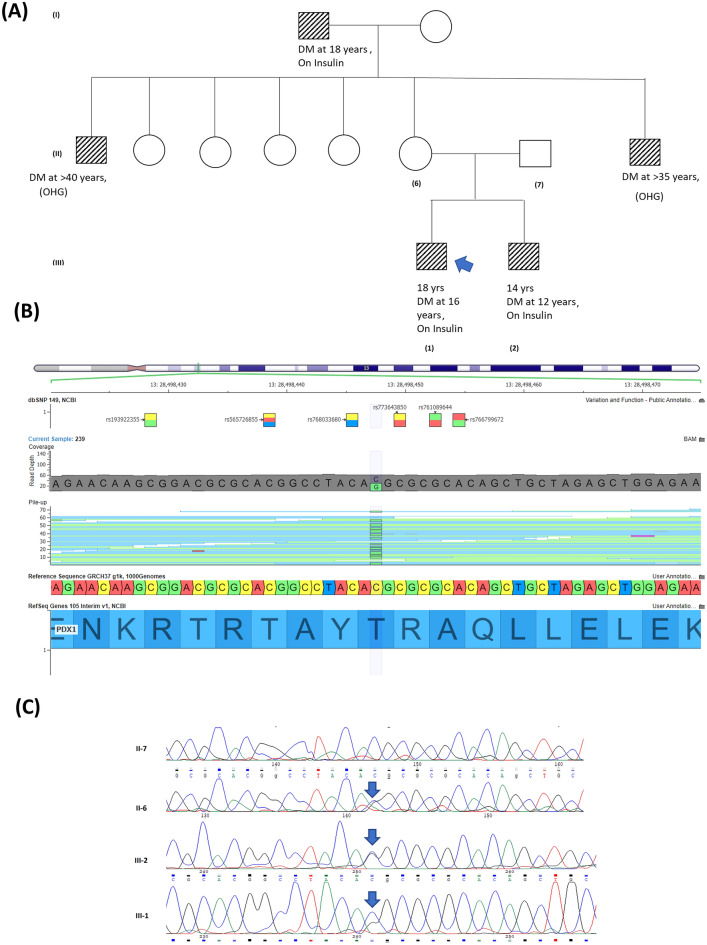
Figure 1
Figure 1
(A) Represents pedigree of a family positive for Maturity Onset Diabetes of the Young (MODY4). The square symbol represents male, and the circle represents female. The filled in symbols indicate affected individuals and the blue arrow indicates the index case. Next generation sequencing revealed a novel heterozygous missense variant in Pancreatic and duodenal homeobox 1 (PDX1) c.461C > G resulting in p.Thr154Arg. (B) Exome sequencing summary layout depicting part of the PDX1 gene location on chromosome 13 at the top and the exons coverage in green and blue. The location of the variants in exon 2 is represented by a vertical green bar and the reference sequence and the altered codon is highlighted. (C) Chromatogram represents Sanger sequencing results confirming the segregation of heterozygous variants in the mother, the index case and his brother.
Figure 2
Figure 2
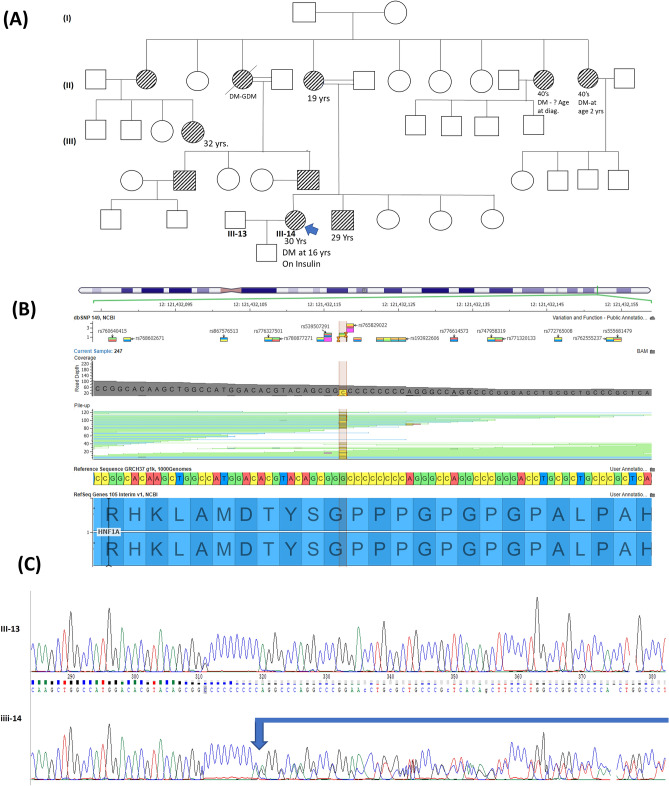
(A) Represents pedigree of a family positive for Maturity Onset Diabetes of the Young (MODY3). The square symbol represents male, and the circle represents female. The filled in symbols indicate affected individuals and the blue arrow indicates the index case. (B) Exome sequencing summary layout depicting part of the HNF1A gene location on chromosome 12 at the top and the exons coverage in green and blue. The location of the c.872dupC, (p.Gly292fs) frameshift mutation is represented by a vertical yellow bar and the reference sequence and the altered codon is highlighted. (C) Chromatogram represents Sanger sequencing of the HNF1A gene in control family member (top) and confirming the heterozygous frameshift mutation in the index (bottom arrow-line).
Figure 3
Figure 3
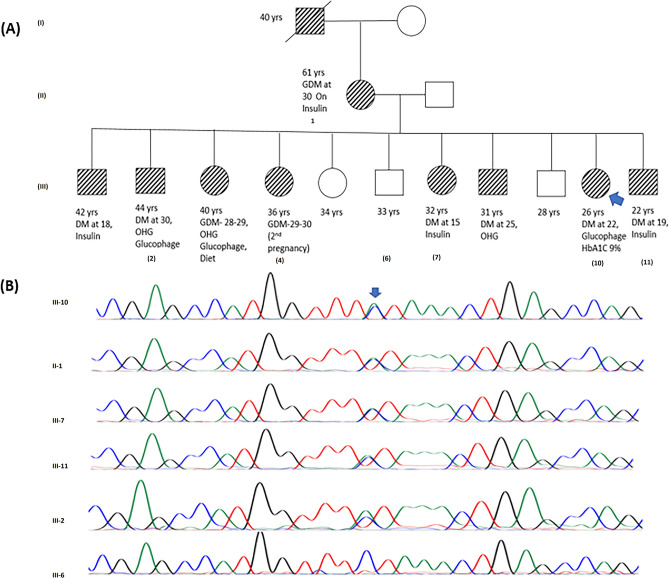
(A) Represents pedigree of a family positive for Maturity Onset Diabetes of the Young (MODY3). The square symbol represents male, and the circle represents female. The filled in symbols indicate affected individuals and the blue arrow indicates the index case. Next generation sequencing revealed a novel heterozygous missense variant in HNF1A, c.8C > A, resulting in p.Ser3Tyr. (B) Chromatogram represents Sanger sequencing results confirming the segregation of heterozygous variant in the index case, affected and unaffected family members.

References

    1. Fajans SS, Bell GI. MODY: history, genetics, pathophysiology, and clinical decision making. Diabetes Care. 2011;34:1878–1884. doi: 10.2337/dc11-0035. - DOI - PMC - PubMed
    1. Oliveira SC, Neves JS, Pérez A, Carvalho D. Maturity-onset diabetes of the young: From a molecular basis perspective toward the clinical phenotype and proper management. Endocrinol. Diabetes Nutr. 2020;67:137–147. doi: 10.1016/j.endinu.2019.07.012. - DOI - PubMed
    1. Lambert AP, et al. Identifying hepatic nuclear factor 1alpha mutations in children and young adults with a clinical diagnosis of type 1 diabetes. Diabetes Care. 2003;26:333–337. doi: 10.2337/diacare.26.2.333. - DOI - PubMed
    1. Møller AM, et al. Mutations in the hepatocyte nuclear factor-1alpha gene in Caucasian families originally classified as having Type I diabetes. Diabetologia. 1998;41:1528–1531. doi: 10.1007/s001250051101. - DOI - PubMed
    1. Awa WL, et al. Reclassification of diabetes type in pediatric patients initially classified as type 2 diabetes mellitus: 15 years follow-up using routine data from the German/Austrian DPV database. Diabetes Res. Clin. Pract. 2011;94:463–467. doi: 10.1016/j.diabres.2011.09.011. - DOI - PubMed

Publication types

Supplementary concepts