Review
. 2022 Feb;13(2):90-101.
doi: 10.1007/s13238-021-00869-0. Epub 2021 Aug 9.

Nuclear cGAS: sequestration and beyond

Affiliations
Review

Nuclear cGAS: sequestration and beyond

Juli Bai et al. Protein Cell. 2022 Feb.

Abstract

The cyclic GMP-AMP (cGAMP) synthase (cGAS) has been identified as a cytosolic double stranded DNA sensor that plays a pivotal role in the type I interferon and inflammation responses via the STING-dependent signaling pathway. In the past several years, a growing body of evidence has revealed that cGAS is also localized in the nucleus where it is associated with distinct nuclear substructures such as nucleosomes, DNA replication forks, the double-stranded breaks, and centromeres, suggesting that cGAS may have other functions in addition to its role in DNA sensing. However, while the innate immune function of cGAS is well established, the non-canonical nuclear function of cGAS remains poorly understood. Here, we review our current understanding of the complex nature of nuclear cGAS and point to open questions on the novel roles and the mechanisms of action of this protein as a key regulator of cell nuclear function, beyond its well-established role in dsDNA sensing and innate immune response.

Keywords: DNA damage repair; STING; cGAS; innate immunity; micronuclei; nuclear translocation.


Figures

Figure 1
Figure 1
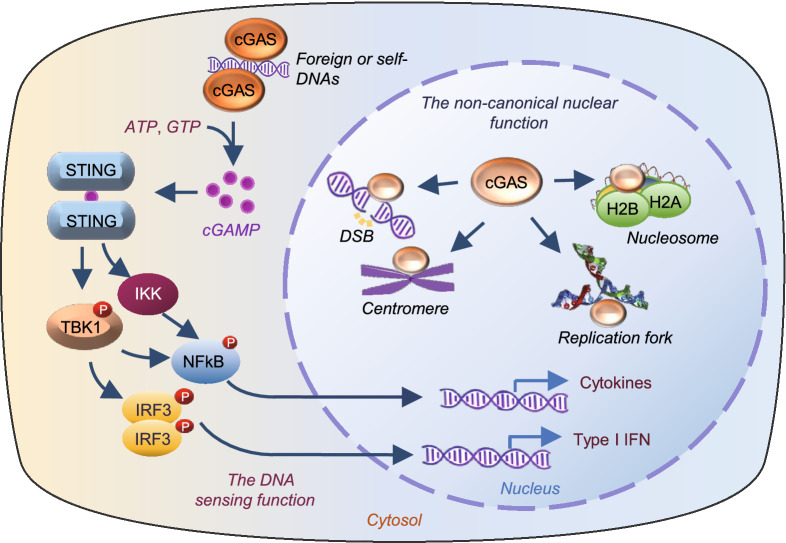
Canonical role of cytosolic cGAS and non-canonical role of nuclear cGAS. In the cytosol, cGAS is activated by self- or non-self dsDNAs, leading to dimerization-induced activation and cGAMP production, which in turn promotes IFN gene expression by activating the STING-TBK1-IRF3 axis. The binding of cGAMP to STING also leads to the activation of the IKK/NFκB pathway, resulting in inflammatory gene expression. In the nucleus, cGAS is localized at DSB, the replication fork, centromere, and/or nucleosome where it carries out the nonconical roles beyond innate immune function
Figure 2
Figure 2
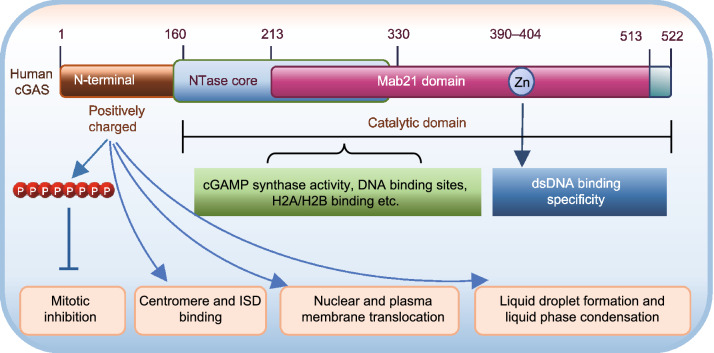
Sequence Structure and Structure-based Function of cGAS. Human cGAS consists of a ~160 amino acid long unstructured and positively charged N terminus and a 360 amino acid C-terminal fragment that contains a nucleotidyltransferase (NTase) core domain (160–330) and the male abnormal 21 (Mab21) domain (213–513). The NTase domain is critical for the enzyme activity of cGAS. The Mab21 domain contains a zinc-ribbon structural domain (390–404) that is important to scale the specificity of cGAS toward dsDNA. Hyperphosphorylated N-terminus of cGAS is critical in suppressing cGAS activity during mitosis. This less evolutionarily conserved sequence also plays a key role in determining nuclear, cytoplasmic distribution, sensing nuclear chromatin, binding to immune stimulatory DNA (ISD), plasma membrane, or centromere as well as assembly of lipid phase condensation
Figure 3
Figure 3
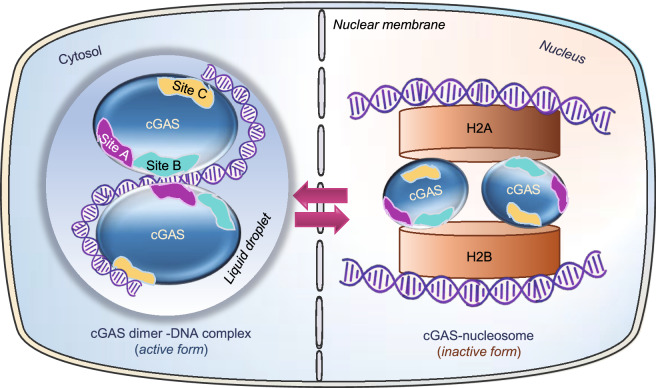
Schematics of cGAS in cytoplasmic active state and in nuclear inactive state. In the cytosol, cGAS interacts with dsDNA via DNA binding site A (purple) or B (teal) or C (yellow), which leads to the formation of cGAS dimerization and DNA liquid phase condensation, thus activating its enzymatic function. In the nucleus, cGAS site B interacts with the histones H2A-H2B of the nucleosome, which blocks cGAS dimerization and thus activation
Figure 4
Figure 4
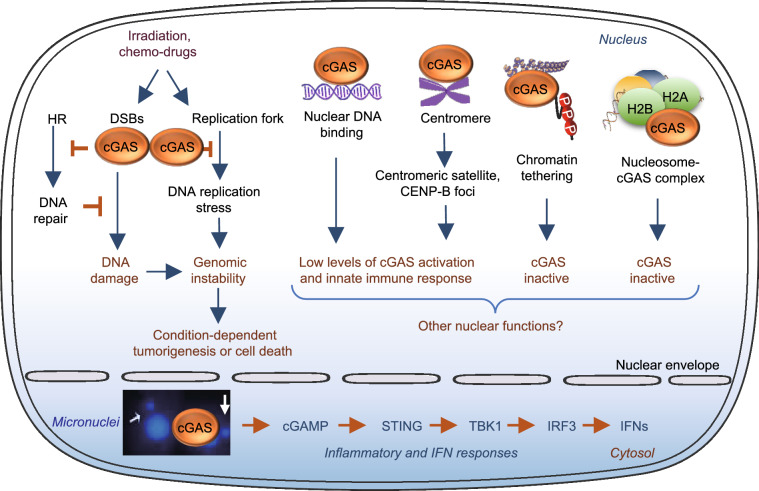
Nuclear function of cGAS. Irradiation or chemo-drugs induces DNA damage, leading to increased micronuclei and genomic instability. In the DNA damaged nucleus, cGAS binds to the double-stranded DNA breaks (DSBs), where it inhibits homologous recombination (HR)-mediated DNA repair, leading to uncontrolled genomic stability and tumorigenesis. On the other hand, cGAS could suppress DNA replication stress-induced DNA damage by slowing replication forks through a direct binding of DNA replication components proliferation cell nuclear antigen (PCNA), which leads to a resistance to radiation and chemotherapy in cancer cells. Increasing cGAS nuclear translocation and its binding to centromere at centromeric satellite or CENP-B foci are associated with low levels of cGAS activation and innate immune response. On the other hand, the binding to nucleosomes, chromatin tethering, and N-terminal hyperphosphorylation is associated with cGAS inactivation. Whether the nuclear localized cGAS has additional function remains to be further determined
Figure 5
Figure 5
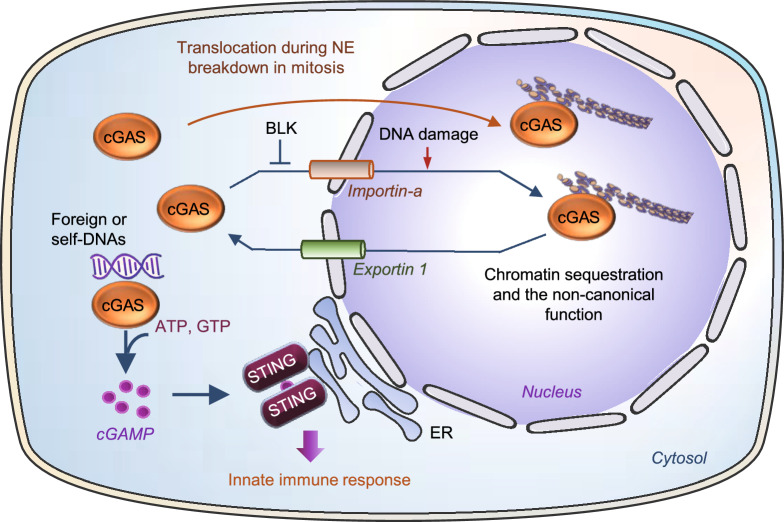
Regulation of cGAS nuclear translocation. Cytosolic cGAS may translocate into the nucleus via an importin α-dependent mechanism, which is stimulated by DNA damage but inhibited by BLK-mediated phosphorylation. cGAS could also translocated to the nucleus during mitosis when the nuclear envelop (NE) is broken. Nuclear cGAS could also be exported to cytosol through Exportin 1. The translocation mechanism of cGAS is related to its distinct function in cellular sublocation
Figure 6
Figure 6
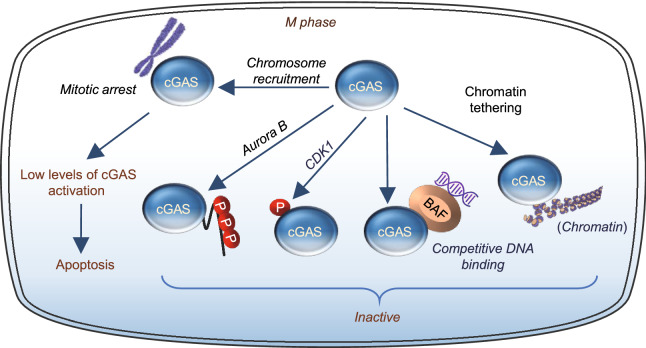
cGAS functions during mitosis. During mitotic arrest, cGAS is recruited to mitotic chromosomes, where it can be activated at a low level to promotes apoptosis. During normal mitosis process, cGAS activity is inhibited by several safeguard mechanisms including mitotic kinase Aurora B- or CDK1-medicated phosphorylation, chromatin tethering and BAF competitive DNA binding

References

    1. Abe T, Barber GN. Cytosolic-DNA-mediated, STING-dependent proinflammatory gene induction necessitates canonical NF-kappaB activation through TBK1. J Virol. 2014;88:5328–5341. - PMC - PubMed
    1. Ablasser A, Chen ZJ. cGAS in action: Expanding roles in immunity and inflammation. Science. 2019;363:eaat8657. - PubMed
    1. Andreeva L, Hiller B, Kostrewa D, Lassig C, de Oliveira Mann CC, Jan Drexler D, Maiser A, Gaidt M, Leonhardt H, Hornung V, et al. cGAS senses long and HMGB/TFAM-bound U-turn DNA by forming protein-DNA ladders. Nature. 2017;549:394–398. - PubMed
    1. Antonin W, Neumann H. Chromosome condensation and decondensation during mitosis. Curr Opin Cell Biol. 2016;40:15–22. - PubMed
    1. Artandi SE, DePinho RA. A critical role for telomeres in suppressing and facilitating carcinogenesis. Curr Opin Genet Dev. 2000;10:39–46. - PubMed

Publication types

MeSH terms

Substances