


Identification of candidate genomic regions for chicken egg number traits based on genome-wide association study
- PMID: 34376144
- PMCID: PMC8356427
- DOI: 10.1186/s12864-021-07755-3
Identification of candidate genomic regions for chicken egg number traits based on genome-wide association study
Abstract
Background: Since the domestication of chicken, various breeds have been developed for food production, entertainment, and so on. Compared to indigenous chicken breeds which generally do not show elite production performance, commercial breeds or lines are selected intensely for meat or egg production. In the present study, in order to understand the molecular mechanisms underlying the dramatic differences of egg number between commercial egg-type chickens and indigenous chickens, we performed a genome-wide association study (GWAS) in a mixed linear model.
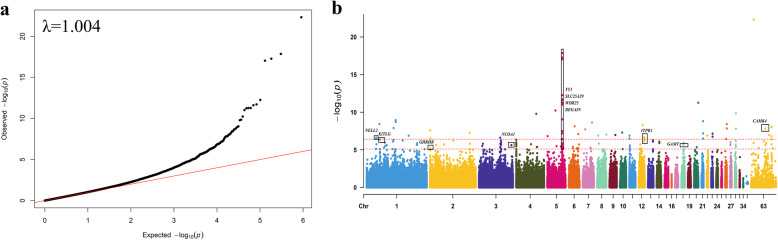
Results: We obtained 148 single nucleotide polymorphisms (SNPs) associated with egg number traits (57 significantly, 91 suggestively). Among them, 4 SNPs overlapped with previously reported quantitative trait loci (QTL), including 2 for egg production and 2 for reproductive traits. Furthermore, we identified 32 candidate genes based on the function of the screened genes. These genes were found to be mainly involved in regulating hormones, playing a role in the formation, growth, and development of follicles, and in the development of the reproductive system. Some genes such as NELL2 (neural EGFL like 2), KITLG (KIT ligand), GHRHR (Growth hormone releasing hormone receptor), NCOA1 (Nuclear receptor coactivator 1), ITPR1 (inositol 1, 4, 5-trisphosphate receptor type 1), GAMT (guanidinoacetate N-methyltransferase), and CAMK4 (calcium/calmodulin-dependent protein kinase IV) deserve our attention and further study since they have been reported to be closely related to egg production, egg number and reproductive traits. In addition, the most significant genomic region obtained in this study was located at 48.61-48.84 Mb on GGA5. In this region, we have repeatedly identified four genes, in which YY1 (YY1 transcription factor) and WDR25 (WD repeat domain 25) have been shown to be related to oocytes and reproductive tissues, respectively, which implies that this region may be a candidate region underlying egg number traits.
Conclusion: Our study utilized the genomic information from various chicken breeds or populations differed in the average annual egg number to understand the molecular genetic mechanisms involved in egg number traits. We identified a series of SNPs, candidate genes, or genomic regions that associated with egg number, which could help us in developing the egg production trait in chickens.
Keywords: Chicken; Egg number; GWAS; Genomic region; SNPs.
© 2021. The Author(s).
Conflict of interest statement
The authors declare that they have no competing interests.
Figures

References
-
- Yang Z, Rose SP, Yang HM, Pirgozliev V, Wang ZY. Egg production in China. World’s Poultry Sci J. 2018;74(3):417–426. doi: 10.1017/S0043933918000429. - DOI
MeSH terms
LinkOut - more resources
Full Text Sources
Miscellaneous
