


A Randomized Controlled Trial to Assess Feasibility and Acceptability of Telephone-Based Psychosocial Interventions in Individuals who Attempted Suicide
- PMID: 34376890
- PMCID: PMC8313454
- DOI: 10.1177/0253717620939272
A Randomized Controlled Trial to Assess Feasibility and Acceptability of Telephone-Based Psychosocial Interventions in Individuals who Attempted Suicide
Abstract
Background: Brief contact interventions such as telephone-based contacts appear to be useful in individuals who attempted suicide. Most studies of telephone-based contacts in such individuals typically consisted of frequent phone reminders for adherence to treatment and seeking help for mental health issues. Telephone-based psychosocial interventions that incorporate elements of supportive and problem-solving strategies are of interest in Indian settings due to their potential application in mitigating the wide mental health gap. Feasibility studies of telephone-based psychosocial interventions could help ascertain the difficulties that arise in the implementation of such treatments.
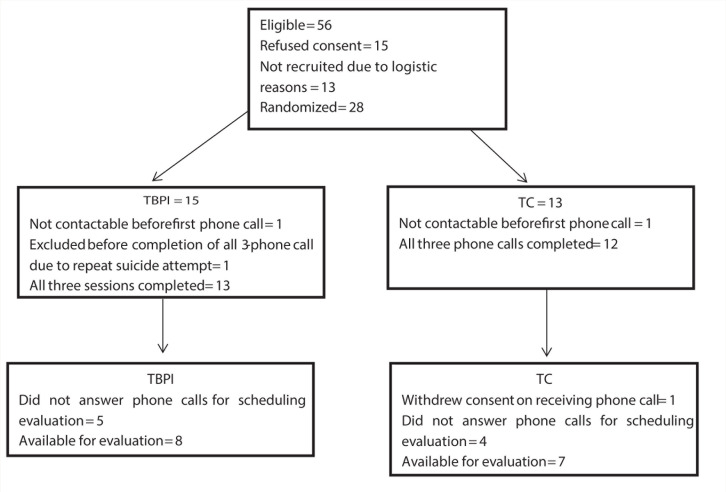
Methods: A multicentric randomized controlled trial (RCT) is currently underway in general hospital settings in two Indian cities to study the efficacy of telephone-based psychosocial interventions in individuals with a recent suicide attempt, with routine telephone contacts (TCs) serving as the comparator. Prior to that RCT, this feasibility study was conducted to assess the acceptability of the telephone-based intervention and telephone contacts. Feasibility was assessed using dropout rates. Acceptability was assessed using participant-rated Likert-based visual analog scores from 0 to 10, with higher scores indicating greater acceptability.
Results: Dropout rates and mean acceptability scores for telephone-based psychosocial interventions were 38.5% and 8.63, while those for TCs were 41.7% and 7.57, respectively.
Conclusions: Telephone-based psychosocial interventions are feasible and acceptable in individuals with a recent suicide attempt.
Keywords: Suicide attempt; brief contact; psychosocial; suicide; telephone interventions.
© 2021 Indian Psychiatric Society - South Zonal Branch.
Conflict of interest statement
Declaration of Conflicting Interests: The authors declared no potential conflicts of interest with respect to the research, authorship, and/or publication of this article.
References
-
- Hom MA, Stanley IH, and Joiner TE. Evaluating factors and interventions that influence help-seeking and mental health service utilization among suicidal individuals: a review of the literature. Clin Psychol Rev, 2015; 40 28–39. - PubMed
-
- Lester D and Walker RL. The stigma for attempting suicide and the loss to suicide prevention efforts. Crisis, 2006; 27 147–148. - PubMed
Grants and funding
LinkOut - more resources
Full Text Sources
Miscellaneous
