


Impact of MEK Inhibitor Therapy on Neurocognitive Functioning in NF1
- PMID: 34377779
- PMCID: PMC8351286
- DOI: 10.1212/NXG.0000000000000616
Impact of MEK Inhibitor Therapy on Neurocognitive Functioning in NF1
Abstract
Background and objectives: Neurofibromatosis type 1 (NF1)-associated cognitive impairments carry significant lifelong morbidity. The lack of targeted biologic treatments remains a significant unmet need. We examine changes in cognition in patients with NF1 in the first 48 weeks of mitogen-activated protein kinase inhibitor (MEKi) treatment.
Methods: Fifty-nine patients with NF1 aged 5-27 years on an MEKi clinical trial treating plexiform neurofibroma underwent pretreatment and follow-up cognitive assessments over 48 weeks of treatment. Performance tasks (Cogstate) and observer-reported functioning (BRIEF) were the primary outcomes. Group-level (paired t tests) and individual-level analyses (Reliable Change Index, RCI) were used.
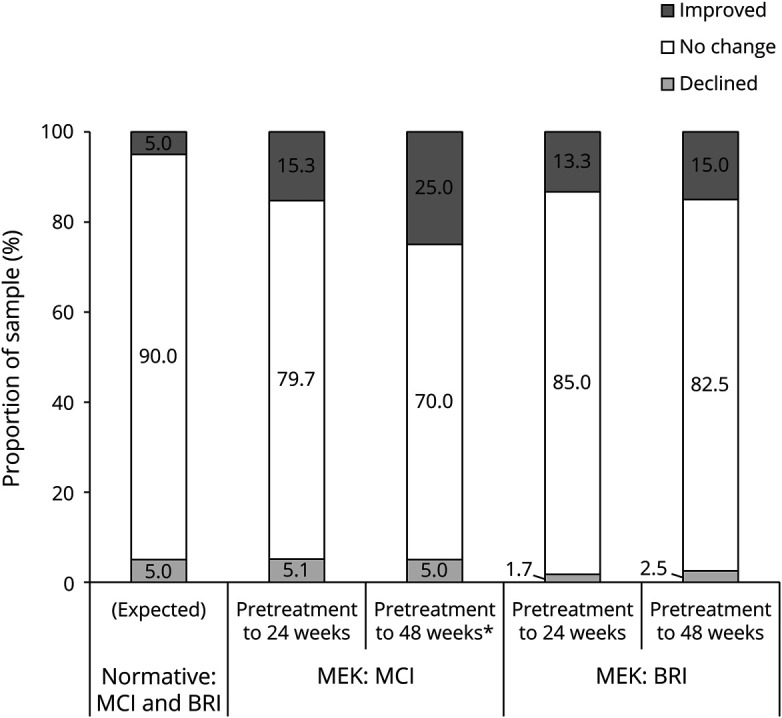
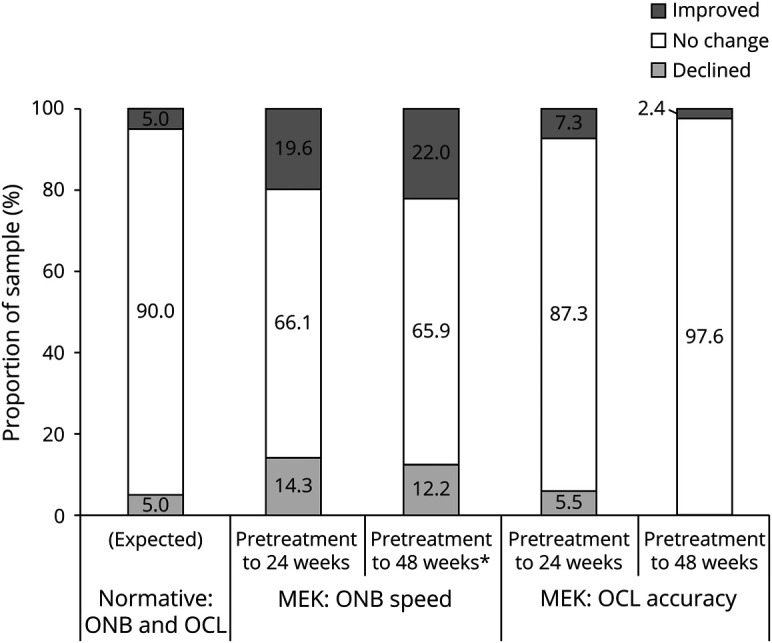
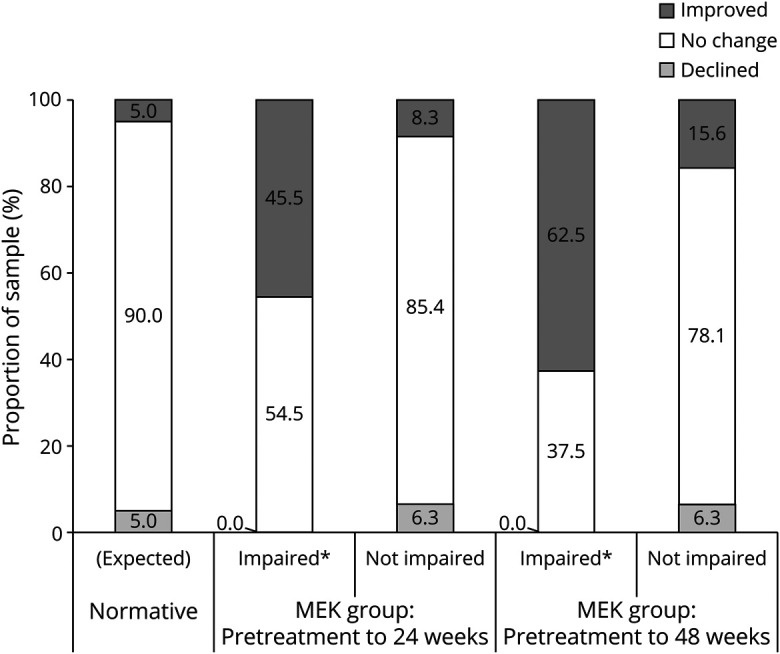
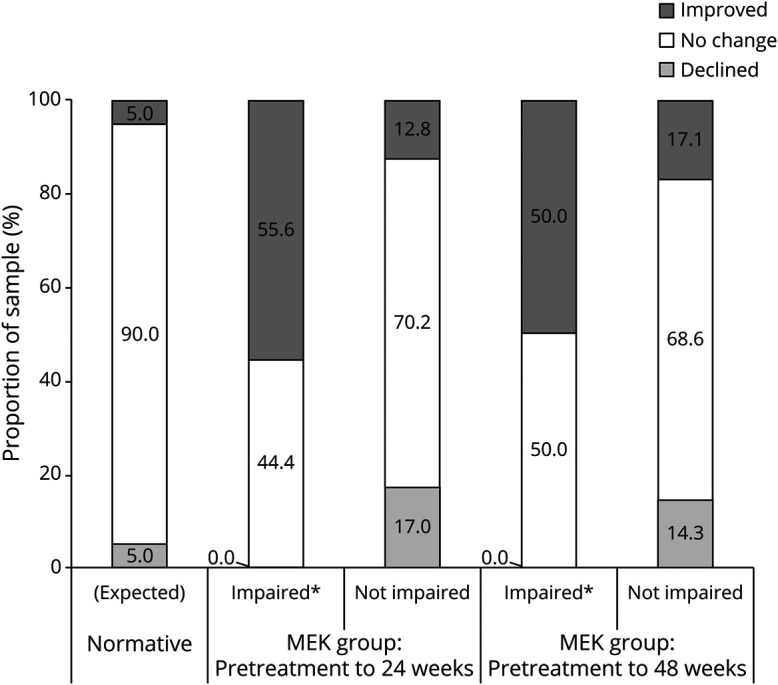
Results: Analysis showed statistically significant improvements on BRIEF compared with baseline (24-week Behavioral Regulation Index: t (58) = 3.03, p = 0.004, d = 0.24; 48-week Metacognition Index: t (39) = 2.70, p = 0.01, d = 0.27). RCI indicated that more patients had clinically significant improvement at 48 weeks than expected by chance (χ2 = 11.95, p = 0.001, odds ratio [OR] = 6.3). Group-level analyses indicated stable performance on Cogstate (p > 0.05). RCI statistics showed high proportions of improved working memory (24-week χ2 = 8.36, p = 0.004, OR = 4.6, and 48-week χ2 = 9.34, p = 0.004, OR = 5.3) but not visual learning/memory. Patients with baseline impairments on BRIEF were more likely to show significant improvement than nonimpaired patients (24 weeks 46% vs 8%; χ2 = 9.54, p = 0.008, OR = 9.22; 48 weeks 63% vs 16%; χ2 = 7.50, p = 0.02, OR = 9.0).
Discussion: Our data show no evidence of neurotoxicity in 48 weeks of treatment with an MEKi and a potential clinical signal supporting future research of MEKi as a cognitive intervention.
Copyright © 2021 The Author(s). Published by Wolters Kluwer Health, Inc. on behalf of the American Academy of Neurology.
Figures
References
-
- Krab LC, Oostenbrink R, de Goede-Bolder A, Aarsen FK, Elgersma Y, Moll HA. Health-related quality of life in children with neurofibromatosis type 1: contribution of demographic factors, disease-related factors, and behavior. J Pediatr. 2009;154(3):420-425, 425.e1. - PubMed
-
- Moore BD III, Ater JL, Needle MN, Slopis J, Copeland DR. Neuropsychological profile of children with neurofibromatosis, brain tumor, or both. J Child Neurol. 1994;9(4):368-377. - PubMed
-
- Payne JM, Hyman SL, Shores EA, North KN. Assessment of executive function and attention in children with neurofibromatosis type 1: relationships between cognitive measures and real-world behavior. Child Neuropsychol. 2011;17(4):313-329. - PubMed
LinkOut - more resources
Full Text Sources
Research Materials
Miscellaneous