


Survival and long-term outcomes following in-hospital cardiac arrest in a Swiss university hospital: a prospective observational study
- PMID: 34380539
- PMCID: PMC8359113
- DOI: 10.1186/s13049-021-00931-0
Survival and long-term outcomes following in-hospital cardiac arrest in a Swiss university hospital: a prospective observational study
Abstract
Background: Incidence of in-hospital cardiac arrest is reported to be 0.8 to 4.6 per 1,000 patient admissions. Patient survival to hospital discharge with favourable functional and neurological status is around 21-30%. The Bern University Hospital is a tertiary medical centre in Switzerland with a cardiac arrest team that is available 24 h per day, 7 days per week. Due to lack of central documentation of cardiac arrest team interventions, the incidence, outcomes and survival rates of cardiac arrests in the hospital are unknown. Our aim was to record all cardiac arrest team interventions over 1 year, and to analyse the outcome and survival rates of adult patients after in-hospital cardiac arrests.
Methods: We conducted a prospective single-centre observational study that recorded all adult in-hospital cardiac arrest team interventions over 1 year, using an Utstein-style case report form. The primary outcome was 30-day survival after in-hospital cardiac arrest. Secondary outcomes were return of spontaneous circulation, neurological status (after return of spontaneous circulation, after 24 h, after 30 days, after 1 and 5 years), according to the Glasgow Outcomes Scale, and functional status at 30 days and 1 year, according to the Short-form-12 Health Survey.
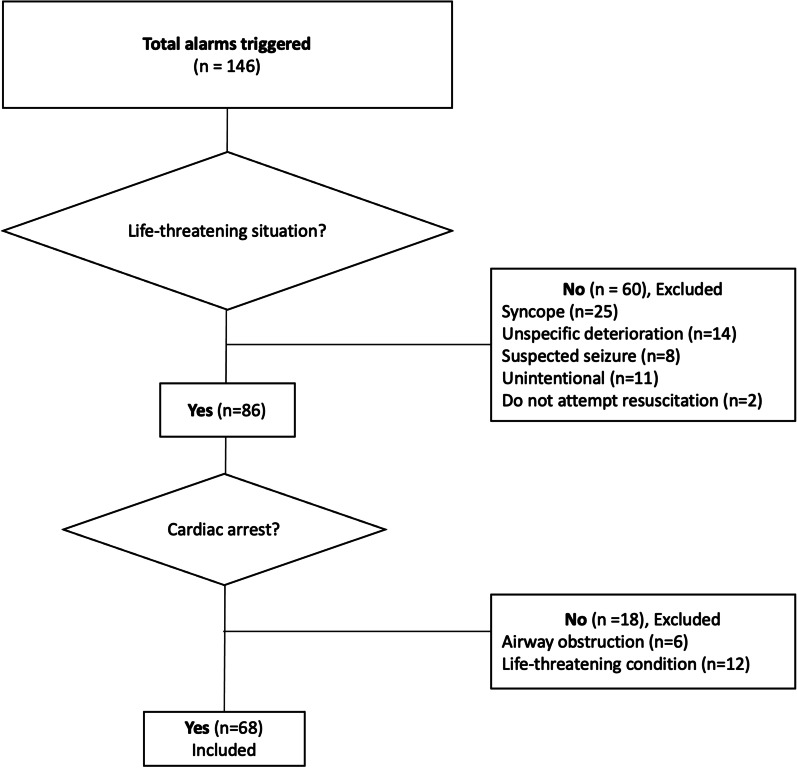
Results: The cardiac arrest team had 146 interventions over the study year, which included 60 non-life-threatening alarms (41.1%). The remaining 86 (58.9%) acute life-threatening situations included 68 (79.1%) as patients with cardiac arrest. The mean age of these cardiac arrest patients was 68 ± 13 years, with a male predominance (51/68; 75.0%). Return of spontaneous circulation was recorded in 49 patients (72.1%). Over one-third of the cardiac arrest patients (27/68) were alive after 30 days with favourable neurological outcome. The patients who survived the first year lived also to 5 years after the event with favourable neurological and functional status.
Conclusions: The in-hospital cardiac arrest incidence on a large tertiary Swiss university hospital was 1.56 per 1000 patient admissions. After a cardiac arrest, about a third of the patients survived to 5 years with favourable neurological and functional status. Alarms unrelated to life-threatening situations are common and need to be taken into count within a low-threshold alarming system.
Trial registration: The trial was registered in clinicaltrials.gov (NCT02746640).
Keywords: Cardiopulmonary resuscitation; Chain of survival; Functional outcome; Health-related quality of life; In-hospital cardiac arrest; Return of spontaneous circulation.
© 2021. The Author(s).
Conflict of interest statement
RG is the ERC Board Director of Guidelines and ILCOR, and ILCOR Education, Implementation and Team Task Force Chair. All of the other authors declare that they have no conflicts of interests.
References
-
- Holmberg MJ, Ross CE, Fitzmaurice GM, Chan PS, Duval-Arnould J, Grossestreuer AV, Yankama T, Donnino MW, Andersen LW. American Heart Association's get with the guidelines-resuscitation I: annual incidence of adult and pediatric in-hospital cardiac arrest in the United States. Circ Cardiovasc Qual Outcomes. 2019;12(7):e005580. doi: 10.1161/CIRCOUTCOMES.119.005580. - DOI - PMC - PubMed
-
- Nolan JP, Soar J, Smith GB, Gwinnutt C, Parrott F, Power S, Harrison DA, Nixon E, Rowan K. National Cardiac Arrest A: Incidence and outcome of in-hospital cardiac arrest in the United Kingdom National Cardiac Arrest Audit. Resuscitation. 2014;85(8):987–992. doi: 10.1016/j.resuscitation.2014.04.002. - DOI - PubMed
-
- Grasner JT, Herlitz J, Tjelmeland IBM, Wnent J, Masterson S, Lilja G, Bein B, Bottiger BW, Rosell-Ortiz F, Nolan JP, et al. European Resuscitation Council guidelines 2021: epidemiology of cardiac arrest in Europe. Resuscitation. 2021;161:61–79. doi: 10.1016/j.resuscitation.2021.02.007. - DOI - PubMed
