


Very high-power short-duration temperature-controlled ablation versus conventional power-controlled ablation for pulmonary vein isolation: The fast and furious - AF study
- PMID: 34381869
- PMCID: PMC8333145
- DOI: 10.1016/j.ijcha.2021.100847
Very high-power short-duration temperature-controlled ablation versus conventional power-controlled ablation for pulmonary vein isolation: The fast and furious - AF study
Abstract
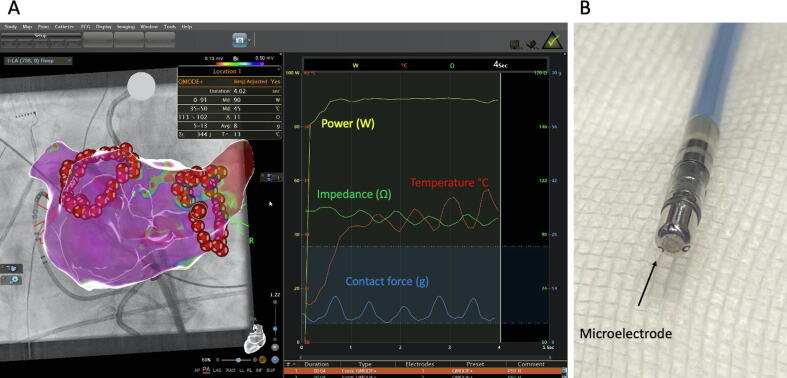
Background: Catheter ablation for atrial fibrillation (AF) treatment provides effective and durable pulmonary vein isolation (PVI) and is associated with encouraging clinical outcome. A novel CF sensing temperature-controlled radiofrequency (RF) ablation catheter allows for very high-power short-duration (vHP-SD, 90 W/4 s) ablation aiming a potentially safer, more effective and faster ablation. We thought to evaluate preliminary safety and efficacy of vHP-SD ablation for PVI utilizing a novel vHP-SD catheter. The data was compared to conventional power-controlled ablation index (AI) guided PVI utilizing conventional contact force (CF) sensing catheters.
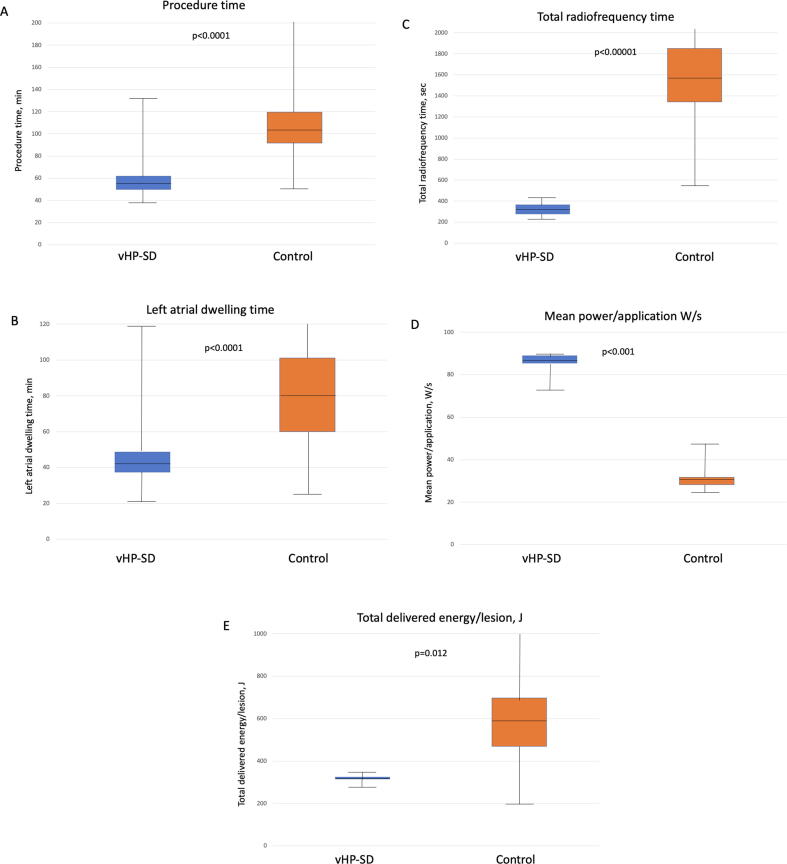
Methods and results: Fifty-six patients with paroxysmal or persistent AF were prospectively enrolled in this study. Twenty-eight consecutive patients underwent vHP-SD based PVI (vHP-SD group) and were compared to 28 consecutive patients treated with conventional CF-sensing catheters utilizing the AI (control group). All PVs were successfully isolated using vHP-SD. The median RF ablation time for vHP-SD was 338 (IQR 286, 367) seconds vs control 1580 (IQR 1350, 1848) seconds (p < 0.0001), the median procedure duration was vHP-SD 55 (IQR 48-60) minutes vs. control 105 (IQR 92-120) minutes (p < 0.0001). No differences in periprocedural complications were observed.
Conclusions: This preliminary data of the novel vHP-SD ablation mode provides safe and effective PVI. Procedure duration and RF ablation time were substantially shorter in the vHP-SD group in comparison to the control group.
Keywords: Acute efficacy; Atrial fibrillation; High-power short duration, pulmonary vein isolation; Radiofrequency.
© 2021 Published by Elsevier B.V.
Conflict of interest statement
The authors declare the following financial interests/personal relationships which may be considered as potential competing interests: CHH received travel grants and research grants by Boston Scientific, Biosense Webster and Cardiofocus and Speakeŕs Honoraria from Boston Scientific, Biosense Webster and Cardiofocus. RRT is a consultant of Boston Scientific, Biotronik and Biosense Webster and received Speakeŕs Honoraria from Biosense Webster, Medtronic, Boston Scientific and Abbot Medical. KHK reports grants and personal fees from Abbott Vascular,. Medtronic, Biosense Webster outside submitted work. All other authors have no relevant disclosures.
Figures
References
-
- Hindricks G., Potpara T., Dagres N., Arbelo E., Bax J.J., Blomström-Lundqvist C. ESC Guidelines for the diagnosis and management of atrial fibrillation developed in collaboration with the European Association of Cardio-Thoracic Surgery (EACTS)The Task Force for the diagnosis and management of atrial fibrillation of the European Society of Cardiology (ESC) Developed with the special contribution of the European Heart Rhythm Association (EHRA) of the ESC. Eur Heart J. 2020 2020;ehaa612. - PubMed
-
- Ouyang F., Tilz R., Chun J., Schmidt B., Wissner E., Zerm T., Neven K., Köktürk B., Konstantinidou M., Metzner A., Fuernkranz A., Kuck K.-H. Long-term results of catheter ablation in paroxysmal atrial fibrillation: lessons from a 5-year follow-up. Circulation. 2010;122(23):2368–2377. - PubMed
-
- Tilz R.R., Heeger C.-H., Wick A., Saguner A.M., Metzner A., Rillig A., Wohlmuth P., Reissmann B., Lemeš C., Maurer T., Santoro F., Riedl J., Sohns C., Mathew S., Kuck K.-H., Ouyang F. Ten-Year Clinical Outcome After Circumferential Pulmonary Vein Isolation Utilizing the Hamburg Approach in Patients With Symptomatic Drug-Refractory Paroxysmal Atrial Fibrillation. Circulation Arrhythmia and electrophysiology. 2018;11(2) doi: 10.1161/CIRCEP.117.005250. - DOI - PubMed
-
- Hussein A., Das M., Chaturvedi V., Asfour I.K., Daryanani N., Morgan M., Ronayne C., Shaw M., Snowdon R., Gupta D. Prospective use of Ablation Index targets improves clinical outcomes following ablation for atrial fibrillation. J. Cardiovasc. Electrophysiol. 2017;28(9):1037–1047. - PubMed
-
- Hussein A., Das M., Riva S., Morgan M., Ronayne C., Sahni A., Shaw M., Todd D., Hall M., Modi S., Natale A., Dello Russo A., Snowdon R., Gupta D. Use of Ablation Index-Guided Ablation Results in High Rates of Durable Pulmonary Vein Isolation and Freedom From Arrhythmia in Persistent Atrial Fibrillation Patients. Circulation Arrhythmia Electrophysiol. 2018;11(9) doi: 10.1161/CIRCEP.118.006576. - DOI - PubMed
LinkOut - more resources
Full Text Sources
Medical
Research Materials
