Policy Makers' Priorities for Addressing Youth Substance Use and Factors That Influence Priorities
- PMID: 34384231
- PMCID: PMC9704547
- DOI: 10.1176/appi.ps.202000919
Policy Makers' Priorities for Addressing Youth Substance Use and Factors That Influence Priorities
Abstract
Objective: Understanding public policy makers' priorities for addressing youth substance use and the factors that influence these priorities can inform the dissemination and implementation of strategies that promote evidence-based decision making. This study characterized the priorities of policy makers in substance use agencies of U.S. states and counties for addressing youth substance use, the factors that influenced these priorities, and the differences in priorities and influences between state and county policy makers.
Methods: In 2020, a total of 122 substance use agency policy makers from 35 states completed a Web-based survey (response rate=22%). Respondents rated the priority of 14 issues related to youth substance use and the extent to which nine factors influenced these priorities. Data were analyzed as dichotomous and continuous variables and for state and county policy makers together and separately.
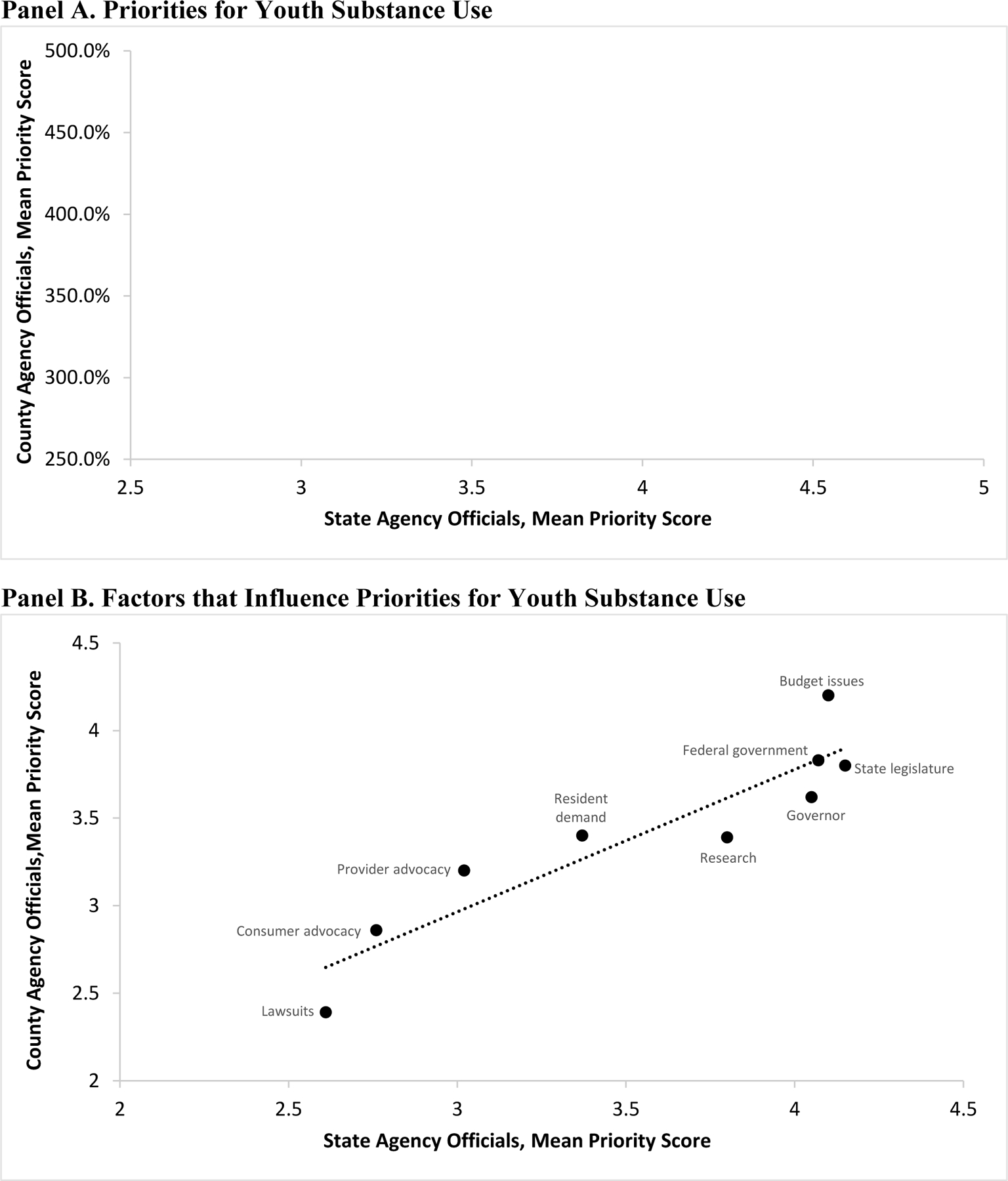
Results: The highest priorities for youth substance use were social determinants of substance use (87%), adverse childhood experiences and childhood trauma (85%), and increasing access to school-based substance use programs (82%). The lowest priorities were increasing access to naloxone for youths (49%), increasing access to medications for opioid use disorder among youths (49%), and deimplementing non-evidence-based youth substance use programs (41%). The factors that most influenced priorities were budget issues (80%) and state legislature (69%), federal (67%), and governor priorities (65%). Issues related to program implementation and deimplementation were significantly higher priorities for state than for county policy makers.
Conclusions: These findings can inform the tailoring of dissemination and implementation strategies to account for the inner- and outer-setting contexts of substance use agencies.
Keywords: Adolescence; Implementation science; Policymakers; Public substance use agencies; Substance use; Youth.
Figures
References
-
- Cavanaugh D, Kraft MK, Muck R, Merrigan DM. Toward an effective treatment system for adolescents with substance use disorders: The role of the states. Children and Youth Services Review 2011;33:S16–S22.
-
- Government Accountability Office. Adolescent and Young Adult Substance Use: Federal Grants for Prevention, Treatment, and Recovery Services and for Research, GAO-18–606 2018. https://www.gao.gov/products/GAO-18-606.
-
- Winters KC, Botzet AM, Stinchfield R, et al. Adolescent substance abuse treatment: A review of evidence-based research. Adolescent Substance Abuse: Springer; 2018:141–171.
-
- Miller WR, Sorensen JL, Selzer JA, Brigham GS. Disseminating evidence-based practices in substance abuse treatment: A review with suggestions. Journal of substance abuse treatment 2006;31(1):25–39. - PubMed
Publication types
MeSH terms
Grants and funding
LinkOut - more resources
Full Text Sources
Medical