


Scope, context and quality of telerehabilitation guidelines for physical disabilities: a scoping review
- PMID: 34385253
- PMCID: PMC8361705
- DOI: 10.1136/bmjopen-2021-049603
Scope, context and quality of telerehabilitation guidelines for physical disabilities: a scoping review
Abstract
Objective: To identify the available guidance and training to implement telerehabilitation movement assessments for people (adults and children) with a physical disability, including those recovering from COVID-19.
Design: Rapid scoping review.
Included sources and articles: PubMed, CINAHL, PsychInfo, Cochrane, Embase, Web of Science, PEDro, UK Health Forum, WHO, National Archives and NHS England were searched using the participant-concept-context framework from 2015 to August 2020. Primary studies that recruited individuals with physical disabilities and guidance documents aimed at providers to implement movement-related telerehabilitation were included.
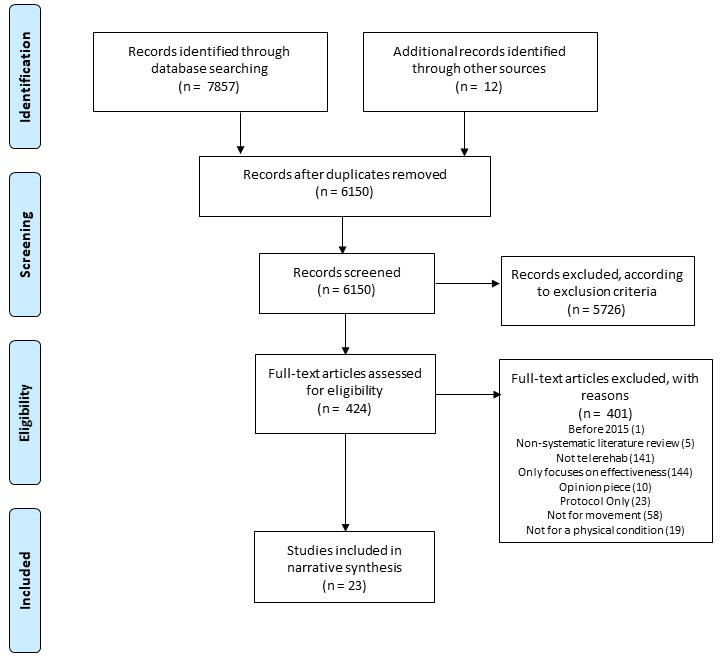
Results: 23 articles (11 primary research studies, 3 systematic reviews and 9 guidance documents) were included out of 7857 that were identified from the literature search. Two main issues were found: (1) telerehabilitation guidance (from both research studies and guidance documents) was not specific to movement-related assessment and (2) most primary research studies provided neither guidance nor training of movement-specific assessment to practitioners. Of the COVID-19 related guidance, two articles reported COVID-19 management that only referred to identifying COVID-19 status without references to specific movement-related guidance.
Conclusions: Telerehabilitation guidance and training have existed pre-COVID-19, yet the lack of specific movement-related information and provider support is surprising. This gap must be addressed to optimise effective implementation of remote assessments for those with physical disabilities.
Review registration: Open Science Framework: osf.io/vm6sp.
Keywords: COVID-19; physiology; protocols & guidelines; rehabilitation medicine; telemedicine.
© Author(s) (or their employer(s)) 2021. Re-use permitted under CC BY. Published by BMJ.
Conflict of interest statement
Competing interests: None declared.
Figures
References
-
- Charted Society of Physiotherapy . Rehabilitation and Covid-19 - CSP policy statement, 2020. Available: https://www.csp.org.uk/professional-clinical/improvement-innovation/comm...
-
- Phillips M, Turner-Stokes L, Wade D. Rehabilitation in the wake of Covid-19-a Phoenix from the ashes. British Society of Rehabilitation Medicine 2020https://www.cmsuk.org/executive-summary-of-rehabilitation-in-the-wake-of...
-
- Wade DT. The future of rehabilitation in the United Kingdom National health service: using the COVID-19 crisis to promote change, increasing efficiency and effectiveness. London, England: SAGE Publications Sage UK, 2020. - PubMed
Publication types
MeSH terms
Grants and funding
LinkOut - more resources
Full Text Sources
Medical
Miscellaneous
