


Feasibility and Effectiveness of Telecounseling on the Psychological Problems of Frontline Healthcare Workers Amidst COVID-19: A Randomized Controlled Trial from Central India
- PMID: 34385729
- PMCID: PMC8327876
- DOI: 10.1177/02537176211024537
Feasibility and Effectiveness of Telecounseling on the Psychological Problems of Frontline Healthcare Workers Amidst COVID-19: A Randomized Controlled Trial from Central India
Abstract
Background: Preliminary reports suggest that during the COVID-19 pandemic, telecounseling could be an effective model of psychological intervention for the frontline healthcare workers (fHCW) with psychological problems. Literature is sparse in this area, particularly from low- and middle-income countries, including India. We aimed to investigate the feasibility and the effectiveness of telecounseling (vs. general education) on the psychological problems of the fHCW over three time-points (baseline vs. end-of-session and at two and four weeks after the intervention).
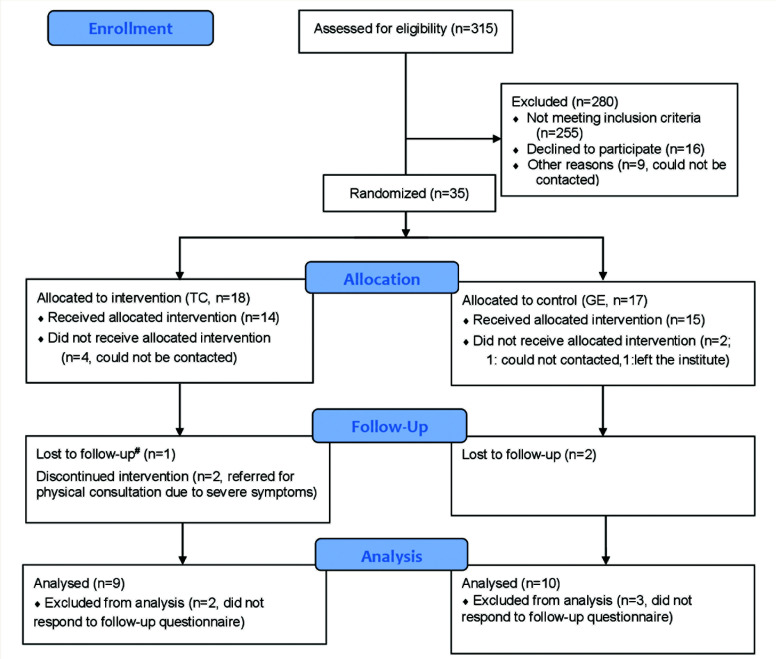
Methods: The study followed a single-blind, active arm versus general education, parallel-group randomized control design, with participant allocation in 1:1. Active healthcare workers (HCWs) with mild- to-severe or clinically concerning scores on any of the sub-scales of Depression, Anxiety and Stress Scale (DASS-21) or Impact of Event Scale-Revised (IES-R; represented by higher scores) were included, while those with known psychiatric illness were excluded. Chi-square and Mann-Whitney U test and linear-mixed effect model (group-, time, and group by time-effect) were used for analysis.
Results: There were no baseline group differences (telecounseling group, active arm, n = 9; general education group, control arm, n = 10). A significant time-effect (P = 0.044 to <.001) was found on DASS-21 on intention-to-treat analysis. Per-protocol analysis, additionally, found a significant group effect on Impact of Event Scale-Revised (IES-R; P = 0.036). A significant random effect of the participants was also found (P <.001).
Conclusion: Telecounseling could be a feasible and scalable model of psychological interventions for the fHCW with psychological problems, albeit with some feasibility challenges.
Keywords: COVID-19; Frontline; Healthcare workers; Randomize-control trial; Telecounseling.
© 2021 Indian Psychiatric Society - South Zonal Branch.
Conflict of interest statement
Declaration of Conflicting Interests: The authors declared no potential conflicts of interest with respect to the research, authorship, and/or publication of this article.
Figures
References
-
- Coronavirus disease 2019 (COVID-19) situation report -70.pdf. https://www.who.int/docs/default-source/coronaviruse/situation-reports/2... (accessed April20, 2020)
LinkOut - more resources
Full Text Sources
