


Detection of Cell Types Contributing to Cancer From Circulating, Cell-Free Methylated DNA
- PMID: 34386036
- PMCID: PMC8353442
- DOI: 10.3389/fgene.2021.671057
Detection of Cell Types Contributing to Cancer From Circulating, Cell-Free Methylated DNA
Abstract
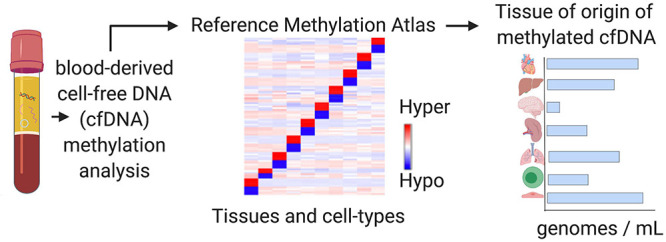
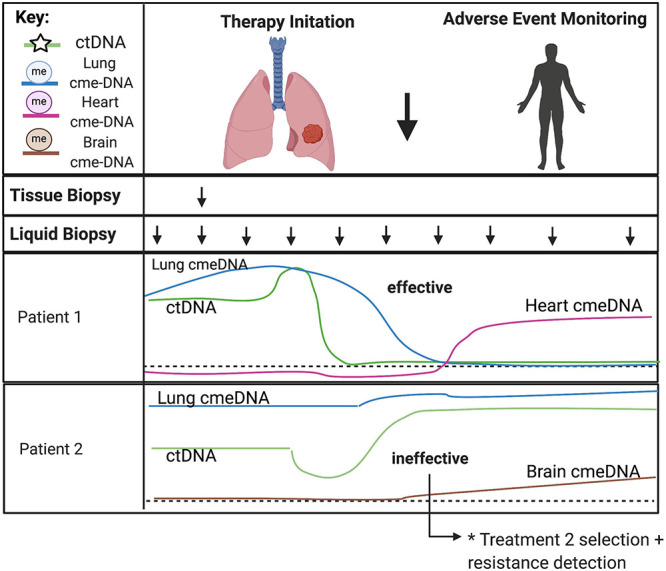
Detection of cellular changes in tissue biopsies has been the basis for cancer diagnostics. However, tissue biopsies are invasive and limited by inaccuracies due to sampling locations, restricted sampling frequency, and poor representation of tissue heterogeneity. Liquid biopsies are emerging as a complementary approach to traditional tissue biopsies to detect dynamic changes in specific cell populations. Cell-free DNA (cfDNA) fragments released into the circulation from dying cells can be traced back to the tissues and cell types they originated from using DNA methylation, an epigenetic regulatory mechanism that is highly cell-type specific. Decoding changes in the cellular origins of cfDNA over time can reveal altered host tissue homeostasis due to local cancer invasion and metastatic spread to distant organs as well as treatment responses. In addition to host-derived cfDNA, changes in cancer cells can be detected from cell-free, circulating tumor DNA (ctDNA) by monitoring DNA mutations carried by cancer cells. Here, we will discuss computational approaches to identify and validate robust biomarkers of changed tissue homeostasis using cell-free, methylated DNA in the circulation. We highlight studies performing genome-wide profiling of cfDNA methylation and those that combine genetic and epigenetic markers to further identify cell-type specific signatures. Finally, we discuss opportunities and current limitations of these approaches for implementation in clinical oncology.
Keywords: Cell-free DNA (cfDNA); cellular damage; circulating tumor DNA (ctDNA); deconvolution; liquid biopsy; tissue-of-origin; tumor microenvironment.
Copyright © 2021 Barefoot, Loyfer, Kiliti, McDeed, Kaplan and Wellstein.
Conflict of interest statement
Georgetown University filed a patent related to some of the approaches described in this manuscript. MB and AW are named as inventors on this application and declare that as a potential conflict of interest. The remaining authors declare that the research was conducted in the absence of any commercial or financial relationships that could be construed as a potential conflict of interest.
Figures
References
-
- Barefoot M. E., Lindberg M. R., Wellstein A. (2021). Decoding the tissue of origin of cellular damage from cell-free dna in liquid biopsies. Syst. Med. 2 365–378. 10.1016/b978-0-12-801238-3.11669-1 - DOI
-
- Caggiano C., Celona B., Garton F., Mefford J., Black B., Lomen-Hoerth C., et al. (2020). Estimating the rate of cell type degeneration from epigenetic sequencing of cell-free DNA. bioRxiv [Preprint]. 10.1101/2020.01.15.907022 - DOI
Publication types
Grants and funding
LinkOut - more resources
Full Text Sources
Other Literature Sources
