


Out-of-Frame Mutations in ACTN2 Last Exon Cause a Dominant Distal Myopathy With Facial Weakness
- PMID: 34386585
- PMCID: PMC8356702
- DOI: 10.1212/NXG.0000000000000619
Out-of-Frame Mutations in ACTN2 Last Exon Cause a Dominant Distal Myopathy With Facial Weakness
Abstract
Background and objectives: To clinically, genetically, and histopathologically characterize patients presenting with an unusual combination of distal myopathy and facial weakness, without involvement of upper limb or shoulder girdle muscles.
Methods: Two families with a novel form of actininopathy were identified. Patients had been followed up over 10 years. Their molecular genetic diagnosis was not clear after extensive investigations, including analysis of candidate genes and FSHD1-related D4Z4 repeats.
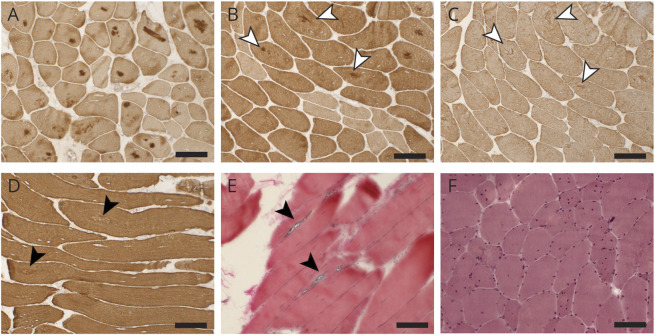
Results: Patients shared a similar clinical phenotype and a common pattern of muscle involvement. They presented with a very slowly progressive myopathy involving anterior lower leg and facial muscles. Muscle MRI finding showed complete fat replacement of anterolateral compartment muscles of the lower legs with variable involvement of soleus and gastrocnemius but sparing thigh muscles. Muscle biopsy showed internalized nuclei, myofibrillar disorganization, and rimmed vacuoles. High-throughput sequencing identified in each proband a heterozygous single nucleotide deletion (c.2558del and c.2567del) in the last exon of the ACTN2 gene. The deletions are predicted to lead to a novel but unstructured slightly extended C-terminal amino acid sequence.
Discussion: Our findings indicate an unusual form of actininopathy with specific molecular and clinical features. Actininopathy should be considered in the differential diagnosis of distal myopathy combined with facial weakness.
Copyright © 2021 The Author(s). Published by Wolters Kluwer Health, Inc. on behalf of the American Academy of Neurology.
Figures

References
-
- Atkinson RA, Joseph C, Kelly G, et al. . Ca2+-independent binding of an EF-hand domain to a novel motif in the alpha-actinin-titin complex. Nat Struct Biol. 2001;8(10):853-857. - PubMed
-
- North KN, Yang N, Wattanasirichaigoon D, Mills M, Easteal S, Beggs AH. A common nonsense mutation results in alpha-actinin-3 deficiency in the general population. Nat Genet. 1999;21(4):353-354. - PubMed
-
- Savarese M, Palmio J, Poza JJ, et al. . Actininopathy: a new muscular dystrophy caused by ACTN2 dominant mutations. Ann Neurol. 2019;85(6):899-906. - PubMed
Grants and funding
LinkOut - more resources
Full Text Sources