


Comparative analysis of rapid concentration methods for the recovery of SARS-CoV-2 and quantification of human enteric viruses and a sewage-associated marker gene in untreated wastewater
- PMID: 34388890
- PMCID: PMC8325557
- DOI: 10.1016/j.scitotenv.2021.149386
Comparative analysis of rapid concentration methods for the recovery of SARS-CoV-2 and quantification of human enteric viruses and a sewage-associated marker gene in untreated wastewater
Abstract
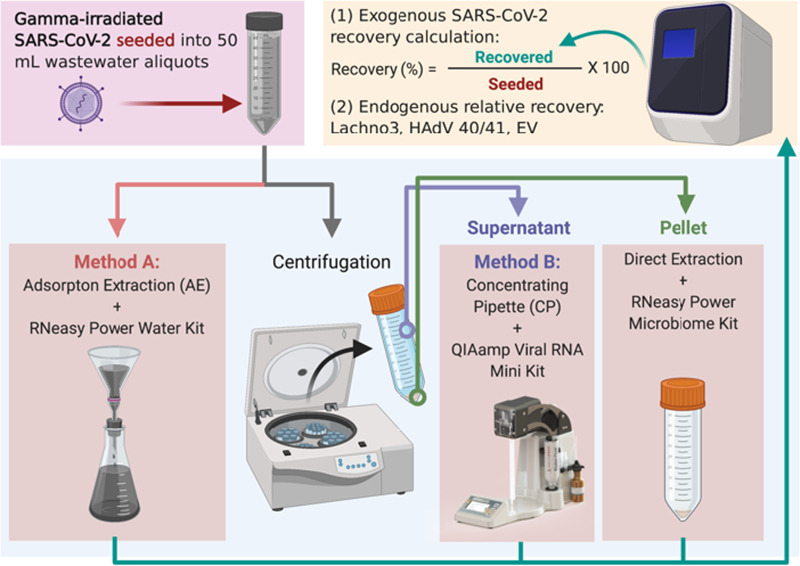
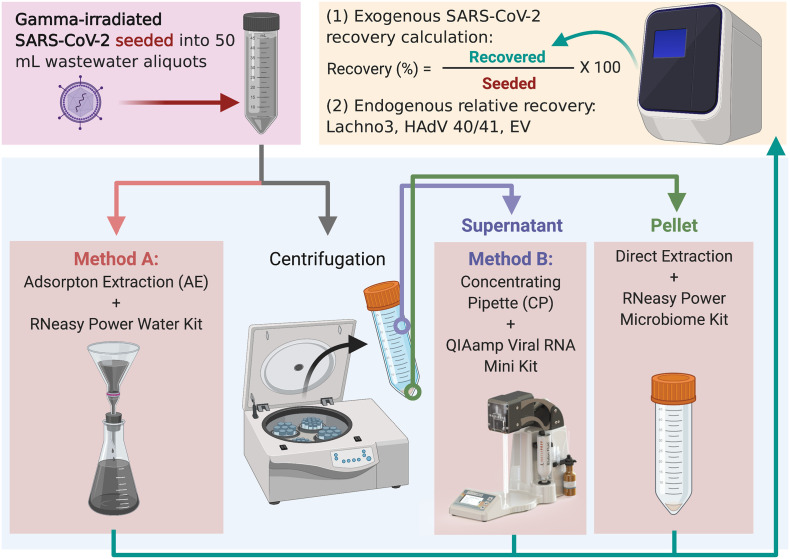
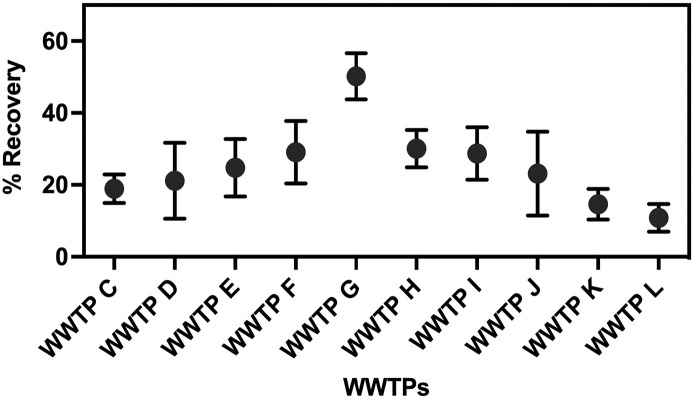
To support public-health-related disease surveillance and monitoring, it is crucial to concentrate both enveloped and non-enveloped viruses from domestic wastewater. To date, most concentration methods were developed for non-enveloped viruses, and limited studies have directly compared the recovery efficiency of both types of viruses. In this study, the effectiveness of two different concentration methods (Concentrating pipette (CP) method and an adsorption-extraction (AE) method amended with MgCl2) were evaluated for untreated wastewater matrices using three different viruses (SARS-CoV-2 (seeded), human adenovirus 40/41 (HAdV 40/41), and enterovirus (EV)) and a wastewater-associated bacterial marker gene targeting Lachnospiraceae (Lachno3). For SARS-CoV-2, the estimated mean recovery efficiencies were significantly greater by as much as 5.46 times, using the CP method than the AE method amended with MgCl2. SARS-CoV-2 RNA recovery was greater for samples with higher titer seeds regardless of the method, and the estimated mean recovery efficiencies using the CP method were 25.1 ± 11% across ten WWTPs when wastewater samples were seeded with 5 × 10⁴ gene copies (GC) of SARS-CoV-2. Meanwhile, the AE method yielded significantly greater concentrations of indigenous HAdV 40/41 and Lachno3 from wastewater compared to the CP method. Finally, no significant differences in indigenous EV concentrations were identified in comparing the AE and CP methods. These data indicate that the most effective concentration method varies by microbial analyte and that the priorities of the surveillance or monitoring program should be considered when choosing the concentration method.
Keywords: COVID-19; Concentration method; Enveloped virus; Murine hepatitis virus; Recovery; SARS-CoV-2; Wastewater.
Copyright © 2021 The Author(s). Published by Elsevier B.V. All rights reserved.
Conflict of interest statement
Declaration of competing interest The authors declare that they have no known competing financial interests or personal relationships that could have appeared to influence the work reported in this paper.
Figures
References
-
- Ahmed W., Angel N., Edson J., Bibby K., Bivins A., Brien J.W.O., Choi P.M., Kitajima M., Simpson S.L., Li J., Tscharke B., Verhagen R., Smith W.J.M., Zaugg J., Dierens L., Hugenholtz P., Thomas K.V., Mueller J.F. First confirmed detection of SARS-CoV-2 in untreated wastewater in Australia: a proof of concept for the wastewater surveillance of COVID-19 in the community. Sci. Total Environ. 2020;728 - PMC - PubMed
-
- Ahmed W., Bertsch P.M., Bivins A., Bibby K., Farkas K., Gathercole A., Haramoto E., Gyawali P., Korajkic A., McMinn B.R., Mueller J.F., Simpson S.L., Smith W.J.M., Symonds E.M., Thomas K.V., Verhagen R., Kitajima M. Comparison of virus concentration methods for the RT-qPCR based recovery of murine hepatitis virus, a surrogate for SARS-CoV-2 from untreated wastewater. Sci. Total Environ. 2020;739 - PMC - PubMed
-
- American Society for Testing and Materials . 2020. Guidance on SARS-CoV-2 Surrogate Selection.https://www.astm.org/COMMIT/GuidanceCOVID19SurrogateSel_April242020press... Available from.
-
- Besselsen D.G., Wagner A.M., Loganbill J.K. Detection of rodent coronaviruses by use of fluorogenic reverse transcriptase-polymerase chain reaction analysis. Comp. Med. 2002;52(2):111–116. - PubMed
MeSH terms
Substances
LinkOut - more resources
Full Text Sources
Medical
Miscellaneous
