


The determinants of lipid profiles in early adolescence in a Ugandan birth cohort
- PMID: 34389769
- PMCID: PMC8363641
- DOI: 10.1038/s41598-021-96035-x
The determinants of lipid profiles in early adolescence in a Ugandan birth cohort
Abstract
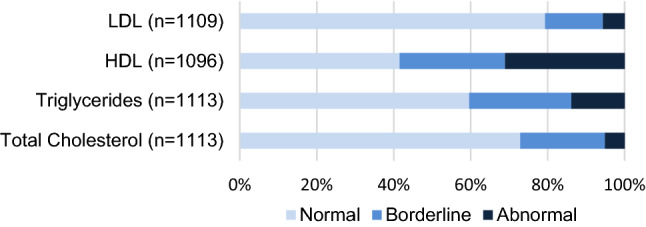
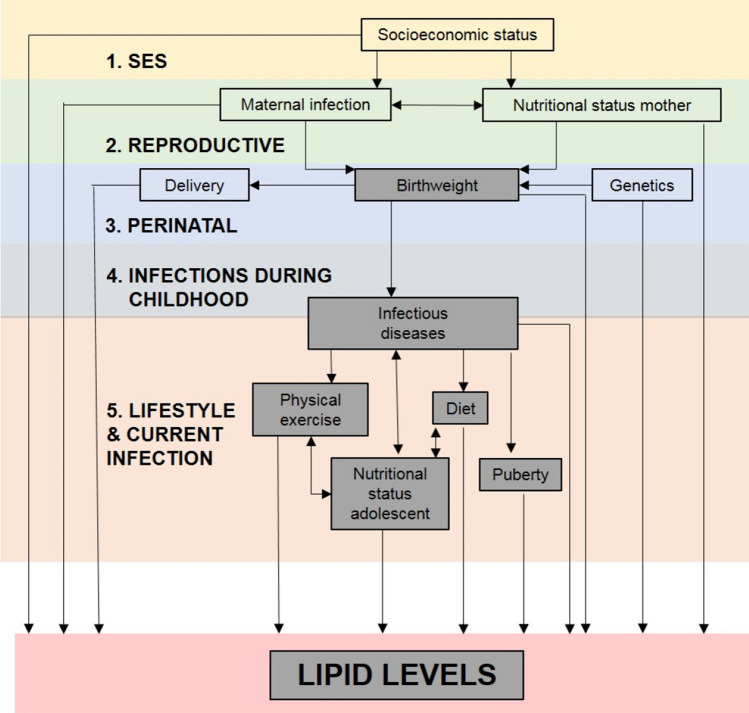
Dyslipidaemia in adolescence tracks into adulthood and is an important risk factor for cardiovascular disease. Little is known about the effects of environmental exposures and early-life exposure to infectious diseases common to tropical regions on lipids. In 1119 early adolescent participants in the Entebbe Mother and Baby Study, we used linear regression to examine whether prenatal, childhood or adolescent factors are associated with lipid levels. Reduced high-density lipoprotein (HDL) and elevated triglyceride levels were common (prevalence 31% and 14%, respectively), but elevated low-density lipoprotein (LDL) or total cholesterol (TC) were rare. Current malaria infection was associated with lower mean LDL (adjusted ß - 0.51; 95% CI - 0.81, - 0.21), HDL (adjusted ß - 0.40; 95% CI - 0.56, - 0.23), and TC levels (adjusted ß - 0.62; 95% CI - 0.97, - 0.27), but higher mean triglyceride levels (geometric mean ratio (GMR) 1.47; 95% CI 1.18-1.84). Early-life asymptomatic malaria was associated with modest reductions in HDL and TC. Body mass index (BMI) was positively associated with LDL, TC, and triglycerides. No associations with helminth infection were found. Our findings suggest that early-life factors have only marginal effects on the lipid profile. Current malaria infection and BMI are strongly associated with lipids and important to consider when trying to improve the lipid profile.
© 2021. The Author(s).
Conflict of interest statement
The authors declare no competing interests.
Figures
References
-
- WHO Factsheet Cardiovascular Diseases (CVDs). https://www.who.int/news-room/fact-sheets/detail/cardiovascular-diseases... (2017). Accessed 05 May 2020.
-
- Poirier P, et al. Obesity and cardiovascular disease: Pathophysiology, evaluation, and effect of weight loss: An update of the 1997 American Heart Association Scientific Statement on Obesity and Heart Disease from the Obesity Committee of the Council on Nutrition, Physical Activity, and Metabolism. Circulation. 2006;113:898–918. doi: 10.1161/CIRCULATIONAHA.106.171016. - DOI - PubMed
Publication types
MeSH terms
Substances
Grants and funding
LinkOut - more resources
Full Text Sources
Research Materials
