


Investigation of gene-environment interactions in relation to tic severity
- PMID: 34389898
- PMCID: PMC8536549
- DOI: 10.1007/s00702-021-02396-y
Investigation of gene-environment interactions in relation to tic severity
Abstract
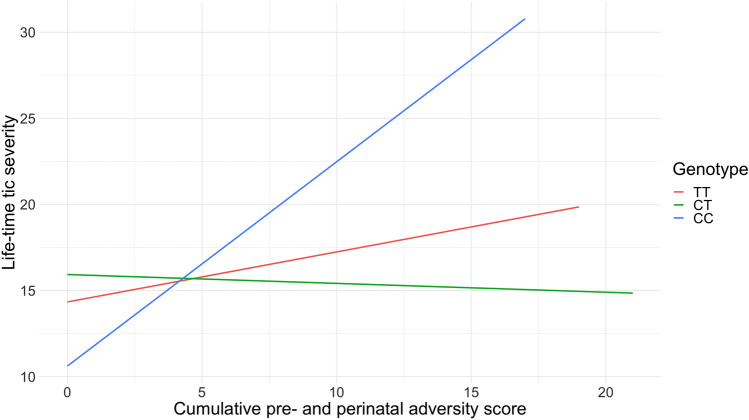
Tourette syndrome (TS) is a neuropsychiatric disorder with involvement of genetic and environmental factors. We investigated genetic loci previously implicated in Tourette syndrome and associated disorders in interaction with pre- and perinatal adversity in relation to tic severity using a case-only (N = 518) design. We assessed 98 single-nucleotide polymorphisms (SNPs) selected from (I) top SNPs from genome-wide association studies (GWASs) of TS; (II) top SNPs from GWASs of obsessive-compulsive disorder (OCD), attention-deficit/hyperactivity disorder (ADHD), and autism spectrum disorder (ASD); (III) SNPs previously implicated in candidate-gene studies of TS; (IV) SNPs previously implicated in OCD or ASD; and (V) tagging SNPs in neurotransmitter-related candidate genes. Linear regression models were used to examine the main effects of the SNPs on tic severity, and the interaction effect of these SNPs with a cumulative pre- and perinatal adversity score. Replication was sought for SNPs that met the threshold of significance (after correcting for multiple testing) in a replication sample (N = 678). One SNP (rs7123010), previously implicated in a TS meta-analysis, was significantly related to higher tic severity. We found a gene-environment interaction for rs6539267, another top TS GWAS SNP. These findings were not independently replicated. Our study highlights the future potential of TS GWAS top hits in gene-environment studies.
Keywords: Gene–environment interaction; Pre- and perinatal complications; Tic severity; Tourette syndrome.
© 2021. The Author(s).
Conflict of interest statement
Drs. Mathews and Scharf are on the scientific advisory board of the Tourette Association of America (TAA) and have received travel and Grant support from the TAA. Dr. Mathews is also on the scientific advisory board of the International Obsessive–Compulsive Disorder Foundation and the Family Foundation for OCD Research. Dr. Scharf is on the scientific advisory board of the TLC Foundation for Body-Focused Repetitive Behaviors and has received consulting fees from Nuvelution Pharma and Abide Pharmaceuticals. Dr. Coffey is co-Chair of the TAA Medical Advisory Board and has received honoraria from the TAA-CDC partnership She has also received honoraria from the American Academy of Child and Adolescent Psychiatry, Partners Health Care, Harvard Medical School/Psychiatry Academy; consulting fees fromTeva/Nuvelution, and Skyland Trail, and research support from NIMH and Emalex Pharmaceuticals. The remaining authors reported no biomedical financial interest or potential conflict of interest.
Figures
References
Publication types
MeSH terms
Grants and funding
- R01 MH092292/MH/NIMH NIH HHS/United States
- R01 MH092513/MH/NIMH NIH HHS/United States
- R01 MH071507/MH/NIMH NIH HHS/United States
- UL1 TR001863/TR/NCATS NIH HHS/United States
- R01 MH079488/MH/NIMH NIH HHS/United States
- R01 MH092290/MH/NIMH NIH HHS/United States
- R01 MH079494/MH/NIMH NIH HHS/United States
- R01 NS040024/NS/NINDS NIH HHS/United States
- R13 MH073250/MH/NIMH NIH HHS/United States
- R01 MH079487/MH/NIMH NIH HHS/United States
- R01 MH092516/MH/NIMH NIH HHS/United States
- R01 MH092291/MH/NIMH NIH HHS/United States
- R01 ES021462/ES/NIEHS NIH HHS/United States
- U01 NS040024/NS/NINDS NIH HHS/United States
- R01 MH115958/MH/NIMH NIH HHS/United States
- R01 NS016648/NS/NINDS NIH HHS/United States
- K08 MH099424/MH/NIMH NIH HHS/United States
- R01 MH092520/MH/NIMH NIH HHS/United States
- U24 NS095914/NS/NINDS NIH HHS/United States
- R01 MH092289/MH/NIMH NIH HHS/United States
- R01 MH079489/MH/NIMH NIH HHS/United States
- R01 MH115961/MH/NIMH NIH HHS/United States
- U24 MH068457/MH/NIMH NIH HHS/United States
- R01 MH115963/MH/NIMH NIH HHS/United States
- R01 MH092293/MH/NIMH NIH HHS/United States
LinkOut - more resources
Full Text Sources
Medical
Miscellaneous
