. 2021 Nov;121(11):3161-3172.
doi: 10.1007/s00421-021-04768-4. Epub 2021 Aug 14.

Endurance training-induced increase in muscle oxidative capacity without loss of muscle mass in younger and older resistance-trained men

Affiliations

Endurance training-induced increase in muscle oxidative capacity without loss of muscle mass in younger and older resistance-trained men

Paul William Hendrickse et al. Eur J Appl Physiol. 2021 Nov.

Abstract

While concurrent training is regularly used in older populations, the inverse relationship between fibre size and oxidative capacity suggests that endurance training in resistance-trained individuals may result in some loss of resistance training-induced gains in muscle mass, which may be more pronounced in older people. We investigated the impact of superimposed endurance training in younger (28.5 ± 4.8 years; n = 8) and older (67.5 ± 5.5 years; n = 7) highly resistance-trained men. Participants underwent a 10-week endurance cycling training programme consisting of five 6-min intervals at 75% max heart rate (HRmax) separated by 4-min intervals at 90% HRmax. The anatomical cross-sectional area (ACSA) of the thigh muscles, as determined with MRI, was 24% smaller in older compared to younger participants (p < 0.001). Although maximal oxygen consumption (VO2max) was also lower in the older group (p < 0.001), VO2max per kg body mass did not differ significantly between younger and older participants. Histological analyses of biopsies of the m. vastus lateralis showed that endurance training induced an increase in succinate dehydrogenase activity in both younger and older participants (p ≤ 0.043), and an increase in the number of capillaries around type I fibres (p = 0.017). The superimposed endurance training did not induce a significant decrease in thigh ACSA, fibre cross-sectional area, or knee extensor maximum voluntary isometric force. These observations indicate that adding endurance training to resistance training can lead to positive endurance-related adaptations without negative consequences for muscle size and strength in older and younger resistance-trained people.

Keywords: Capillarisation; Muscle size.


Conflict of interest statement

The authors declare no conflicts of interests.

Figures
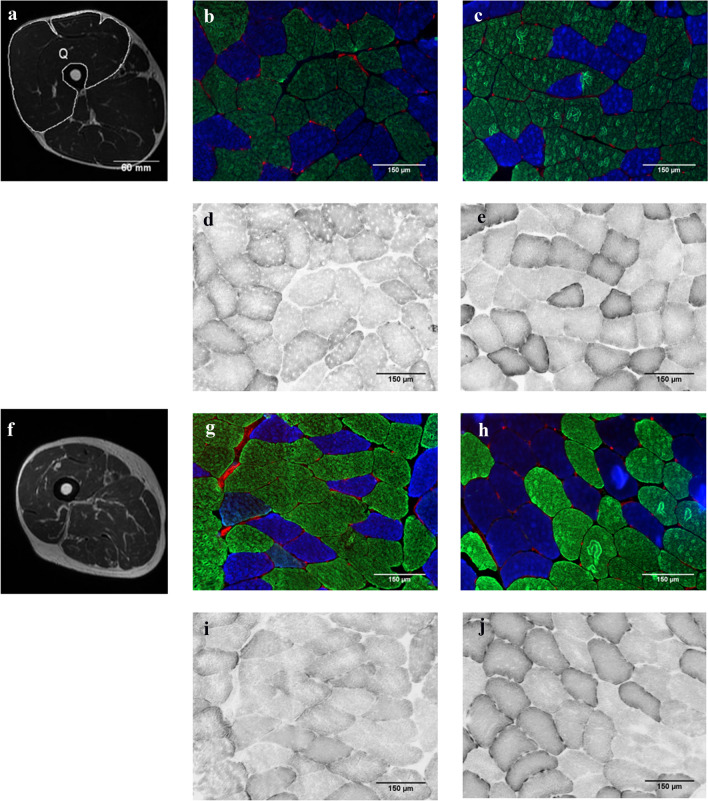
Fig. 1
Fig. 1
a and f show MRI scans from younger and older participants, respectively, of a left thigh at approximately 60% of femur length (from distal end) with labelled quadriceps muscles in the image of the younger participant (Q). b, c, g and h show muscle cross-sections from younger pre, younger post, older pre and older post, respectively, immuno-fluorescently stained for type I (blue fibres) and type II (green and non-stained fibres) fibres, and capillaries (stained red) stained with Rhodamine-labelled Ulex Europaeus Agglutinin I. d, e, i and j show serial sections of (b), (c), (g) and (h), respectively, all stained for succinate dehydrogenase activity
Fig. 2
Fig. 2
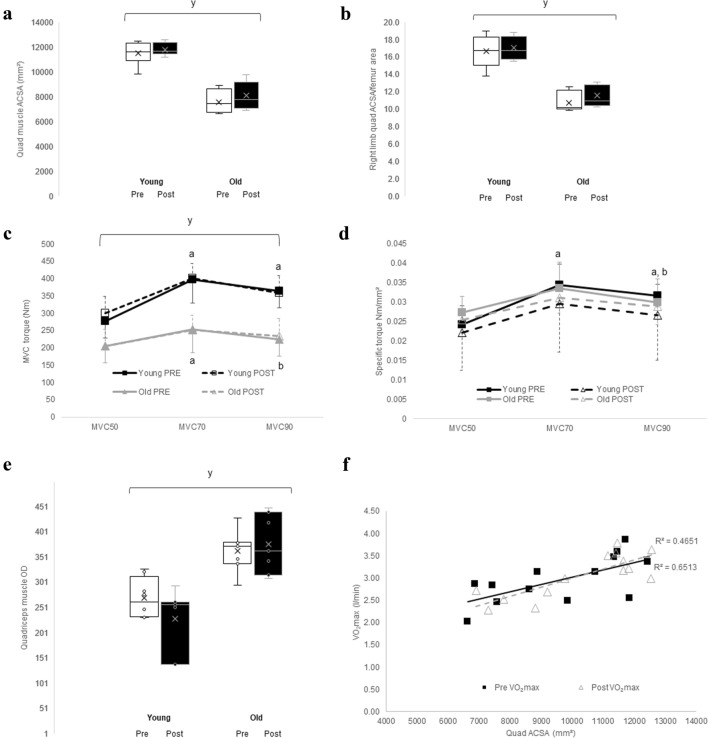
a Total quadriceps muscle anatomical cross-sectional area (ACSA) pre- and post-endurance training in young and old highly resistance-trained men. b Shows right quadriceps ACSA/femur area pre- and post-endurance exercise in young and old participants. c Shows maximal voluntary isometric contraction of knee extension (MVC) at 50, 70 and 90° (MVC50, MVC70 and MVC90, respectively) of young and old participants pre- and post-endurance exercise. d Shows the specific torque (MVC/quadriceps ACSA) of quadriceps muscles at MVC50, MVC70 and MVC90 for young and old participants pre- and post-endurance exercise. yIndicates a significant difference to young participants at p < 0.001; aindicates a significant difference to MVC50 at p ≤ 0.007. bIndicates a significant difference to MVC70 at p ≤ 0.002. e Shows the quadriceps muscle optical density (OD) in young and old highly resistance-trained men pre- and post-endurance exercise programme. f Shows the relationship between quadriceps anatomical cross-sectional area (ACSA) and maximal oxygen consumption (VO2max) pre- and post-endurance exercise. yIndicates a significant difference in OD compared to young subjects at p ≤ 0.03
Fig. 3
Fig. 3
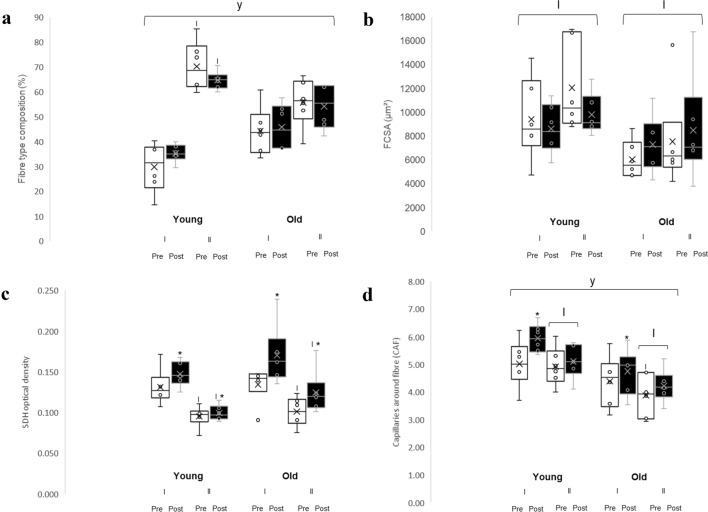
a Shows fibre type composition in the m. vastus lateralis from young and old highly resistance-trained men pre- and post-endurance exercise. b Shows fibre cross-sectional area (FCSA) for type I and type II fibres pre- and post-endurance exercise in young and old highly resistance-trained men. c Shows succinate dehydrogenase (SDH) staining optical density for type I and type II fibres pre- and post-endurance exercise in young and old participants. d Shows the capillaries around fibres (CAF) for type I and II fibres pre- and post-endurance exercise in young and old participants. *Indicates a training effect at p ≤ 0.043; yindicates a significant difference compared to young subjects at p ≤ 0.028; Iindicates a significant difference compared to type I fibres at p ≤ 0.041

References

    1. Andersen JL. Muscle fibre type adaptation in the elderly human muscle. Scand J Med Sci Sports. 2003;13(1):40–47. doi: 10.1034/j.1600-0838.2003.00299.x. - DOI - PubMed
    1. Baar K. Training for endurance and strength: lessons from cell signaling. Med Sci Sports Exerc. 2006;38(11):1939–1944. doi: 10.1249/01.mss.0000233799.62153.19. - DOI - PubMed
    1. Ballak SB, Buse-Pot T, Harding PJ, Yap MH, Deldicque L, de Haan A, Jaspers RT, Degens H. Blunted angiogenesis and hypertrophy are associated with increased fatigue resistance and unchanged aerobic capacity in old overloaded mouse muscle. Age (dordr) 2016;38(2):39. doi: 10.1007/s11357-016-9894-1. - DOI - PMC - PubMed
    1. Barnouin Y, McPhee JS, Butler-Browne G, Bosutti A, De Vito G, Jones DA, Narici M, Behin A, Hogrel JY, Degens H. Coupling between skeletal muscle fiber size and capillarization is maintained during healthy aging. J Cachexia Sarcopenia Muscle. 2017;8(4):647–659. doi: 10.1002/jcsm.12194. - DOI - PMC - PubMed
    1. Cadore EL, Pinto RS, Bottaro M, Izquierdo M. Strength and endurance training prescription in healthy and frail elderly. Aging Dis. 2014;5(3):183–195. doi: 10.14336/ad.2014.0500183. - DOI - PMC - PubMed

LinkOut - more resources