


The impact of artificial intelligence on clinical education: perceptions of postgraduate trainee doctors in London (UK) and recommendations for trainers
- PMID: 34391424
- PMCID: PMC8364021
- DOI: 10.1186/s12909-021-02870-x
The impact of artificial intelligence on clinical education: perceptions of postgraduate trainee doctors in London (UK) and recommendations for trainers
Abstract
Background: Artificial intelligence (AI) technologies are increasingly used in clinical practice. Although there is robust evidence that AI innovations can improve patient care, reduce clinicians' workload and increase efficiency, their impact on medical training and education remains unclear.
Methods: A survey of trainee doctors' perceived impact of AI technologies on clinical training and education was conducted at UK NHS postgraduate centers in London between October and December 2020. Impact assessment mirrored domains in training curricula such as 'clinical judgement', 'practical skills' and 'research and quality improvement skills'. Significance between Likert-type data was analysed using Fisher's exact test. Response variations between clinical specialities were analysed using k-modes clustering. Free-text responses were analysed by thematic analysis.
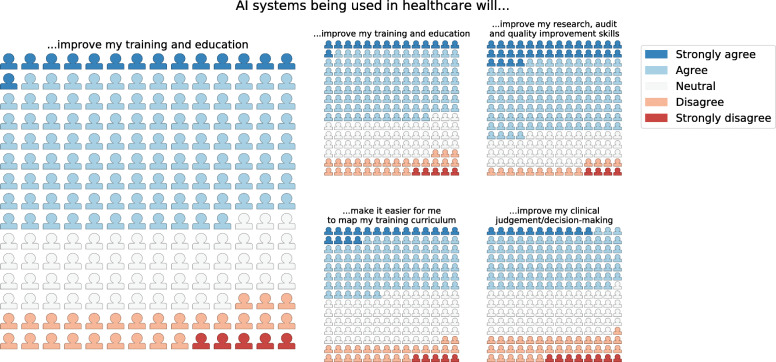
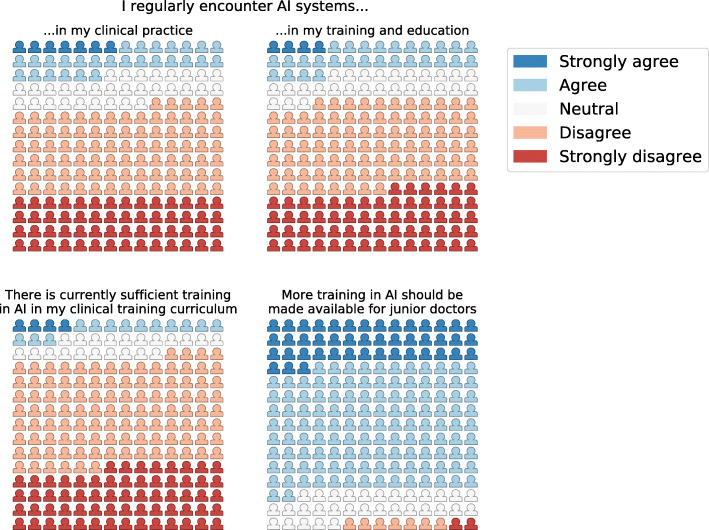
Results: Two hundred ten doctors responded to the survey (response rate 72%). The majority (58%) perceived an overall positive impact of AI technologies on their training and education. Respondents agreed that AI would reduce clinical workload (62%) and improve research and audit training (68%). Trainees were skeptical that it would improve clinical judgement (46% agree, p = 0.12) and practical skills training (32% agree, p < 0.01). The majority reported insufficient AI training in their current curricula (92%), and supported having more formal AI training (81%).
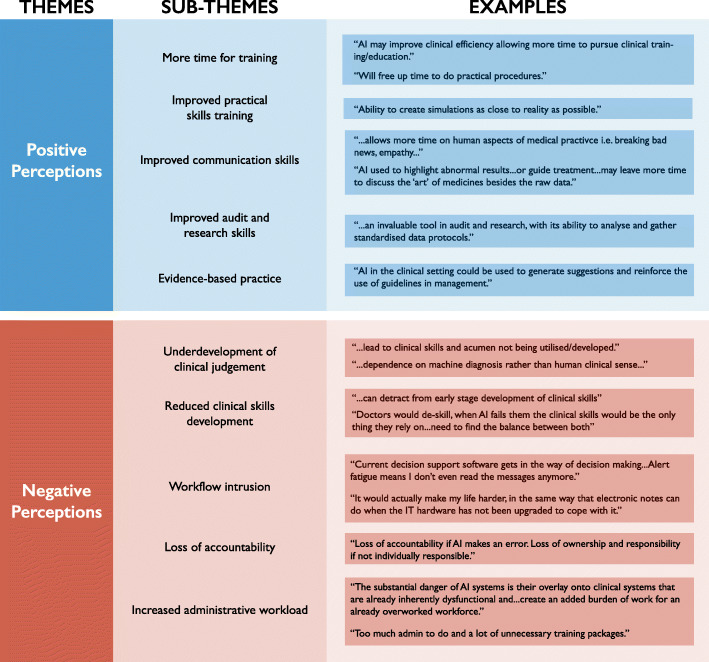
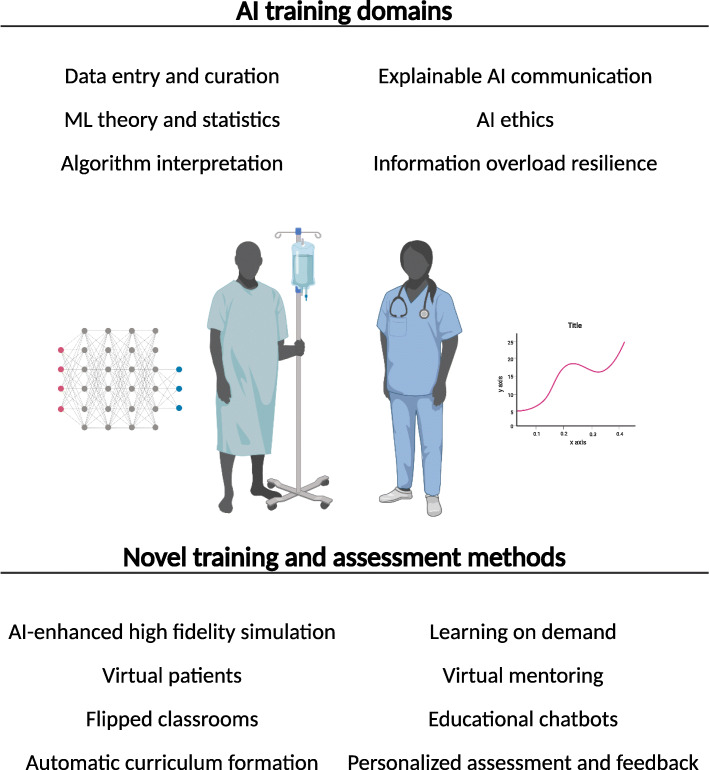
Conclusions: Trainee doctors have an overall positive perception of AI technologies' impact on clinical training. There is optimism that it will improve 'research and quality improvement' skills and facilitate 'curriculum mapping'. There is skepticism that it may reduce educational opportunities to develop 'clinical judgement' and 'practical skills'. Medical educators should be mindful that these domains are protected as AI develops. We recommend that 'Applied AI' topics are formalized in curricula and digital technologies leveraged to deliver clinical education.
Keywords: Artificial intelligence; Clinical training; Machine learning; Medical education.
© 2021. The Author(s).
Conflict of interest statement
The authors declare that they have no competing interests.
Figures
References
-
- Ross J, Webb C, Rahman F, AoRCM. Artificial Intelligence in Healthcare: Academy of Medical Royal Colleges; 2019. [cited 2020 Jan 12]. Available from: https://www.aomrc.org.uk/wp-content/uploads/2019/01/Artificial_intellige...
-
- Topol E. The Topol Review - preparing the healthcare workforce to deliver the digital future: NHS; 2019. [cited 2021 Jan 12]. Available from: https://topol.hee.nhs.uk/wp-content/uploads/HEE-Topol-Review-2019.pdf
-
- Joshi I, Morley J. Artificial Intelligence: How to get it right. Putting policy into practice for safe data-driven innovation in health and care: NHSX; 2019. [cited 2021 Jan 12]. Available from: https://www.nhsx.nhs.uk/media/documents/NHSX_AI_report.pdf
MeSH terms
LinkOut - more resources
Full Text Sources
