Review
. 2021 Sep;297(3):101077.
doi: 10.1016/j.jbc.2021.101077. Epub 2021 Aug 12.

Deubiquitinating enzymes (DUBs): Regulation, homeostasis, and oxidative stress response

Affiliations
Review

Deubiquitinating enzymes (DUBs): Regulation, homeostasis, and oxidative stress response

Nathan A Snyder et al. J Biol Chem. 2021 Sep.

Abstract

Ubiquitin signaling is a conserved, widespread, and dynamic process in which protein substrates are rapidly modified by ubiquitin to impact protein activity, localization, or stability. To regulate this process, deubiquitinating enzymes (DUBs) counter the signal induced by ubiquitin conjugases and ligases by removing ubiquitin from these substrates. Many DUBs selectively regulate physiological pathways employing conserved mechanisms of ubiquitin bond cleavage. DUB activity is highly regulated in dynamic environments through protein-protein interaction, posttranslational modification, and relocalization. The largest family of DUBs, cysteine proteases, are also sensitive to regulation by oxidative stress, as reactive oxygen species (ROS) directly modify the catalytic cysteine required for their enzymatic activity. Current research has implicated DUB activity in human diseases, including various cancers and neurodegenerative disorders. Due to their selectivity and functional roles, DUBs have become important targets for therapeutic development to treat these conditions. This review will discuss the main classes of DUBs and their regulatory mechanisms with a particular focus on DUB redox regulation and its physiological impact during oxidative stress.

Keywords: DUB; deubiquitination; enzymatic regulation; oxidative stress; redox signaling; translation; ubiquitin.


Conflict of interest statement

Conflict of interest The authors declare that they have no conflicts of interest with the contents of this article.

Figures
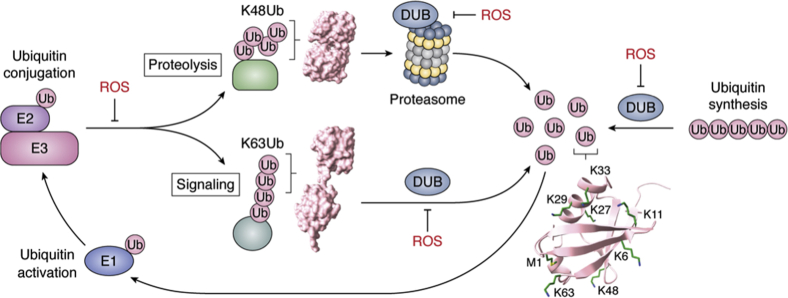
Figure 1
Figure 1
Cycle of ubiquitin signaling. Ubiquitin (ub) is synthesized as polymers or fusions of ribosomal proteins that are cleaved into ubiquitin monomers by deubiquitinating enzymes (DUBs). Ubiquitin monomers are then used by E1 ubiquitin-activating enzymes to charge E2 ubiquitin conjugases, which work with or without E3 ubiquitin ligases to attach ubiquitin to targets. The conformation of K-linked ubiquitin chains (e.g., K48 or K63) determines the fate of the targets, whether they undergo ubiquitin signaling, or if they are sent to the proteasome for degradation. In either case, DUBs are responsible for removal of the ubiquitin and replenishment of the ubiquitin monomer pool. Reactive oxygen species (ROS)-sensitive steps are labeled in red. Structures depicted include ubiquitin (PDB: 1UBQ), and representatives of two forms of di-ubiquitin, K48 (PDB: 3AUL) and K63 (PDB: 3H7P).
Figure 2
Figure 2
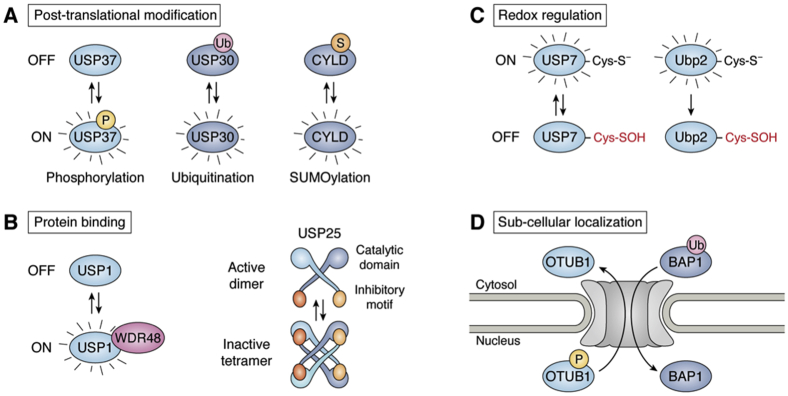
DUB regulatory mechanisms. Examples of posttranslational DUB regulatory mechanisms are depicted. These regulatory mechanisms include: (A) posttranslational modification (e.g., ubiquitination, SUMOylation, phosphorylation), (B) protein binding, (C) redox regulation, and (D) subcellular localization.
Figure 3
Figure 3
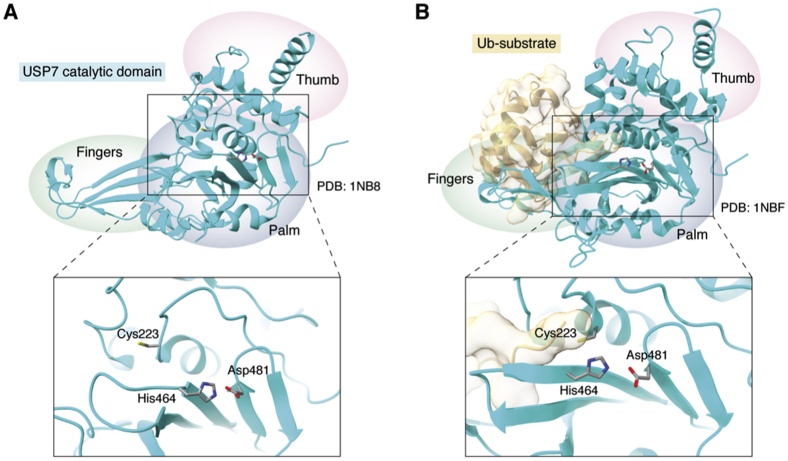
Conformations of cysteine proteases. Inactive (A, PDB: 1NB8) and active (B, PDB: 1NBF) conformations of the USP family cysteine protease USP7 are shown in cyan. Below are enlarged views of the catalytic triad positions. In the inactive state (A), the catalytic cysteine (Cys223) is positioned far from the other members of the catalytic triad (His464 and Asp481). This prevents the histidine from lowering the pKa to deprotonate the thiol of the cysteine and promote the active state. In the active state (B), USP7 is bound to a ubiquitin substrate, which induces a conformational shift that brings the catalytic cysteine closer to the other members of the catalytic triad, enabling its deprotonation into a reactive thiolate. In either case, the fingers domain (containing the ubiquitin interaction motif), as well as the palm and thumb domains (containing the catalytic center) are indicated.
Figure 4
Figure 4
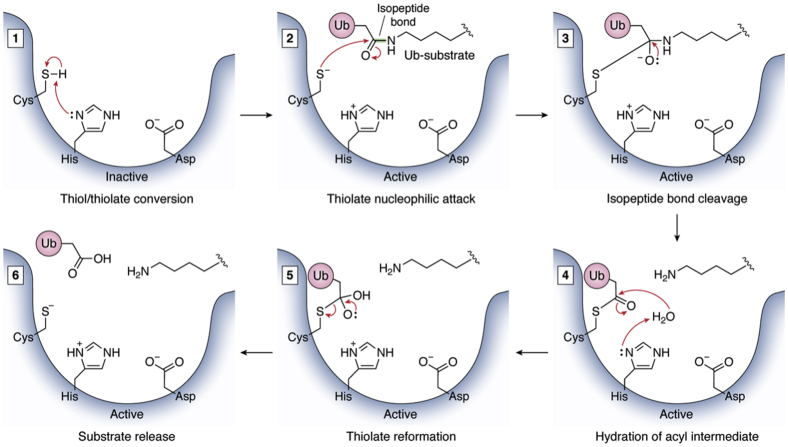
DUB cysteine protease catalytic mechanism. A generalized mechanism of cysteine protease DUBs is shown, including the three most common members of the catalytic triad (Cys, His, and Asp) and the isopeptide bond of the ubiquitinated substrate. The general steps of the mechanism are as follows: 1, the histidine, depolarized by the aspartate, deprotonates the cysteine, converting its side chain from an inactive thiol to a reactive thiolate. 2, the thiolate of cysteine undergoes a nucleophilic attack on the acyl group of the ubiquitin isopeptide bond, forming a tetrameric intermediate. 3, the isopeptide bond is cleaved as the amide group of the isopeptide bond deprotonates the DUB histidine, freeing the substrate from ubiquitin, which is still bound as an intermediate with the DUB cysteine. 4, hydration of the DUB cysteine acyl intermediate utilizing a water molecule to convert the acyl intermediate to a carboxyl intermediate. 5, the intermediate bond between the ubiquitin and DUB cysteine is broken, reforming the ubiquitin monomer and thiolate. 6, the ubiquitin monomer and substrate are released from the DUB.
Figure 5
Figure 5
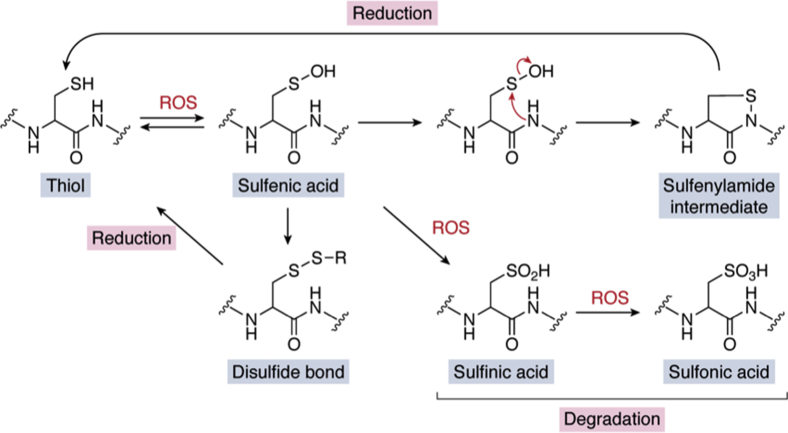
States of DUB cysteines during reversible and irreversible oxidation resulting from redox regulation. When subjected to reactive oxygen species (ROS), the catalytic cysteine of DUBs may be oxidized, converting the thiol/thiolate into different species. Primary oxidation reaction generates a reversible sulfenic acid. This reversibility can be stabilized by further conversion of the sulfenic acid into disulfide through hydrolysis with another cysteine thiol or through the generation of a sulfenylamide intermediate through a hydrolysis reaction with the amine group of the neighboring amino acid. Either of these states may be reduced to a thiol. In contrast, further oxidation of the sulfenic acid group results in the formation of irreversible sulfinic acid or sulfonic acid side chains, permanently inhibiting the DUB, requiring degradation of the oxidized DUB and de novo synthesis to reacquire activity.

References

    1. Watson D.C., Levy W.B., Dixon G.H. Free ubiquitin is a non-histone protein of trout testis chromatin. Nature. 1978;276:196–198. - PubMed
    1. Komander D., Rape M. The ubiquitin code. Annu. Rev. Biochem. 2012;81:203–229. - PubMed
    1. Kliza K., Husnjak K. Resolving the complexity of ubiquitin networks. Front. Mol. Biosci. 2020;7:21. - PMC - PubMed
    1. Callis J. The ubiquitination machinery of the ubiquitin system. Arabidopsis Book. 2014;12 - PMC - PubMed
    1. Dittmar G., Winklhofer K.F. Linear ubiquitin chains: Cellular functions and strategies for detection and quantification. Front. Chem. 2019;7:915. - PMC - PubMed

Publication types

LinkOut - more resources