


On the Efficiency of Haptic Based Object Identification: Determining Where to Grasp to Get the Most Distinguishing Information
- PMID: 34395537
- PMCID: PMC8358325
- DOI: 10.3389/frobt.2021.686490
On the Efficiency of Haptic Based Object Identification: Determining Where to Grasp to Get the Most Distinguishing Information
Abstract
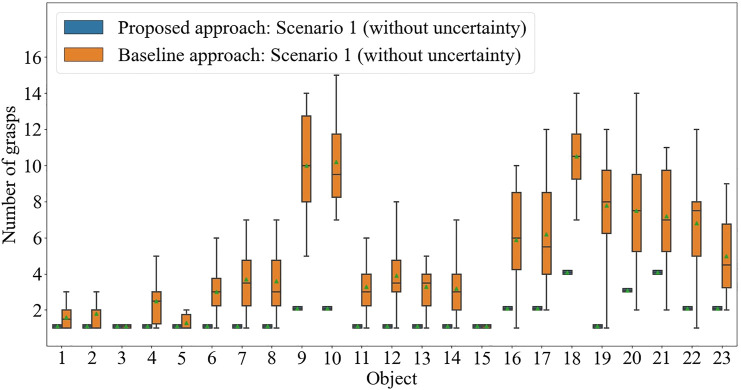
Haptic perception is one of the key modalities in obtaining physical information of objects and in object identification. Most existing literature focused on improving the accuracy of identification algorithms with less attention paid to the efficiency. This work aims to investigate the efficiency of haptic object identification to reduce the number of grasps required to correctly identify an object out of a given object set. Thus, in a case where multiple grasps are required to characterise an object, the proposed algorithm seeks to determine where the next grasp should be on the object to obtain the most amount of distinguishing information. As such, the paper proposes the construction of the object description that preserves the association of the spatial information and the haptic information on the object. A clustering technique is employed both to construct the description of the object in a data set and for the identification process. An information gain (IG) based method is then employed to determine which pose would yield the most distinguishing information among the remaining possible candidates in the object set to improve the efficiency of the identification process. This proposed algorithm is validated experimentally. A Reflex TakkTile robotic hand with integrated joint displacement and tactile sensors is used to perform both the data collection for the dataset and the object identification procedure. The proposed IG approach was found to require a significantly lower number of grasps to identify the objects compared to a baseline approach where the decision was made by random choice of grasps.
Keywords: clustering; haptic based object identification; identification efficiency; information gain; object description.
Copyright © 2021 Xia, Mohammadi, Tan, Chen, Choong and Oetomo.
Conflict of interest statement
The authors declare that the research was conducted in the absence of any commercial or financial relationships that could be construed as a potential conflict of interest.
Figures

References
-
- Bholowalia P., Kumar A. (2014). Ebk-Means: A Clustering Technique Based on Elbow Method and K-Means in Wsn. Int. J. Computer Appl. 105 (9), 17–24. 10.5120/18405-9674 - DOI
-
- Corradi T., Hall P., Iravani P. (2015). “Bayesian Tactile Object Recognition: Learning and Recognising Objects Using a New Inexpensive Tactile Sensor,” in Proceedings of IEEE International Conference on Robotics and Automation, Seattle, WA, IEEE, 3909–3914. 10.1109/icra.2015.7139744 - DOI
-
- Funabashi S., Morikuni S., Geier A., Schmitz A., Ogasa S., Torno T. P., et al. (2018). “Object Recognition through Active Sensing Using a Multi-Fingered Robot Hand with 3D Tactile Sensors,” in Proceedings of IEEE International Conference on Intelligent Robots and Systems, Madrid, Spain, IEEE, 2589–2595. 10.1109/iros.2018.8594159 - DOI
LinkOut - more resources
Full Text Sources
