


Editorial
doi: 10.1016/j.jaccao.2020.11.003.
eCollection 2020 Dec.
Implementation of Cardio-Oncology Training for Cardiology Fellows
Affiliations
- PMID: 34396296
- PMCID: PMC8352041
- DOI: 10.1016/j.jaccao.2020.11.003
Item in Clipboard
Editorial
Implementation of Cardio-Oncology Training for Cardiology Fellows
JACC CardioOncol.
.
No abstract available
Keywords: cardio-oncology; cardiology; fellowship training.
Conflict of interest statement
Dr. Yang has received research funding from CSL Behring. Dr. Moslehi has served a consultant for Bristol Myers Squibb, Takeda, Deciphera, AstraZeneca, Nektar, Audentes Therapeutics, TripleGene, Boston Biomedical, ImmunoCore, Janssen, and Myovant; and is supported by grants from the National Institutes of Health (R01HL144146 and R01HL155990). Dr. Hayek is supported by the National Heart, Lung, and Blood Institute (1R01HL153384-01). All other authors have reported that they have no relationships relevant to the contents of this paper to disclose.
Figures
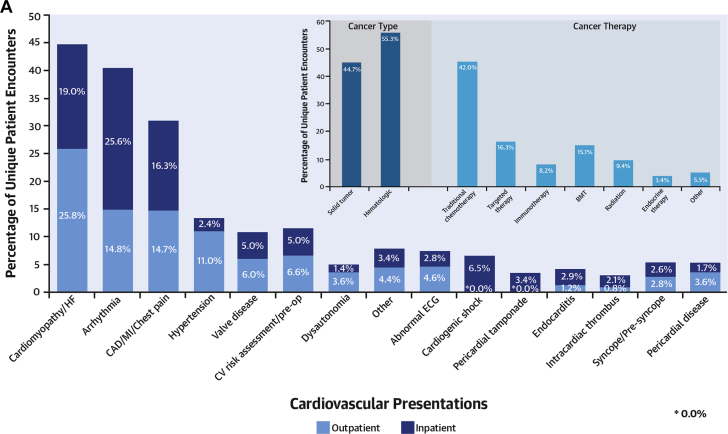
Characteristics of Cardio-Oncology Clinical Encounters During Training and a Proposed Timeline to Achieve Competency in Cardio-Oncology Training (A) Distribution of cardiovascular presentations, cancer type, and cancer therapy. Distribution of cardiovascular presentations seen during inpatient and outpatient encounters and the distribution of cancer type and therapy seen during outpatient encounters for 8 fellows at the Mayo Clinic, University of California Los Angeles, Emory University, Lahey Hospital and Medical Center, and The Ohio State University during cardio-oncology training in general cardiology fellowship. Percentages reflect the average percent contribution of each cardiovascular complaint, cancer type, and cancer therapy among all encounters across the 5 institutions. Trainees pursuing cardio-oncology training had a wide range of clinical exposures. (B) Cardio-oncology training sample roadmap. A proposed timeline of the roadmap to achieve level II and level III competency in cardio-oncology clinical care and research during general cardiology training (post-graduate years 4 to 6) and advanced training (post-graduate year 7). ACGME core competencies relevant to each training goal are listed in parentheses. BMT = bone marrow transplant; CAD = coronary artery disease; CHF = congestive heart failure; CT = computed tomography; CV = cardiovascular; ECG = electrocardiogram; EP = electrophysiology; HF = heart failure; ICS = interpersonal and communication skills; MI = myocardial infarction; MK = medical knowledge; MRI = magnetic resonance imaging; P = professionalism; PBLI = practice-based learning and improvement; PC = patient care; pre-op = pre-operative assessment; SBP = systems-based practice; TEE = transesophageal echocardiography.
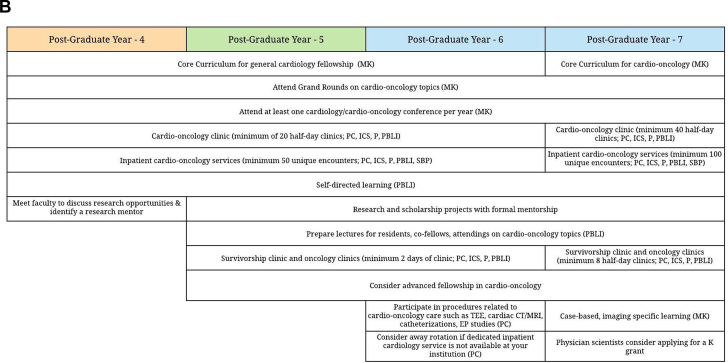
Characteristics of Cardio-Oncology Clinical Encounters During Training and a Proposed Timeline to Achieve Competency in Cardio-Oncology Training (A) Distribution of cardiovascular presentations, cancer type, and cancer therapy. Distribution of cardiovascular presentations seen during inpatient and outpatient encounters and the distribution of cancer type and therapy seen during outpatient encounters for 8 fellows at the Mayo Clinic, University of California Los Angeles, Emory University, Lahey Hospital and Medical Center, and The Ohio State University during cardio-oncology training in general cardiology fellowship. Percentages reflect the average percent contribution of each cardiovascular complaint, cancer type, and cancer therapy among all encounters across the 5 institutions. Trainees pursuing cardio-oncology training had a wide range of clinical exposures. (B) Cardio-oncology training sample roadmap. A proposed timeline of the roadmap to achieve level II and level III competency in cardio-oncology clinical care and research during general cardiology training (post-graduate years 4 to 6) and advanced training (post-graduate year 7). ACGME core competencies relevant to each training goal are listed in parentheses. BMT = bone marrow transplant; CAD = coronary artery disease; CHF = congestive heart failure; CT = computed tomography; CV = cardiovascular; ECG = electrocardiogram; EP = electrophysiology; HF = heart failure; ICS = interpersonal and communication skills; MI = myocardial infarction; MK = medical knowledge; MRI = magnetic resonance imaging; P = professionalism; PBLI = practice-based learning and improvement; PC = patient care; pre-op = pre-operative assessment; SBP = systems-based practice; TEE = transesophageal echocardiography.
References
-
- Miller K.D., Nogueira L., Mariotto A.B. Cancer treatment and survivorship statistics, 2019. CA Cancer J Clin. 2019;69:363–385. - PubMed
