. 2021 Jun 15;3(2):221-232.
doi: 10.1016/j.jaccao.2021.03.006. eCollection 2021 Jun.

Risk of Atrial Fibrillation According to Cancer Type: A Nationwide Population-Based Study

Affiliations

Risk of Atrial Fibrillation According to Cancer Type: A Nationwide Population-Based Study

Jun Pil Yun et al. JACC CardioOncol. .

Abstract

Background: Patients with cancer have an increased risk of atrial fibrillation (AF). However, there is a paucity of information regarding the association between cancer type and risk of AF.

Objectives: This study sought to evaluate the risk of AF according to the type of cancer.

Methods: We enrolled 816,811 patients who were diagnosed with cancer from the Korean National Health Insurance Service database between 2009 and 2016. Age- and sex-matched noncancer control subjects (1:2; n = 1,633,663) were also selected. Newly diagnosed AF was identified based on the type of cancer.

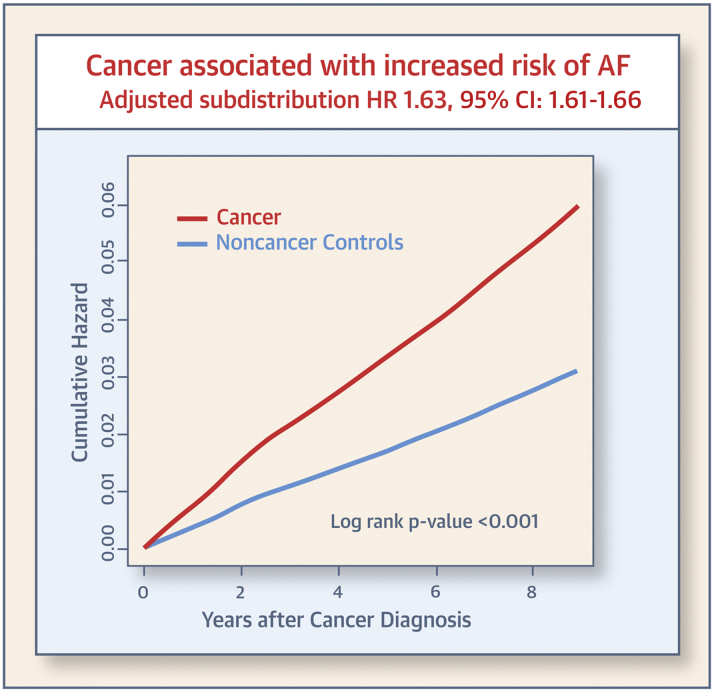
Results: During a median follow-up of 4.5 years, AF was newly diagnosed in 25,356 patients with cancer (6.6 per 1,000 person-years). In multivariable Fine and Gray's regression analysis, cancer was an independent risk factor for incident AF (adjusted subdistribution hazard ratio [aHR]: 1.63; 95% confidence interval [CI]: 1.61 to 1.66). Multiple myeloma showed a higher association with incident AF (aHR: 3.34; 95% CI: 2.98 to 3.75). Esophageal cancer showed the highest risk among solid cancers (aHR: 2.69; 95% CI: 2.45 to 2.95), and stomach cancer showed the lowest association with AF risk (aHR: 1.27; 95% CI 1.23 to 1.32).

Conclusions: Although patients with cancer were found to have a higher risk of AF, the impact on AF development varied by cancer type.

Keywords: AF, atrial fibrillation; CI, confidence interval; CKD, chronic kidney disease; CNS, central nervous system; CVD, cardiovascular disease; DM, diabetes mellitus; HR, hazard ratio; ICD-10, International Classification of Diseases–10th Revision; IQR, interquartile range; NHIS, National Health Insurance Service; atrial fibrillation; cancer; epidemiology; type of cancer.


Conflict of interest statement

This work was supported by the Korea Medical Device Development Fund grant funded by the Korean government (the Ministry of Science and ICT; the Ministry of Trade, Industry and Energy; the Ministry of Health and Welfare; the Ministry of Food and Drug Safety) (Project Number: 202013B14) and by the Korea National Research Foundation funded by the Ministry of Education, Science and Technology (grant 2020R1F1A106740). The authors have reported that they have no relationships relevant to the contents of this paper to disclose.

Figures

None
Graphical abstract
Figure 1
Figure 1
Flowchart of the Cohort Establishment and Follow-Up Patients who were newly diagnosed with cancer between 2009 and 2016 and had a health examination in the 2 years prior to cancer diagnosis were identified. Age- and sex-matched noncancer control subjects without prior history of atrial fibrillation (AF) were also selected. Incident AF events were monitored until December 2017.
Figure 2
Figure 2
Cumulative Hazard of AF According to the Diagnosis of Cancer Age- and sex-adjusted Kaplan–Meier curves with cumulative hazard of atrial fibrillation (AF). Patients with cancer show a consistently higher incidence of AF compared with noncancer control subjects. CI = confidence interval; HR = hazard ratio.
Central Illustration
AF Risk According to Cancer, as Compared With Noncancer Control Subjects, and Cancer Type 816,811 patients who were diagnosed with cancer from the Korean National Health Insurance Service database between 2009 and 2016 were compared to 1,633,663 age-and sex-matched non-cancer control subjects (1:2). In multivariable Fine and Gray’s regression analysis, cancer was an independent risk factor for incident AF (adjusted subdistribution hazard ratio [aHR]: 1.63; 95% confidence interval [CI]: 1.61 to 1.66). All types of cancer show an increased risk of AF compared with the control group, but the risk of AF varied depending on the type of cancer. Death was considered a competing risk in Fine and Gray’s competing risk regression models. The time to event for subjects having AF presented as the median (years). ∗Per 1000 person-years. Adjusted for age, sex, smoking, drinking, regular exercise, socioeconomic status, diabetes mellitus, hypertension, dyslipidemia, BMI, and chronic kidney disease.
Figure 3
Figure 3
Subgroup Analysis for AF Risk in Patients With Cancer Patients with cancer showed a consistently higher risk of developing AF, regardless of the subgroup statement. Death was considered a competing risk in Fine and Gray’s competing risk regression models. ∗Per 1,000 person-years. †Adjusted for age, sex, smoking, drinking, regular exercise, socioeconomic status, diabetes mellitus (DM), hypertension, dyslipidemia, body mass index (BMI), and chronic kidney disease (CKD). CI = confidence interval; other abbreviations as in Figure 2.
Figure 4
Figure 4
AF Incidence According to the Type of Cancer and Age (A) Atrial fibrillation (AF) incidence according to age in patients with hematologic malignancies; (B) AF incidence according to age in patients with major solid malignancies. In A, multiple myeloma showed the highest incidence of AF in the >35 years of age group and a steep rise with increasing age. In B, lung cancer showed the highest AF incidence in the >50 years of age group, and liver cancer showed the highest AF incidence in the <50 years of age group.

References

    1. Jemal A., Ward E.M., Johnson C.J. Annual Report to the Nation on the Status of Cancer, 1975-2014, Featuring Survival. J Natl Cancer Inst. 2017;109:djx030. - PMC - PubMed
    1. Bluethmann S.M., Mariotto A.B., Rowland J.H. Anticipating the “silver tsunami”: prevalence trajectories and comorbidity burden among older cancer survivors in the United States. Cancer Epidemiol Biomarkers Prev. 2016;25:1029–1036. - PMC - PubMed
    1. Mertens A.C., Liu Q., Neglia J.P. Cause-specific late mortality among 5-year survivors of childhood cancer: the Childhood Cancer Survivor Study. J Natl Cancer Inst. 2008;100:1368–1379. - PMC - PubMed
    1. Okwuosa T.M., Anzevino S., Rao R. Cardiovascular disease in cancer survivors. Postgrad Med J. 2017;93:82–90. - PubMed
    1. Vincent L., Leedy D., Masri S.C., Cheng R.K. Cardiovascular disease and cancer: is there increasing overlap? Curr Oncol Rep. 2019;21:47. - PubMed

LinkOut - more resources