


Early Cardiac Toxicity Associated With Post-Transplant Cyclophosphamide in Allogeneic Stem Cell Transplantation
- PMID: 34396331
- PMCID: PMC8352028
- DOI: 10.1016/j.jaccao.2021.02.011
Early Cardiac Toxicity Associated With Post-Transplant Cyclophosphamide in Allogeneic Stem Cell Transplantation
Abstract
Background: Post-transplant cyclophosphamide (PT-Cy) has become a standard of care in haploidentical hematopoietic stem cell transplantation (HSCT) to reduce the risk of graft-versus-host disease. However, data on cardiac events associated with PT-Cy are scarce.
Objectives: This study sought to assess the incidence and clinical features of cardiac events associated with PT-Cy.
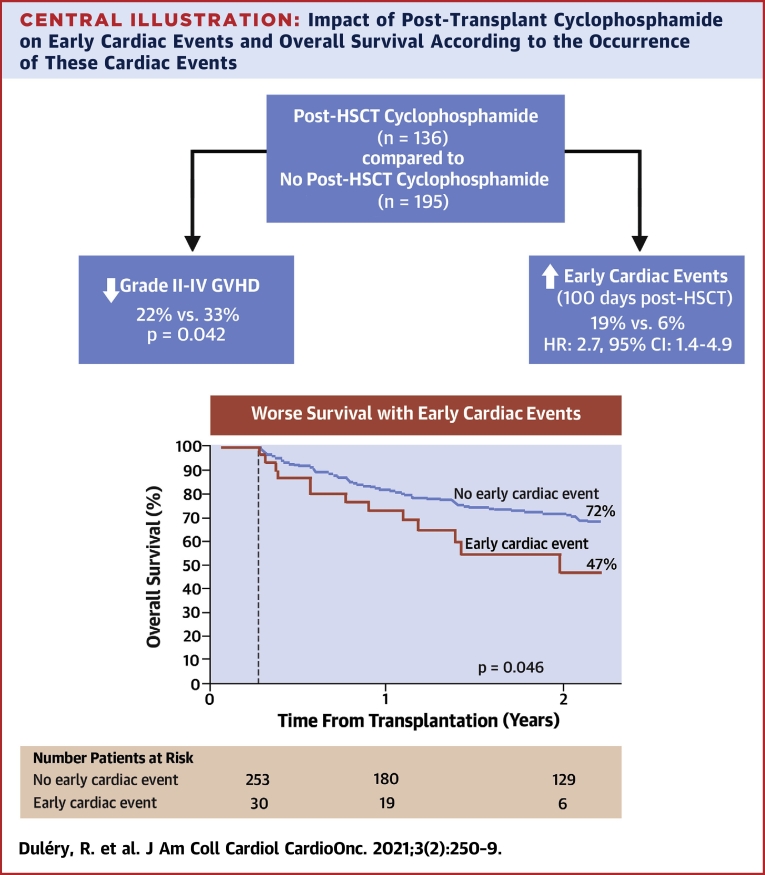
Methods: The study compared clinical outcomes between patients who received PT-Cy (n = 136) and patients who did not (n = 195), with a focus on early cardiac events (ECE) occurring within the first 100 days after HSCT. All patients had the same systematic cardiac monitoring.
Results: The cumulative incidence of ECE was 19% in the PT-Cy group and 6% in the no-PT-Cy group (p < 0.001). The main ECE occurring after PT-Cy were left ventricular systolic dysfunction (13%), acute pulmonary edema (7%), pericarditis (4%), arrhythmia (3%), and acute coronary syndrome (2%). Cardiovascular risk factors were not associated with ECE. In multivariable analysis, the use of PT-Cy was associated with ECE (hazard ratio: 2.7; 95% confidence interval: 1.4 to 4.9; p = 0.002]. Older age, sequential conditioning regimen, and Cy exposure before HSCT were also associated with a higher incidence of ECE. Finally, a history of cardiac events before HSCT and ECE had a detrimental impact on overall survival.
Conclusions: PT-Cy is associated with a higher incidence of ECE occurring within the first 100 days after HSCT. Patients who have a cardiac event after HSCT have lower overall survival. These results may help to improve the selection of patients who are eligible to undergo HSCT with PT-Cy, especially older adult patients and patients with previous exposure to Cy.
Keywords: CI, confidence interval; CVD, cardiovascular disease; CVRF, cardiovascular risk factor; Cy, cyclophosphamide; ECE, early cardiac events; GRFS, graft-versus-host disease-free, relapse-free survival; GVHD, graft-versus-host disease; HR, hazard ratio; HSCT, hematopoietic stem cell transplantation; LVEF, left ventricular ejection fraction; LVSD, left ventricular systolic dysfunction; PT-Cy, post-transplant cyclophosphamide; allogeneic stem cell transplantation; cardiotoxicity; haploidentical transplantation; left ventricular systolic dysfunction; post-transplant cyclophosphamide.
© 2021 The Authors.
Conflict of interest statement
This study was supported by the Association for Training, Education and Research in Hematology, Immunology, and Transplantation (ATERHIT). Drs. Duléry, Mohty, and Malard have received honoraria for lectures from Keocyt and Sanofi, whose drugs were included in this study. All other authors have reported that they have no relationships relevant to the contents of this paper to disclose.
Figures
References
-
- Bashey A., Zhang X., Jackson K. Comparison of outcomes of hematopoietic cell transplants from T-replete haploidentical donors using post-transplantation cyclophosphamide with 10 of 10 HLA-A, -B, -C, -DRB1, and -DQB1 allele-matched unrelated donors and HLA-identical sibling donors: a multivariable analysis including disease risk index. Biol Blood Marrow Transplant. 2016;22:125–133. - PubMed
-
- Raiola A.M., Dominietto A., di Grazia C. Unmanipulated haploidentical transplants compared with other alternative donors and matched sibling grafts. Biol Blood Marrow Transplant. 2014;20:1573–1579. - PubMed
-
- Ringdén O., Labopin M., Ciceri F. Is there a stronger graft-versus-leukemia effect using HLA-haploidentical donors compared with HLA-identical siblings? Leukemia. 2016;30:447–455. - PubMed
-
- Ruggeri A., Labopin M., Sanz G. Comparison of outcomes after unrelated cord blood and unmanipulated haploidentical stem cell transplantation in adults with acute leukemia. Leukemia. 2015;29:1891–1900. - PubMed
LinkOut - more resources
Full Text Sources
