


Gonococcal Pelvic Inflammatory Disease: Placing Mechanistic Insights Into the Context of Clinical and Epidemiological Observations
- PMID: 34396410
- PMCID: PMC8365115
- DOI: 10.1093/infdis/jiab227
Gonococcal Pelvic Inflammatory Disease: Placing Mechanistic Insights Into the Context of Clinical and Epidemiological Observations
Abstract
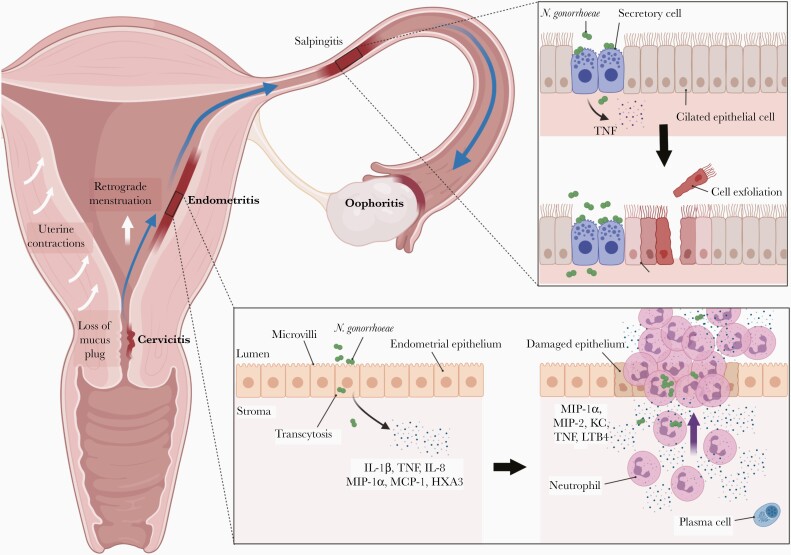
While infection by Neisseria gonorrhoeae is often asymptomatic in women, undetected infections can ascend into the upper genital tract to elicit an inflammatory response that manifests as pelvic inflammatory disease, with the outcomes depending on the intensity and duration of inflammation and whether it is localized to the endometrial, fallopian tube, ovarian, and/or other tissues. This review examines the contribution of N. gonorrhoeae versus other potential causes of pelvic inflammatory disease by considering new insights gained through molecular, immunological, and microbiome-based analyses, and the current epidemiological burden of infection, with an aim to highlighting key areas for future study.
Keywords: Neisseria gonorrhoeae; cervicitis; endometrial infection; endometritis; gonorrhea; neutrophil; oophoritis; pelvic inflammatory disease (PID); salpingitis.
© The Author(s) 2021. Published by Oxford University Press for the Infectious Diseases Society of America. All rights reserved. For permissions, e-mail: journals.permissions@oup.com.
Figures
References
-
- Hook EW 3rd, Holmes KK. Gonococcal infections. Ann Intern Med 1985; 102:229–43. - PubMed
-
- Paavonen J, Westrõm L, Eschenbach D. Pelvic inflammatory disease. In: Holmes KK, Sparling FP, Stamm WE, et al., eds. Sexually Transmitted Diseases. 4th ed. New York, NY: McGraw-Hill; 2008.
-
- Brunham RC, Gottlieb SL, Paavonen J. Pelvic inflammatory disease. N Engl J Med 2015; 372:2039–48. - PubMed
-
- Cohen MS, Cannon JG. Human experimentation with Neisseria gonorrhoeae: progress and goals. J Infect Dis 1999; 179(suppl 2):S375–9. - PubMed
-
- Mårdh PA. An overview of infectious agents of salpingitis, their biology, and recent advances in methods of detection. Am J Obstet Gynecol 1980; 138:933–51. - PubMed
Publication types
MeSH terms
Grants and funding
LinkOut - more resources
Full Text Sources
Medical
