Review
. 2021 Aug 27;49(4):1881-1890.
doi: 10.1042/BST20210840.

Organ-on-chip applications in drug discovery: an end user perspective

Affiliations
Review

Organ-on-chip applications in drug discovery: an end user perspective

Naomi Clapp et al. Biochem Soc Trans. .

Abstract

Organ-on-chip (OoC) systems are in vitro microfluidic models that mimic the microstructures, functions and physiochemical environments of whole living organs more accurately than two-dimensional models. While still in their infancy, OoCs are expected to bring ground-breaking benefits to a myriad of applications, enabling more human-relevant candidate drug efficacy and toxicity studies, and providing greater insights into mechanisms of human disease. Here, we explore a selection of applications of OoC systems. The future directions and scope of implementing OoCs across the drug discovery process are also discussed.

Keywords: drug development; drug discovery; microfluidic models; organ-on-a-chip.


Conflict of interest statement

The authors declare that there are no competing interests associated with the manuscript.

Figures
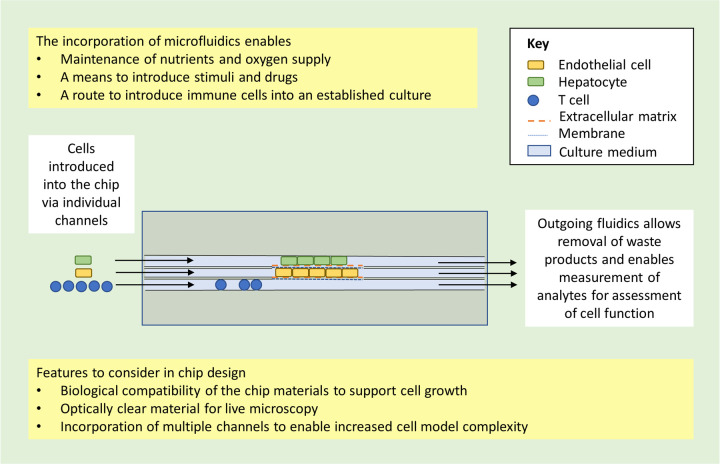
Figure 1.
Figure 1.. Schematic diagram depicting an example of a basic liver-on-chip model as a representative organ-on-chip (OoC).
The active flow within the channel of a chip enables cells to be perfused with media containing oxygen and nutrients (inlet) and the removal of waste products and the sampling of metabolites for assessment of cell function (outlet). This schematic is for illustrative purposes only and does not represent any particular existing OoC model or all possible types of OoC models. It is intended to exemplify some of the basic bioengineering principles required for the development of an OoC unit.
Figure 2.
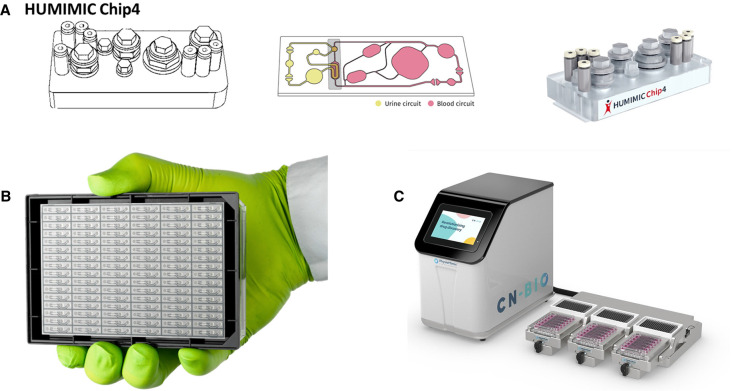
Figure 2.. Examples of commercialised organ-on-chip (OoC) systems.
(A) The HUMINIC chip 4 manufactured by Tissuse. (B) The OrganoPlate® 2-lane 96 manufactured by MIMETAS. (C) The PhysioMimix™ OoC manufactured by CN-Bio. The pictures are reprinted courtesy of the manufacturers and with their permission.
Figure 3.
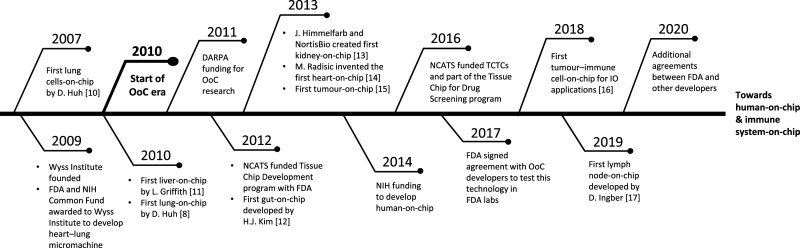
Figure 3.. Timeline for the evolution of organ-on-chip (OoC).
The first OoC model to accomplish organ-level functionality, tissue–tissue interactions and a physiologically relevant organ microenvironment with vascular perfusion came in 2007 as a lung-on-chip by Huh et al. Since then, funding from organisations such as DARPA and NIH, and the founding of Wyss Institute, has propelled OoC technology from a nascent idea to a rapidly growing area of research with potential for utility across the drug discovery process. DARPA, Defence Advanced Research Projects Agency; FDA, US Food and Drug Administration; IO, immuno-oncology; MEM, micro electromechanical system; microTAS; miniaturised total chemical analysis system; NIH, National Institute of Health; PDMS, polydimethylsiloxane; TCTCs, Tissue Chip Testing Centers.

References

    1. Wouters, O.J., McKee, M. and Luyten, J. (2020) Estimated research and development investment needed to bring a new medicine to market, 2009–2018. J.Am. Med. Assoc. 323, 844–853 10.1001/jama.2020.1166 - DOI - PMC - PubMed
    1. Seyhan, A.A. (2019) Lost in translation: the valley of death across preclinical and clinical divide – identification of problems and overcoming obstacles. Transl. Med. Commun. 4, 18 10.1186/s41231-019-0050-7 - DOI
    1. Cavero, I., Guillon, J.M. and Holzgrefe, H.H. (2019) Human organotypic bioconstructs from organ-on-chip devices for human-predictive biological insights on drug candidates. Expert Opin. Drug Saf. 18, 651–677 10.1080/14740338.2019.1634689 - DOI - PubMed
    1. Mittal, R., Woo, F.W., Castro, C.S., Cohen, M.A., Karanxha, J., Mittal, J.et al. (2019) Organ-on-chip models: implications in drug discovery and clinical applications. J. Cell. Physiol. 234, 8352–8380 10.1002/jcp.27729 - DOI - PubMed
    1. Kimura, H., Sakai, Y. and Fujii, T. (2018) Organ/body-on-a-chip based on microfluidic technology for drug discovery. Drug Metab. Pharmacokinet. 33, 43–48 10.1016/j.dmpk.2017.11.003 - DOI - PubMed