Review
. 2021 Oct;78(19-20):6395-6408.
doi: 10.1007/s00018-021-03912-9. Epub 2021 Aug 16.

Signals for antigen-independent differentiation of memory CD8+ T cells

Affiliations
Review

Signals for antigen-independent differentiation of memory CD8+ T cells

Eliza Mari Kwesi-Maliepaard et al. Cell Mol Life Sci. 2021 Oct.

Abstract

Conventional CD8+ memory T cells develop upon stimulation with foreign antigen and provide increased protection upon re-challenge. Over the past two decades, new subsets of CD8+ T cells have been identified that acquire memory features independently of antigen exposure. These antigen-inexperienced memory T cells (TAIM) are described under several names including innate memory, virtual memory, and memory phenotype. TAIM cells exhibit characteristics of conventional or true memory cells, including antigen-specific responses. In addition, they show responsiveness to innate stimuli and have been suggested to provide additional levels of protection toward infections and cancer. Here, we discuss the current understanding of TAIM cells, focusing on extrinsic and intrinsic molecular conditions that favor their development, their molecular definitions and immunological properties, as well as their transcriptional and epigenetic regulation.

Keywords: Antigen-inexperienced memory; CD8+ T cell; Innate memory; Virtual memory.


Conflict of interest statement

The authors declare no conflict of interest.

Figures
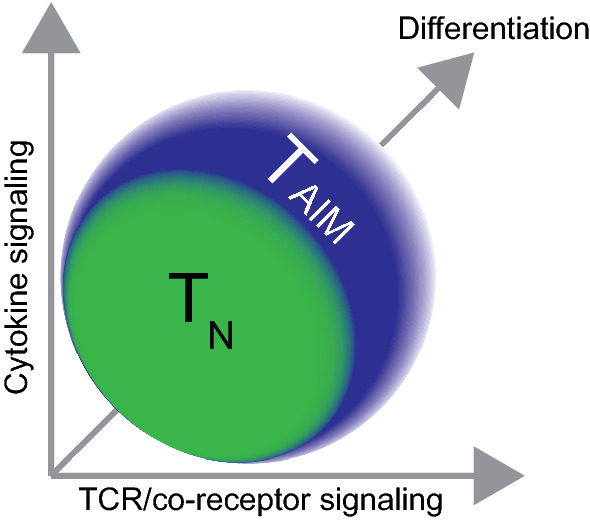
Fig. 1
Fig. 1
Antigen-inexperienced memory T cell (TAIM) differentiation: A delicate balance of integrated signaling. The quality of TCR/co-receptor and cytokine signals are central to TAIM differentiation. Cytokines most important for TAIM cells are IL-4 in the thymus and IL-15 in the periphery. Ablation of these cytokines or their receptors leads to a strong reduction in the number of TAIM cells. The balance between cytokine and TCR signals determines whether a CD8+ T cell remains naïve (TN) or differentiates into a TAIM cell. The TCR and cytokine signals lead to altered transcriptional output, which is further modulated by epigenetic mechanisms. The extracellular signals, and fluctuations in expression of genes involved in these signaling pathways due to transcription dynamics, as well as differentiation and proliferation together affect TAIM differentiation. The net result is a dynamic population of TAIM cells in mouse and humans
Fig. 2
Fig. 2
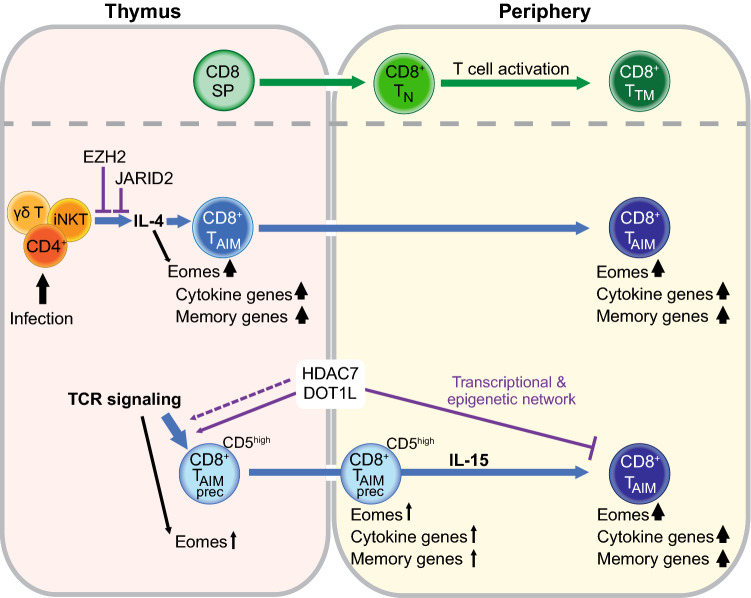
A model of TAIM differentiation regulators. During conventional CD8+ T cell differentiation CD8 single positive (CD8 SP) thymocytes exit the thymus and enter the periphery as naïve (TN) CD8+ cells. Upon encountering a foreign antigen presented on the MHC class I complex of an antigen-presenting cells, TN cells become activated and differentiate into short-lived effector and long-lived true memory (TTM) cells. TTM cells provide a rapid immune response when re-activated, thereby ensuring an effective secondary immune response. In addition to the conventional TTM cells, memory-phenotype cells also arise in an antigen-independent manner. The differentiation of the antigen-inexperienced memory T cells (TAIM) is guided by two main signals: cytokines and T cell receptor (TCR) signaling. Increased IL-4 levels in the thymus, either as a result of infection, or strain specific, or caused by deletion of the epigenetic modulator EZH2 or JARID2, induces TAIM differentiation in CD8 SP thymocytes. These cells have increased expression of cytokine genes and memory genes, including the key transcription factor EOMES. EOMES expression can also be upregulated directly by IL-4. A specific level of heightened TCR signaling also affects EOMES expression and results in the upregulation of CD5 on naïve CD8 single positive thymocytes that are more prone to become TAIM cells. Upon migration to the periphery, these CD5high cells already express mildly increased levels of cytokine genes and memory genes. IL-15 signaling further drives these cells to become TAIM cells. The histone modifiers DOT1L and HDAC7 prevent TAIM differentiation by regulating transcriptional and epigenetic networks that keep cells in a naïve state. Furthermore, DOT1L and, possibly also, HDAC7 are involved in regulating TCR signaling

References

    1. Kaech SM, Wherry EJ, Ahmed R. Effector and memory T-cell differentiation: implications for vaccine development. Nat Rev Immunol. 2002;2:251–262. doi: 10.1038/nri778. - DOI - PubMed
    1. Sallusto F, Geginat J, Lanzavecchia A. Central memory and effector memory T cell subsets: Function, generation, and maintenance. Annu Rev Immunol. 2004;22:745–763. doi: 10.1146/annurev.immunol.22.012703.104702. - DOI - PubMed
    1. White JT, Cross EW, Kedl RM. Antigen-inexperienced memory CD8+ T cells: where they come from and why we need them. Nat Rev Immunol. 2017;17:391–400. doi: 10.1038/nri.2017.34. - DOI - PMC - PubMed
    1. Thiele D, La Gruta N, Nguyen A, Hussain T. Hiding in plain sight: virtually unrecognizable memory phenotype CD8+ T cells. Int J Mol Sci. 2020;21:8626. doi: 10.3390/ijms21228626. - DOI - PMC - PubMed
    1. Jameson SC, Lee YJ, Hogquist KA. Innate memory T cells. Adv Immunol. 2015;126:173–213. doi: 10.1016/bs.ai.2014.12.001. - DOI - PMC - PubMed