Review
. 2021 Nov;190(1):19-38.
doi: 10.1007/s10549-021-06356-8. Epub 2021 Aug 16.

Turning scientific serendipity into discoveries in breast cancer research and treatment: a tale of PhD students and a 50-year roaming tamoxifen team

Affiliations
Review

Turning scientific serendipity into discoveries in breast cancer research and treatment: a tale of PhD students and a 50-year roaming tamoxifen team

V Craig Jordan. Breast Cancer Res Treat. 2021 Nov.

Abstract

Purpose: This retrospective, about a single "mobile" laboratory in six locations on two continents, is intended as a case study in discovery for trainees and junior faculty in the medical sciences. Your knowledge of your topic is necessary to expect the unexpected.

Historical method: In 1972, there was no tamoxifen, only ICI 46, 474, a non-steroidal anti-estrogen with little chance of clinical development. No one would ever be foolish enough to predict that the medicine, 20 years later, would achieve legendary status as the first targeted treatment for breast cancer, and millions of women would benefit from long-term adjuvant tamoxifen therapy. The secret of tamoxifen's success was a translational research strategy proposed in the mid 1970's. This strategy was to treat only patients with estrogen receptor (ER)-positive breast cancer and deploy 5 or more years of adjuvant tamoxifen therapy to prevent recurrence. Additionally, tamoxifen prevented mammary cancer in animals. Could the medicine prevent breast cancer in women?

Results: Tamoxifen and the failed breast cancer drug raloxifene became the first selective estrogen receptor modulators (SERMs): a new drug group, discovered at the University of Wisconsin, Comprehensive Cancer Center. Serendipity can play a fundamental role in discovery, but there must be a rigorous preparation for the investigator to appreciate the possibility of a pending discovery. This article follows the unanticipated discoveries when PhD students "get the wrong answer." The secret of success of my six Tamoxifen Teams was their technical excellence to create models, to decipher mechanisms, that drove the development of new medicines. Discoveries are listed that either changed women's health or allowed an understanding of originally opaque mechanisms of action of potential therapies. These advances in women's health were supported entirely by government-sponsored peer-reviewed funding and major philanthropy from the Lynn Sage Breast Cancer Foundation, the Avon Foundation, and the Susan G. Komen Breast Cancer Foundation. The resulting lives saved or extended, families aided in a time of crisis and the injection of billions of dollars into national economies by drug development, is proof of the value of Federal or philanthropic investment into unencumbered research aimed at saving millions of lives.

Keywords: Estrogen receptor; Raloxifene; Selective estrogen receptor modulators; Tamoxifen; Women’s Health Initiative.


Conflict of interest statement

The author declares that he has no conflicts of interest.

Figures
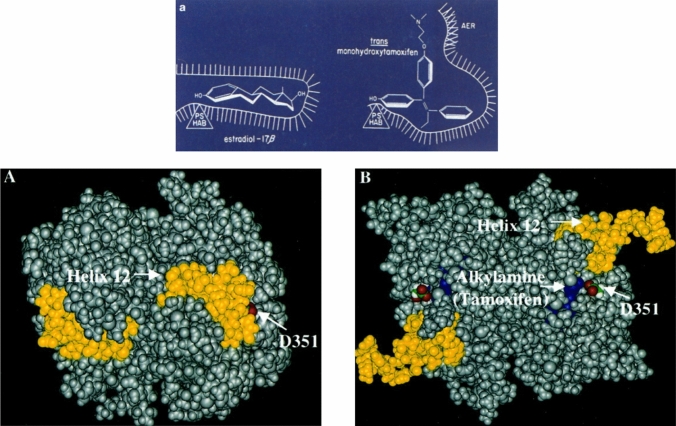
Fig. 1
Fig. 1
Top: The “crocodile model” of antiestrogen action of 4-hydroxytamoxifen [41, 48] and the side antiestrogenic chain interaction with the antiestrogenic region (AER) of the ER. Early work by Lednicer in the 1960s [161] concluded “that the presence of a basic group at a given position in space is required to obtain a molecule, which will antagonize the effects of concurrent estrogen administration.” The finding that the oxygen in the basic side chain can be replaced by a methylene group created compounds, which show the same potency as both antifertility agents and estrogen antagonists bolster the hypothesis. However, the introduction of ring methyl groups into triphenylethylene and triphenylethane antiestrogens ortho to the alkylaminoethoxy side chain is disadvantageous. This suggests that the side chain cannot be inhibited from rotation [162]. a from [41] and A, B from [106] with copy right permission
Fig. 2
Fig. 2
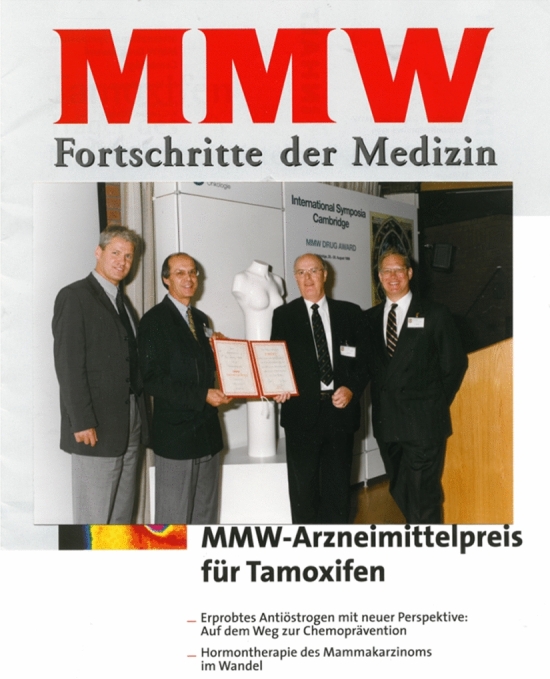
Tamoxifen recognized, August 1999, by the German MMW Drug Award. To celebrate this singular achievement for tamoxifen, Dr. Jordan was invited to organize and chair a three-day medical meeting for German physicians at the University of Cambridge, UK. The speakers in alphabetical order were M Baum, W. Eierman, B. Fisher, H.S. Füessl, W. Jonat, V.C. Jordan, M. Kaufman, and C.K. Osborne. Drs Ian Jackson (Zeneca) and V. Craig Jordan accepted the Award on behalf of AstraZeneca. By coincidence, on the day of his arrival in Cambridge, Dr. Jordan was contacted by the President of Northwestern University, Henry Binnen, to be told he was to be awarded the inaugural personal endowed chair: the Diana, Princess of Wales, Professor of Cancer Research, by Northwestern University
Fig. 3
Fig. 3
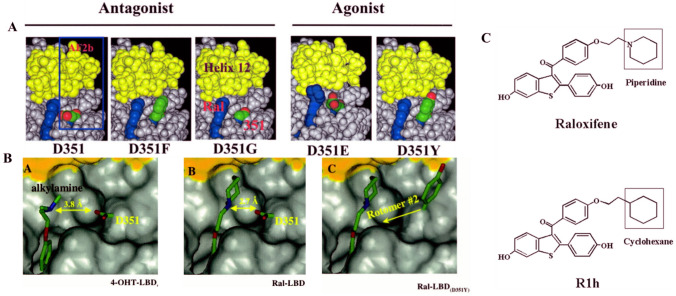
Prior to the resolution of the ligand-binding domain of the ER with either raloxifene [81] or 4-hydroxytamoxifen [80], we had identified amino acid Asp351 in the ER as the AER, i.e., the amino acid that interacts with the antiestrogenic side chain of raloxifene [103, 104]. This was followed by structure–function analyses of the ER complexes with mutations substituted at Asp351 (panels A). These were classified as retaining antiestrogenic properties or changing their actions to be estrogens (agonists). Panel 3A: Surface structures around amino acid 351 of raloxifene-bound LBDs of ERα. A structural model of dimeric human ERα bound to raloxifene was derived from the Protein Data Bank (code 1ERR) by removing all water molecules with the exception of the ordered water-forming H-bond with the O3 of raloxifene, adding hydrogens and minimizing in the consistent valence force field (CVFF) using Discover (Accelrys, San Diego, CA). Mutant receptors were constructed using Biopolymer (Accelrys) to replace Asp351 with Gly, Glu, Phe, or Tyr and to obtain a minimum energy rotomer for the mutant side chain. The results were visualized using Insight II (Accelrys). Molecular modeling of the surface structures of 4-hydroxytamoxifen-LBD (wild type) (A) or raloxifene-LBD (wild type) (B) and raloxifene-LBD (Asp351Tyr) (C). Asp351 replaced with Tyr351 in raloxifene-bound ERα LBD. To avoid steric clashes, Tyr351 is placed in a rotomer that projects the side chain upward. The side chain of Tyr351 is out of reach of the raloxifene side chain. Tyrosine residues typically lay down on the surface of proteins. In the ERR.pdb structure, small rearrangements in structure around Tyr351 are required to sterically accommodate the side chain. If this happens, the phenolic side chain would be oriented in rotomer #2. It is important to point out that the antiestrogenic N-containing side chain of tamoxifen (Fig. 3B) is further away from Asp351 than the N of raloxifene. This observation is consistent with the more estrogen-like actions of tamoxifen that results in higher blood clots and endometrial cancer than raloxifene [26, 70]; B, the piperidine side chain of raloxifene shields the charge of Asp351 and disturbs the local charge available for binding coactivators. As a result, AF1 and AF2 cannot collaborate properly, and TGF-α is silenced. C, the tyrosine at amino acid 351, changed the local charge available for coactivator binding because the piperidine can no longer shield the charge. Conformation of raloxifene-Asp351Tyr ERα to be 4-hydroxytamoxifen-ERα-like and TGFα gene is switched on. Panel C: Structures of raloxifene and the derivative R1h used in structure–function studies. Compound R1h is a raloxifene derivative that has a cyclohexane ring instead of a piperidine ring with no antiestrogenic actions. 3A from [107] and 3B from [106] with copy right permission
Fig. 4
Fig. 4
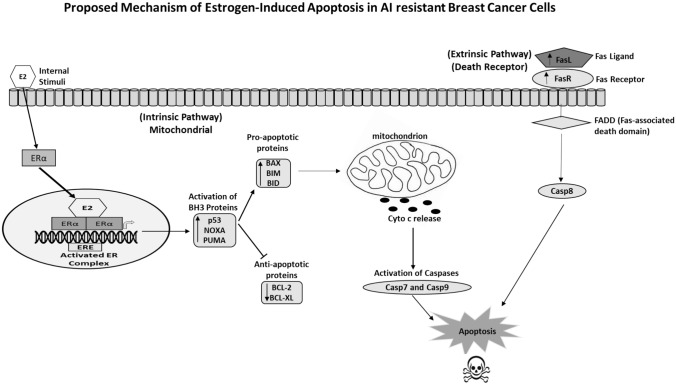
Joan Lewis mapped out [131, 132] the initial mitochondrial pathway (intrinsic that collaborates with the Death Receptor (extrinsic pathway) to cause apoptotic death). Ping Fan at Georgetown and MD Anderson completed the steps in apoptosis-modulating NF-κB activation by the endoplasmic reticulum stress sensor PERK [146] and the role of the glucocorticoid receptor to block estrogen-induced apoptosis. These molecular events in long-term estrogen-deprived breast cancer cells provide transparency to the results of the WHI: estrogen alone decreases breast cancer incidence, whereas estrogen plus MPA increases breast cancer incidence [148]
Fig. 5
Fig. 5
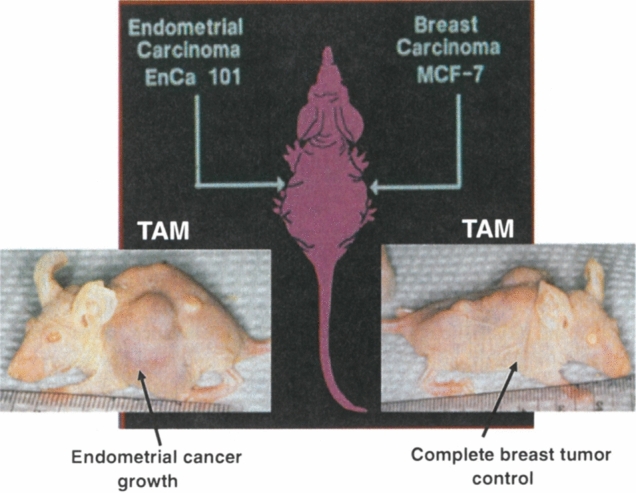
The pioneering bitransplantation study by Gottardis [158] with an ER-positive breast tumor (MCF-7) implanted in one axilla and an ER-positive endometrial tumor (EnCa 101) in the other axilla. Tamoxifen blocks estrogen-stimulated growth of the breast tumor, but tamoxifen encourages the growth of the endometrial tumor
Fig. 6
Fig. 6
Dedication to the late Bill McGuire (right). He and Geoff Greene, of the University of Chicago (left), are getting onto a bus for participants in an International Cancer Congress in Budapest, Hungary, in the mid 1980s

References

    1. Watson, J, (2010) Avoid Boring People, Vintage Books, a division of Random House New York.
    1. Smith DC, Prentice DJ, Thompson DJ, Herrmann WL. Association of exogenous estrogen and endometrial cancer. N Eng J Med. 1975;293:1164–1167. doi: 10.1056/NEJM197512042932302. - DOI - PubMed
    1. Ziel HK, Finkle WD. Increased risk of endometrial carcinoma among users of conjugated estrogens. N Eng J Med. 1975;293:1169–1170. doi: 10.1056/NEJM197512042932303. - DOI - PubMed
    1. Eig J. The Birth of the Pill. London: Pan Macmillan a division of Macmillan Publishers LTD; 2015.
    1. Beutler E. The treatment of acute leukemia: past, present, and future. Leukemia. 2001;15:658–661. doi: 10.1038/sj.leu.2402065. - DOI - PubMed

Substances