. 2022 Mar;43(3):2015-2020.
doi: 10.1007/s10072-021-05536-0. Epub 2021 Aug 16.

New-onset status epilepticus in SARS-CoV-2 infection: a case series

Affiliations

New-onset status epilepticus in SARS-CoV-2 infection: a case series

Marco Belluzzo et al. Neurol Sci. 2022 Mar.

Abstract

Background: Neurological manifestations of COVID-19 infection are well recognized. Seizures and status epilepticus (SE) have been reported as possible manifestations and/or complications of SARS-CoV-2 infection at different disease stages, but few data are known about the type, severity, treatment response, and recurrence.

Methods: Single-center retrospective case series.

Results: This case series describes four COVID-19-positive patients admitted to an Italian University Hospital, who developed status epilepticus during the active phase of disease, independently from the severity of respiratory symptoms. Two of them presented a relapse after resolution of the acute viral infection, a feature that has not been previously reported.

Conclusions: Although a possible association between SE and COVID-19 has been reported, the exact etiopathogenetic mechanism remains still not understood. Our series adds new insights to shed further light on this controversial issue.

Keywords: EEG; Epilepsy; Recurrent SE; SARS-CoV-2 infection; Status epilepticus.


Conflict of interest statement

The authors declare that the research was conducted in the absence of any commercial or financial relationships that could be construed as a potential conflict of interest.

Figures
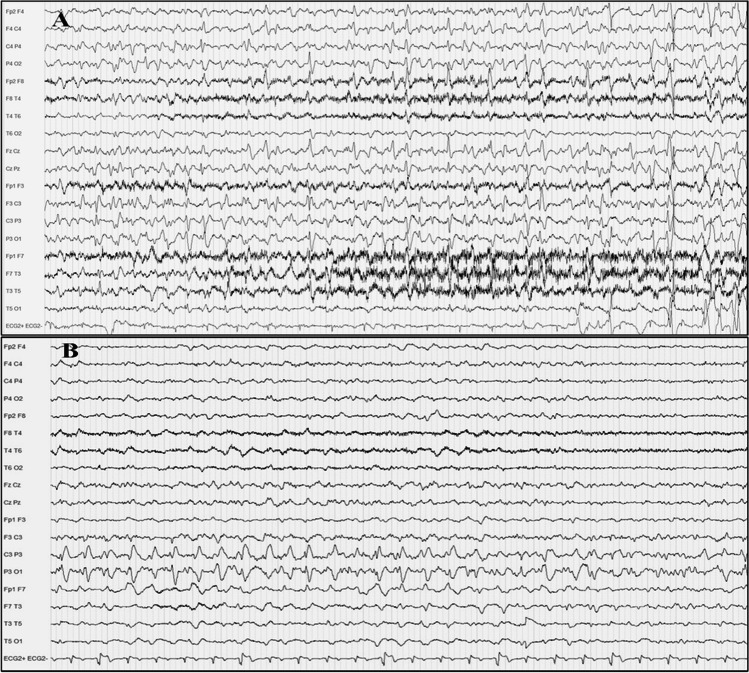
Fig. 1
Fig. 1
EEG recordings of patient no. 1 (A) and patient no. 4 (B). Panel A shows slow background activity with 1- to 2.5-Hz generalized sharp/triphasic waves predominant on the left fronto-parietal region. Panel B presents 2-Hz sharp-waves and sharp-and-slow-wave complexes on the left parietal region with diffusion to ipsilateral temporal region. Longitudinal EEG montage according to the 10/20 International System + ECG, LFF: 70 Hz, HFF: 0.3 Hz, sensitivity 100 µV/mm
Fig. 2
Fig. 2
Radiological findings of patient no. 1 with anti-Zic4 positivity. Brain magnetic resonance imaging (MRI): fluid-attenuated inversion recovery (FLAIR) images revealed hyperintensity in the middle cerebellar peduncles (A), pons (B), and bilateral basal ganglia (C). At 2-month follow-up, FLAIR hyperintensities globally reduced in the same regions (D, E, F) with an increase of cortical atrophy
Fig. 3
Fig. 3
EEG characteristics of patient no. 2 (A, B) and patient no. 3 (C, D). Patient no. 2: panel A shows slow background activity with continuous bursts of 3-Hz sharp-waves over the left hemisphere (first SE); panel B demonstrates generalized 3–3.5-Hz sharp-waves (SE relapse). Patient #3: panel C shows diffuse slow background activity with 2–2.5-Hz spike-and-wave and sharp-and-slow-wave complexes over bilateral frontal regions with right prevalence (electrodes Fp2, F4, and F8) (first SE); panel D reports continuous 2-Hz sharp waves on the right parietal region with contralateral diffusion (SE relapse). Longitudinal EEG montage according to the 10/20 International System + ECG, LFF: 70 Hz, HFF: 0.3 Hz, sensitivity 100 µV/mm

References

    1. Dono F, Nucera B, Lanzone J, Evangelista G, Rinaldi F, Speranza R, et al. Status epilepticus and COVID-19: a systematic review. Epilepsy Behav. 2021;118:107887. doi: 10.1016/j.yebeh.2021.107887. - DOI - PMC - PubMed
    1. Leitinger M, Beniczky S, Rohracher A, Gardella E, Kalss G, Qerama E, et al. Salzburg Consensus Criteria for Non-Convulsive Status Epilepticus – approach to clinical application. Epilepsy Behav. 2015;49:158–163. doi: 10.1016/j.yebeh.2015.05.007. - DOI - PubMed
    1. Paterson RW, Brown RL, Benjamin L, Nortley R, Wiethoff S, Bharucha T, et al. The emerging spectrum of COVID-19 neurology: clinical, radiological and laboratory findings. Brain. 2020;143(10):3104–3120. doi: 10.1093/brain/awaa240. - DOI - PMC - PubMed
    1. Vohora D, Jain S, Tripathi M, Potschka H. COVID-19 and seizures: is there a link? Epilepsia. 2020;61(9):1840–1853. doi: 10.1111/epi.16656. - DOI - PMC - PubMed
    1. Karvigh SA, Vahabizad F, Mirhadi MS, Banihashemi G, Montazeri M. COVID-19-related refractory status epilepticus with the presence of SARS-CoV-2 (RNA) in the CSF: a case report. Neurol Sci. 2021;15:1–4. doi: 10.1007/s10072-021-05239-6. - DOI - PMC - PubMed
