. 2021 Aug 31;118(35):e2100347118.
doi: 10.1073/pnas.2100347118.

Ultrarapid detection of SARS-CoV-2 RNA using a reverse transcription-free exponential amplification reaction, RTF-EXPAR

Affiliations

Ultrarapid detection of SARS-CoV-2 RNA using a reverse transcription-free exponential amplification reaction, RTF-EXPAR

Jake G Carter et al. Proc Natl Acad Sci U S A. .

Abstract

A rapid isothermal method for detecting severe acute respiratory syndrome coronavirus 2 (SARS-CoV-2), the virus responsible for COVID-19, is reported. The procedure uses an unprecedented reverse transcription-free (RTF) approach for converting genomic RNA into DNA. This involves the formation of an RNA/DNA heteroduplex whose selective cleavage generates a short DNA trigger strand, which is then rapidly amplified using the exponential amplification reaction (EXPAR). Deploying the RNA-to-DNA conversion and amplification stages of the RTF-EXPAR assay in a single step results in the detection, via a fluorescence read-out, of single figure copy numbers per microliter of SARS-CoV-2 RNA in under 10 min. In direct three-way comparison studies, the assay has been found to be faster than both RT-qPCR and reverse transcription loop-mediated isothermal amplification (RT-LAMP), while being just as sensitive. The assay protocol involves the use of standard laboratory equipment and is readily adaptable for the detection of other RNA-based pathogens.

Keywords: COVID-19 assay; EXPAR; RNA detection; isothermal amplification; nucleic acids.


Conflict of interest statement

The authors declare no competing interest.

Figures
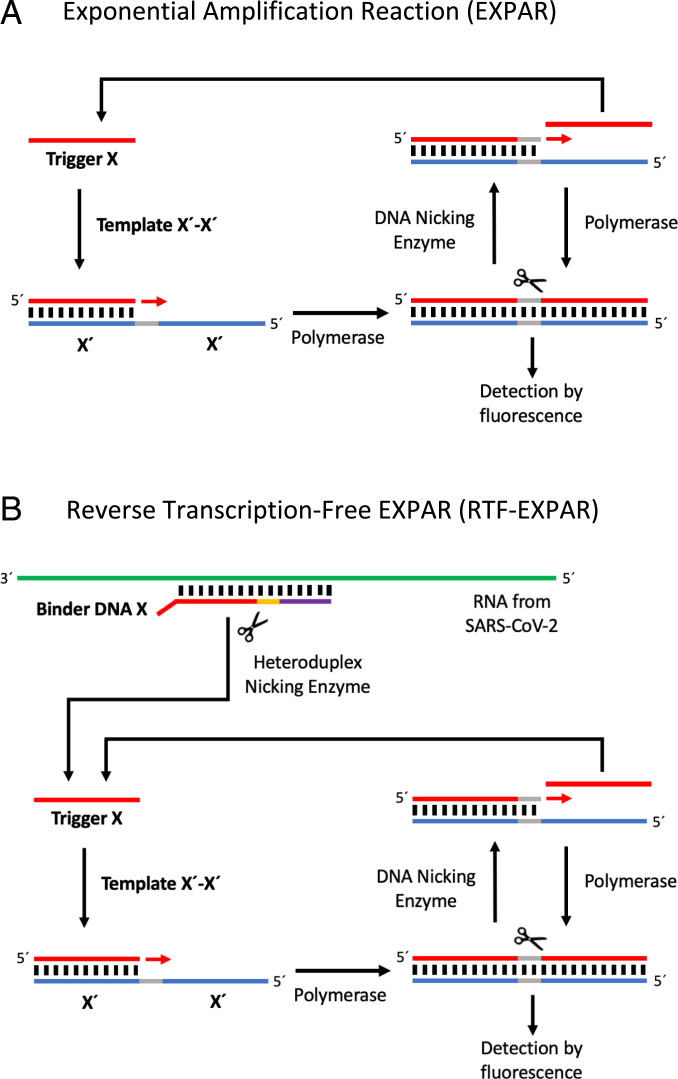
Fig. 1.
Fig. 1.
(A) Reaction scheme for EXPAR: Trigger X anneals to Template X′-X′ and is extended by a DNA polymerase (Bst 2.0 polymerase); the top strand of the newly formed duplex DNA is then cut by a nicking enzyme (Nt.BstNBI); the released DNA (which is displaced by DNA polymerase in a subsequent extension reaction) is identical to Trigger X and is therefore able to prime another Template X′-X′. (B) Reaction scheme for RTF-EXPAR: Binder DNA X anneals to viral RNA; the DNA strand of the DNA:RNA heteroduplex is cut by the restriction endonuclease BstNI, which acts as a nicking enzyme by cutting the DNA strand only; the released DNA strand is Trigger X, which is then amplified by EXPAR.
Fig. 2.
Fig. 2.
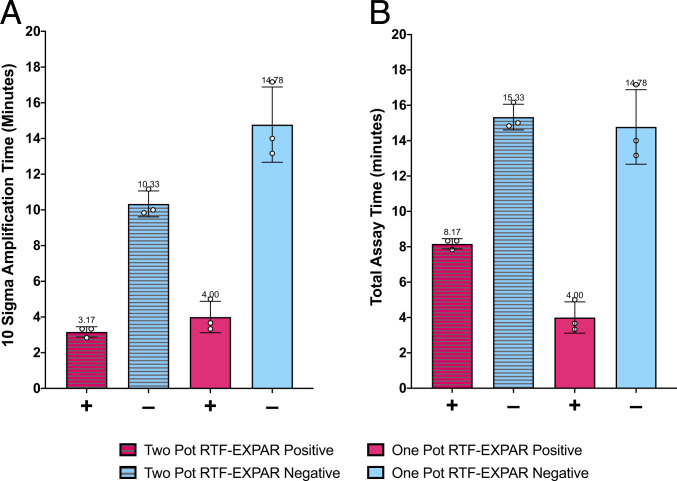
RTF-EXPAR assay data (Protocol 1, Sample Batch 1) for SARS-CoV-2 RNA detection (73 copies per µL, n = 3), showing (A) the mean time for the amplification reaction only and (B) the mean total assay time from RNA sample to signal. Each run time was calculated to be the point at which the fluorescence signal was greater than 10 SDs from the baseline signal (10-sigma time). Error bars in datasets are the SDs of the 10-sigma time. Signals observed for negative samples at >10 min are attributed to amplification arising from nonspecific interactions.
Fig. 3.
Fig. 3.
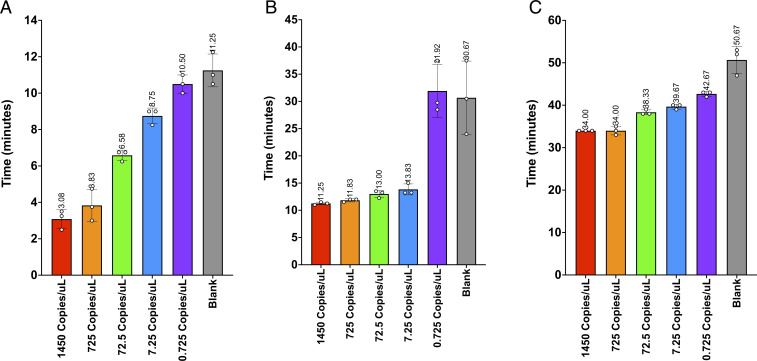
RTF-EXPAR assay data (Protocol 2) for SARS-CoV-2 RNA detection (Sample Batch 2, n = 3), showing (A) the mean time for the amplification reaction using RTF-EXPAR, (B) the mean time for the amplification reaction using RT-LAMP, and (C) the mean time for the amplification reaction using RT-qPCR. Each run time was calculated to be the point at which the fluorescence signal was greater than 10 SDs from the baseline signal (10-sigma time). Error bars in datasets are the SDs of the 10-sigma time.
Fig. 4.
Fig. 4.
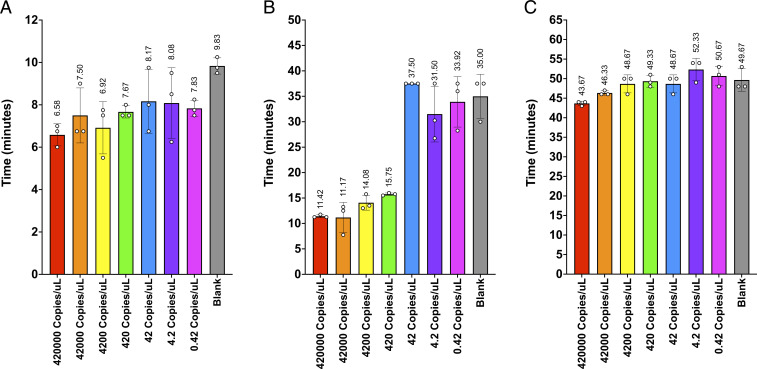
RTF-EXPAR assay data (Protocol 2) on heat-inactivated SARS-CoV-2 virus (Sample Batch 3, n = 3), showing (A) the mean time for the amplification reaction using RTF-EXPAR, (B) the mean time for the amplification reaction using RT-LAMP, and (C) the mean time for the amplification reaction using RT-qPCR. Each run time was calculated to be the point at which the fluorescence signal was greater than 10 SDs from the baseline signal (10-sigma time). Error bars in datasets are the SDs of the 10-sigma time.
Fig. 5.
Fig. 5.
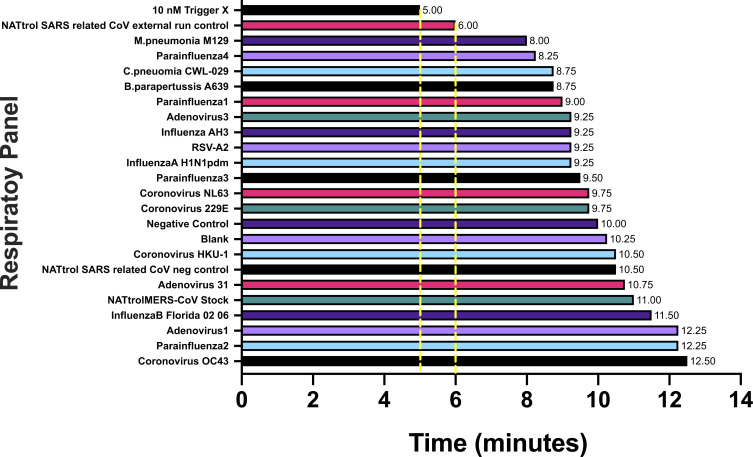
RTF-EXPAR assay data (Protocol 2) for ZeptoMetrix NATtrol Respiratory Verification Panel 2 (Sample Batch 4, n = 1), showing the time for RTF-EXPAR to produce a signal. Yellow dashed lines represent the thresholds for each of the two positive controls. Each run time was calculated to be the point at which the fluorescence signal was greater than 10 SDs from the baseline signal (10-sigma time). It should be noted that runs against Influenza ah 1 a/newcal/20/99 and Rhinovirus type 1a gave no signal after 40 min.

References

    1. Esbin M. N., et al., Overcoming the botteneck to widespread testing: A rapid review of nucleic acid testing approaches for COVID-19 detection. RNA 26, 771–783 (2020). - PMC - PubMed
    1. Guglielmi G., The explosion of new coronavirus tests that could help to end the pandemic. Nature 583, 506–509 (2020). - PubMed
    1. Venter M., Richter K., Towards effective diagnostic assays for COVID-19: A review. J. Clin. Pathol. 73, 370–377 (2020). - PubMed
    1. Sheridan C., Coronavirus and the race to distribute reliable diagnostics. Nat. Biotechnol. 38, 382–384 (2020). - PubMed
    1. Carter L. J., et al., Assay techniques and test development for COVID-19 diagnosis. ACS Cent. Sci. 6, 591–605 (2020). - PMC - PubMed

Publication types