Review
. 2022 Jul 1;14(7):a041268.
doi: 10.1101/cshperspect.a041268.

Nuclear Compartments: An Incomplete Primer to Nuclear Compartments, Bodies, and Genome Organization Relative to Nuclear Architecture

Affiliations
Review

Nuclear Compartments: An Incomplete Primer to Nuclear Compartments, Bodies, and Genome Organization Relative to Nuclear Architecture

Andrew S Belmont. Cold Spring Harb Perspect Biol. .

Abstract

This work reviews nuclear compartments, defined broadly to include distinct nuclear structures, bodies, and chromosome domains. It first summarizes original cytological observations before comparing concepts of nuclear compartments emerging from microscopy versus genomic approaches and then introducing new multiplexed imaging approaches that promise in the future to meld both approaches. I discuss how previous models of radial distribution of chromosomes or the binary division of the genome into A and B compartments are now being refined by the recognition of more complex nuclear compartmentalization. The poorly understood question of how these nuclear compartments are established and maintained is then discussed, including through the modern perspective of phase separation, before moving on to address possible functions of nuclear compartments, using the possible role of nuclear speckles in modulating gene expression as an example. Finally, the review concludes with a discussion of future questions for this field.


Figures

Figure 1.
Figure 1.
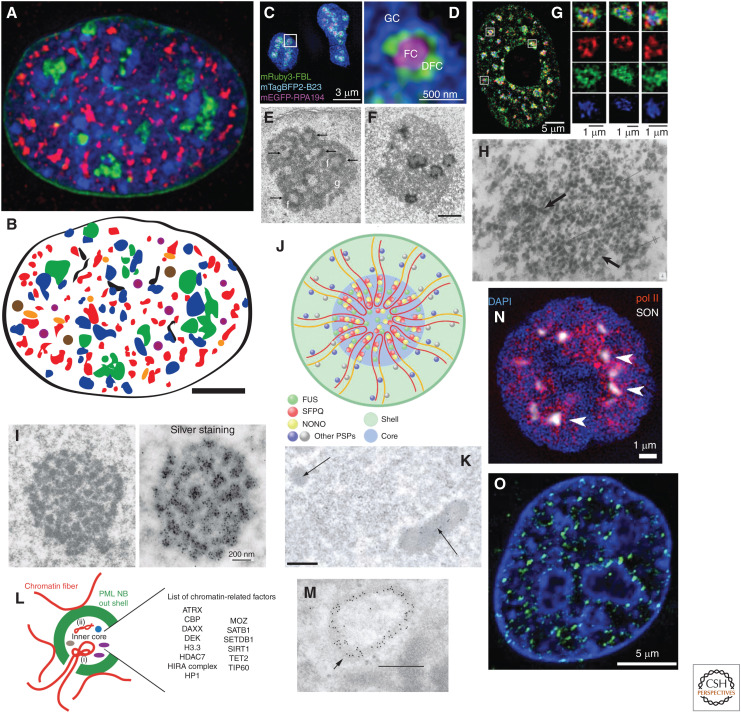
Varied nuclear bodies occupy significant fraction of cell nucleus. (A) Mouse NIH 3T3 fibroblast cell stained with DAPI (blue) to highlight DNA-dense bodies, including chromocenters, and expressing fluorescently labeled proteins to identify nuclear lamina (green, lamin B1), nucleoli (green, fibrillarin), and nuclear speckles (Magoh, red) (Zhao et al. 2020). (Image courtesy of Dr. Pankaj Chaturvedi.) (B) Same nucleus as A was used to outline nuclear lamina (black), nucleoli (green), and nuclear speckles (red) and then superimpose typical numbers for NIH 3T3 cells of additional nuclear bodies: Cajal bodies (brown), paraspeckles (orange), and promyelocytic leukemia (PML) bodies (purple). Scale bar, 5 μm (A,B). (C,D) Nucleoli stained for granular compartment (GC) (blue, B23), fibrillar center (FC) (purple, RPA194), and dense fibrillar component (DFC) (fibrillarin, FBL). Scale bars, 3 µm (C); 500 nm (D). (Panels C and D from Figure 1C in Yao et al. 2019; reprinted, with permission, from Elsevier © 2019.) (E,F) Electron microscopy (EM) visualization of nucleoli showing GC (g), DFC (arrows), FC (f). Conventional uranyl and lead staining were used in E, and silver staining for NOC proteins used in F. (Panels E and F from Penzo et al. 2019; reprinted under the Creative Commons Attribution License CC BY 4.0.) (G) 3D SIM microscopy showing nuclear speckles with partial spatial separation between anti-“SC35” (actually anti-SRRM2, see text) staining (blue) and MALAT1 (red) and U2 RNA (green). (Continued) (Panel G from Fei et al. 2017; reprinted, with permission, from Company of Biologists © 2017.) (H) EM visualization of interchromatin granule cluster (IGC)/nuclear speckle in rat adrenal cortex cell; granules sometimes appear in linear chains (arrows). (Panel H from Monneron and Bernhard 1969; reprinted, with permission, from Elsevier © 1969.) (I) EM visualization of large Cajal (accessory) bodies in neuronal cells showing “coiled thread” internal structure using conventional (left) or silver (right) staining. Scale bar, 200 nm. (Panel I from Lafarga et al. 2017; reprinted, with permission, from Taylor & Francis © 2017.) (J) Model of paraspeckles showing proposed scaffolding role of NEAT1_2 long noncoding RNA (lncRNA) (red and yellow lines) recruiting/binding different paraspeckle proteins over 5′ and 3′ ends (outer shell regions) versus internal sequences (core region). (Panel J from McCluggage and Fox 2021; reprinted, with permission, from John Wiley and Sons © 2017.) (K) EM visualization of round or elliptical paraspeckles (arrows). Scale bar, 0.5 μm. (Panel K is from Fox and Lamond 2010; image courtesy of Sylvie Souquere and Gerard Pierron, Villejuif, France.) (L) Model for PML body structure showing PML protein outer shell and an inner cavity containing many PML proteins, including chromatin factors and, in some cases, chromatin. (Panel L from Corpet et al. 2020; reprinted, with permission, from Oxford University Press © 2020.) (M) EM visualization of PML body showing immunogold-labeled PML protein outer shell. Scale bar, 0.5 μm. (Panel M from Lallemand-Breitenbach and de Thè 2018; reprinted, with permission, from Elsevier © 2018.) (N) Immunostained nucleus from human K562 cell showing RNA Pol II CTD Ser5p foci (red) clustered around nuclear speckles (SON, white) as well as other nuclear interior regions but depleted from periphery of nucleus counterstained for DNA with DAPI (blue). (Panel N from Chen et al. 2018b; reprinted under the Creative Commons License CC BY-NC-SA 4.0.) (O) Live-cell imaging of Mediator (MED1) condensates (green) visualized in mouse embryonic stem cell (mESC) nucleus stained with Hoechst for DNA (blue). (Panel O from Sabari et al. 2018; reprinted, with permission, from The American Association for the Advancement of Science © 2018.)
Figure 2.
Figure 2.
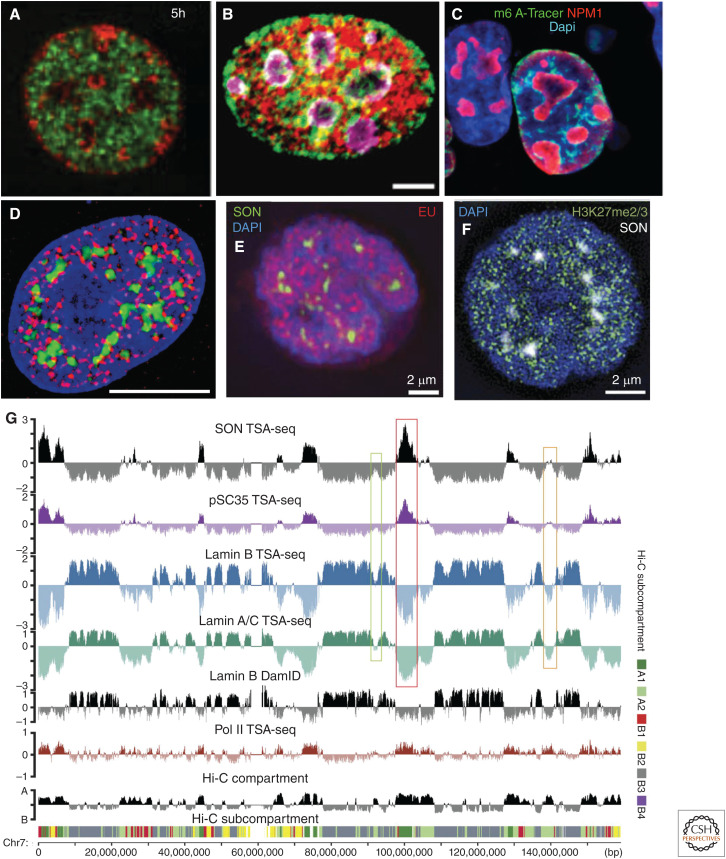
Both imaging and sequencing-based genomics methods suggest binary model for nuclear genome organization as a first approximation to a more complex organization. (AC) An approximately binary nuclear genome organization revealed by imaging L1 repeat enriched chromatin, late-replicating DNA, and lamina-associated domains (LADs) largely at the nuclear and nucleolar peripheries with B1/Alu repeat enriched chromatin, early-replicating DNA, and intervening LADs (iLADs) in the nuclear interior. (A) Mouse embryonic fibroblast, early (green) versus late (red) DNA replication pulse labeling (5 h chase between early and late labeling). (Panel A from Wu et al. 2006; reprinted, with permission, from The Rockefeller Press © 2006.) (Continued) (B) Mouse C2C12 cell. L1 (green) or B repeat (red) FISH with nucleoli stained by nucleolin (purple). Scale bar, 5 μm. (Panel B from Lu et al. 2021; reprinted under the terms of the Creative Commons CC BY license.) (C) LADs, whose DNA was methylated by contact with lamin B1 fused to Dam methylase in the preceding interphase, stochastically redistribute early in the next interphase to the nuclear lamina, periphery of the nucleoli (red, NPM1), and nuclear interior (blue, DAPI), as visualized by the binding of the m6A-Tracer protein (green) that binds methylated DNA. (Panel C from Kind et al. 2013; reprinted, with permission, from Elsevier © 2013.) (DF) Signs of a more complex nuclear genome organization emerge after staining for nuclear speckles and various marks of active versus repressive chromatin. (D) Hyperacetylated histones (red) are distributed nonuniformly within nuclear interior (DNA, blue), including concentrations adjacent to nuclear speckles (green). Scale bar, 10 μm. (Panel D from Hendzel et al. 1998; reprinted, with permission, from the American Society for Cell Biology © 1998.) (E,F) Local concentrations of EU pulse-labeling of nascent transcripts (red) revealing transcriptionally active chromosome regions dispersed nonuniformly through nuclear interior (DAPI, blue), including surrounding nuclear speckles (SON, green) (E); in contrast, repressive H3K27me3 mark (green) for facultative heterochromatin also is present in foci distributed throughout most of the nucleus from the nuclear periphery to the edge of nuclear speckles (F). (Panels E and F from Chen et al. 2018b; reprinted under the Creative Commons License CC BY-NC-SA 4.0.) (G) Genome browser view showing how largely binary division of nuclear genome organization based on lamin B1 DamID, Hi-C compartment (EV1) score, or RNA Pol II CTD Ser5p TSA-seq is further subdivided into chromosomal regions with varying distances to nuclear speckles or from nuclear lamina, as seen by varying location and heights/depths of SON/SC35 TSA-seq peaks/valleys, varying depths of lamin A/C and B TSA-seq valleys, as well as Hi-C subcompartments (note correlation of A1 subcompartment with SON/SC35 TSA-seq peaks and varied localization of B1 [enriched in H3K27me3 mark] along chromosome). (Panel G from Chen et al. 2018b; reprinted under the Creative Commons License CC BY-NC-SA 4.0.)
Figure 3.
Figure 3.
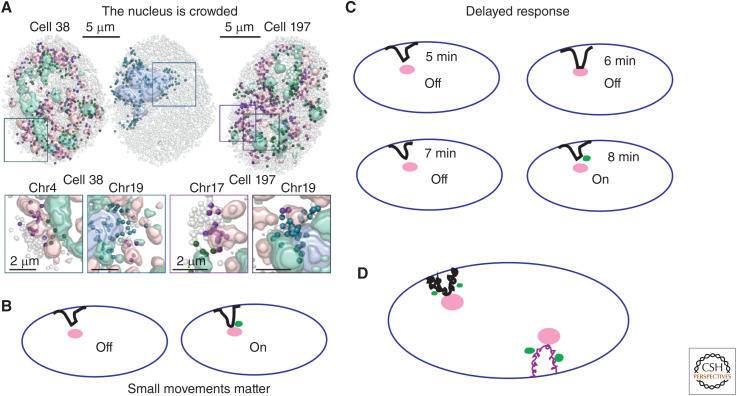
Challenges for the future. (A) The nucleus is crowded with many internal nuclear bodies and structures as revealed by multiplexed imaging of DNA loci relative to nuclear speckles (pink), nucleoli (blue), or H3K9me3-enriched heterochromatin, including chromocenters, in mouse embryonic stem cells (mESCs). A number of specific chromosome loci appear as “fixed” relative to these nuclear structures, meaning they show statistically unusually high frequency of colocalization for particular structures—pink dots for nuclear speckle-associated, green dots for H3K9me3-associated, and blue dots for nucleolar-associated—as compared with chromosome loci that do not show elevated association frequencies with any of these structures (gray dots). (Panel A from Takei et al. 2021; reprinted, with permission, from Nature Publishing © 2021.) (B) Small movements matter: relative movements closer or further to specific nuclear bodies/structures, even of several hundred nm, can be highly correlated with changes in gene expression. (C) Delayed response: greatly complicating analysis of the possible causal relationship between nuclear localization and changes in DNA functional output is that the change in output—i.e., transcription (nascent transcripts represented as green dot)—may show a delayed response. Here, a gene locus starts at 5 min after gene induction a small distance from a nuclear speckle, touches the speckle at 6 min, and in a delayed response, turns on to higher levels at 8 min when it is again away from the nuclear speckle. Examination in fixed cells would instead lead to the inference of a high level of transcription even without nuclear speckle contact. (D) An integrated view: Traditionally, our field has focused solely on individual chromosome loci and their nuclear position. However, movements of chromosome loci toward or away from specific nuclear bodies/structures could be associated with coordinated changes in nuclear localization, large-scale chromatin compaction, and even biochemical changes to flanking chromatin regions, possibly Mbps in size. Here, an active chromosome movement of a speckle-associated chromosomal locus toward a nuclear speckle, followed by its attachment to the speckle, combined with the anchoring of a neighboring LAD to the nuclear lamina could differentially alter the chromatin compaction of the intervening several Mbp of DNA between these two chromosome loci, possibly even leading to differential gene expression (nascent transcripts, green dots) as a function of differential chromosomal stretching.

References

    1. Abramo K, Valton AL, Venev SV, Ozadam H, Fox AN, Dekker J. 2019. A chromosome folding intermediate at the condensin-to-cohesin transition during telophase. Nat Cell Biol 21: 1393–1402. 10.1038/s41556-019-0406-2 - DOI - PMC - PubMed
    1. Alexander KA, Coté A, Nguyen SC, Zhang L, Gholamalamdari O, Agudelo-Garcia P, Lin-Shiao E, Tanim KMA, Lim J, Biddle N, et al. 2021. P53 mediates target gene association with nuclear speckles for amplified RNA expression. Mol Cell 81: 1666–1681.e6. 10.1016/j.molcel.2021.03.006 - DOI - PMC - PubMed
    1. Amat R, Böttcher R, Le Dily F, Vidal E, Quilez J, Cuartero Y, Beato M, de Nadal E, Posas F. 2019. Rapid reversible changes in compartments and local chromatin organization revealed by hyperosmotic shock. Genome Res 29: 18–28. 10.1101/gr.238527.118 - DOI - PMC - PubMed
    1. Amenta PS. 1961. Fusion of nucleoli in cells cultured from the heart of Triturus viridescens. Anat Rec 139: 155–165. 10.1002/ar.1091390207 - DOI - PubMed
    1. Anantharaman A, Jadaliha M, Tripathi V, Nakagawa S, Hirose T, Jantsch MF, Prasanth SG, Prasanth KV. 2016. Paraspeckles modulate the intranuclear distribution of paraspeckle-associated Ctn RNA. Sci Rep 6: 34043. 10.1038/srep34043 - DOI - PMC - PubMed

Publication types

LinkOut - more resources