


Nonideal resistive and synaptic characteristics in Ag/ZnO/TiN device for neuromorphic system
- PMID: 34400734
- PMCID: PMC8367949
- DOI: 10.1038/s41598-021-96197-8
Nonideal resistive and synaptic characteristics in Ag/ZnO/TiN device for neuromorphic system
Abstract
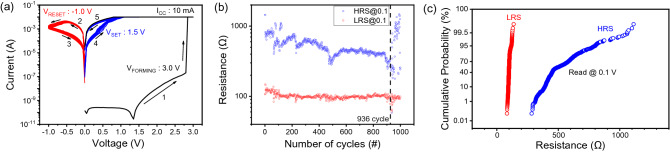
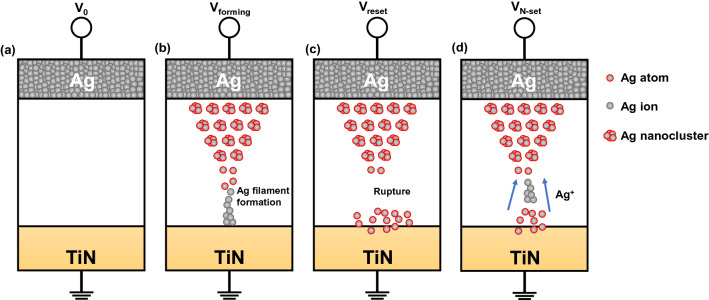
Ideal resistive switching in resistive random-access memory (RRAM) should be ensured for synaptic devices in neuromorphic systems. We used an Ag/ZnO/TiN RRAM structure to investigate the effects of nonideal resistive switching, such as an unstable high-resistance state (HRS), negative set (N-set), and temporal disconnection, during the set process and the conductance saturation feature for synaptic applications. The device shows an I-V curve based on the positive set in the bipolar resistive switching mode. In 1000 endurance tests, we investigated the changes in the HRS, which displays large fluctuations compared with the stable low-resistance state, and the negative effect on the performance of the device resulting from such an instability. The impact of the N-set, which originates from the negative voltage on the top electrode, was studied through the process of intentional N-set through the repetition of 10 ON/OFF cycles. The Ag/ZnO/TiN device showed saturation characteristics in conductance modulation according to the magnitude of the applied pulse. Therefore, potentiation or depression was performed via consecutive pulses with diverse amplitudes. We also studied the spontaneous conductance decay in the saturation feature required to emulate short-term plasticity.
© 2021. The Author(s).
Conflict of interest statement
The authors declare no competing interests.
Figures


References
-
- Lee, H. Y. et al. Low power and high speed bipolar switching with a thin reactive Ti buffer layer in robust HfO2 based RRAM. In 2008 IEEE International Electron Devices Meeting (2008).
-
- Zidan MA, Chen A, Indiveri G, Lu WD. Memristive computing devices and applications. J. Electroceram. 2017;39(1):4–20. doi: 10.1007/s10832-017-0103-0. - DOI
-
- Mikhaylov A, et al. Multilayer metal-oxide memristive device with stabilized resistive switching. Adv. Mater. Technol. 2020;5(1):1900607. doi: 10.1002/admt.201900607. - DOI
Publication types
LinkOut - more resources
Full Text Sources
