Review
. 2021 Dec;22(12):815-833.
doi: 10.1038/s41580-021-00398-y. Epub 2021 Aug 16.

The molecular principles of gene regulation by Polycomb repressive complexes

Affiliations
Review

The molecular principles of gene regulation by Polycomb repressive complexes

Neil P Blackledge et al. Nat Rev Mol Cell Biol. 2021 Dec.

Abstract

Precise control of gene expression is fundamental to cell function and development. Although ultimately gene expression relies on DNA-binding transcription factors to guide the activity of the transcription machinery to genes, it has also become clear that chromatin and histone post-translational modification have fundamental roles in gene regulation. Polycomb repressive complexes represent a paradigm of chromatin-based gene regulation in animals. The Polycomb repressive system comprises two central protein complexes, Polycomb repressive complex 1 (PRC1) and PRC2, which are essential for normal gene regulation and development. Our early understanding of Polycomb function relied on studies in simple model organisms, but more recently it has become apparent that this system has expanded and diverged in mammals. Detailed studies are now uncovering the molecular mechanisms that enable mammalian PRC1 and PRC2 to identify their target sites in the genome, communicate through feedback mechanisms to create Polycomb chromatin domains and control transcription to regulate gene expression. In this Review, we discuss and contextualize the emerging principles that define how this fascinating chromatin-based system regulates gene expression in mammals.


Conflict of interest statement

Competing interests

The authors declare no competing interests.

Figures
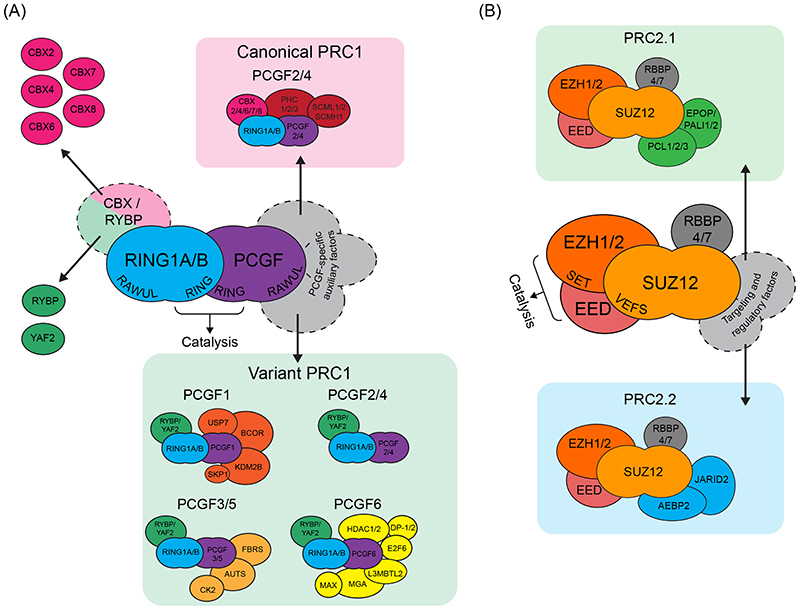
Figure 1
Figure 1. A diverse repertoire of mammalian Polycomb repressive complexes
(A) The core of Polycomb repressive complex 1 (PRC1) comprises a RING1A or RING1B protein (RING1A/B) and one of six Polycomb group RING finger (PGCF) proteins (PCGF1–6). RING1 and PCGF proteins dimerise through their RING domains to form the catalytic core of PRC1, while the RING finger and WD40-associated ubiquitin-like (RAWUL) domains of both proteins interact with a range of auxiliary subunits, giving rise to biochemically distinct PRC1 complexes. Canonical PRC1 (cPRC1) complexes (top) assemble around PCGF2 or PCGF4, and include a chromobox protein (CBX2, 4, 6, 7 or 8) and Polyhomeotic (PHC) protein (PHC1, 2 or 3). In some cases, cPRC1 complexes also contain an SCM protein (SCML1 or 2 or SCMH1). By contrast, variant PRC1 (vPRC1) complexes (bottom) can assemble around all six PCGFs and contain RING and YY1 binding protein (RYBP) or YY1-associated factor 2 (YAF2). The identity of the PCGF protein dictates the incorporation of other auxiliary subunits, resulting in a number of distinct vPRC1 complexes. (B) The catalytic lobe of PRC2 is formed by a SET (Su(var)3-9, Enhancer-of-zeste and Trithorax)-domain containing enhancer of zeste 1 (EZH1) or EZH2 protein, together with embryonic ectoderm development (EED) and the VEFS (VRN2-EMF2-FIS2-SUZ12) domain of suppressor of zeste 12 (SUZ12). The N-terminal part of SUZ12 forms a distinct regulatory lobe that interacts with retinoblastoma-binding protein 4 (RBBP4) or RBBP7 and with other, auxiliary subunits that give rise to distinct PRC2.1 (top) and PRC2.2 (bottom) complexes. PRC2.1 complexes contain a Polycomblike (PCL) subunit (PCL1/2/3) and Elongin BC and Polycomb repressive complex 2-associated protein (EPOP) or PRC2-associated LCOR isoform 1 (PALI1) or PALI2, whereas PRC2.2 complexes contain adipocyte enhancer binding protein 2 (AEBP2) and Jumanji and AT-rich interaction domain containing 2 (JARID2). Protein domains are italicised. AUTS2, autism susceptibility protein 2; BCOR, BCL6 corepressor; CK2, casein kinase 2; DP-1, dimerization partner 1 (also known as transcription factor Dp-1); E2F6, transcription factor E2F6; FBRS, fibrosin; HDAC1, histone deacetylase 1; KDM2B, lysine-specific demethylase 2B; L3MBTL2, lethal(3)malignant brain tumour-like protein 2; MAX, MYC-associated factor X; MGA, MAX gene-associated; SCMH1, sex combs on midleg homolog 1; SCML1, SCM like 1; SKP1, S-phase kinase-associated protein 1; USP7, ubiquitin carboxyl-terminal hydrolase 7.
Figure 2
Figure 2. Primary mechanisms of Polycomb target-site identification
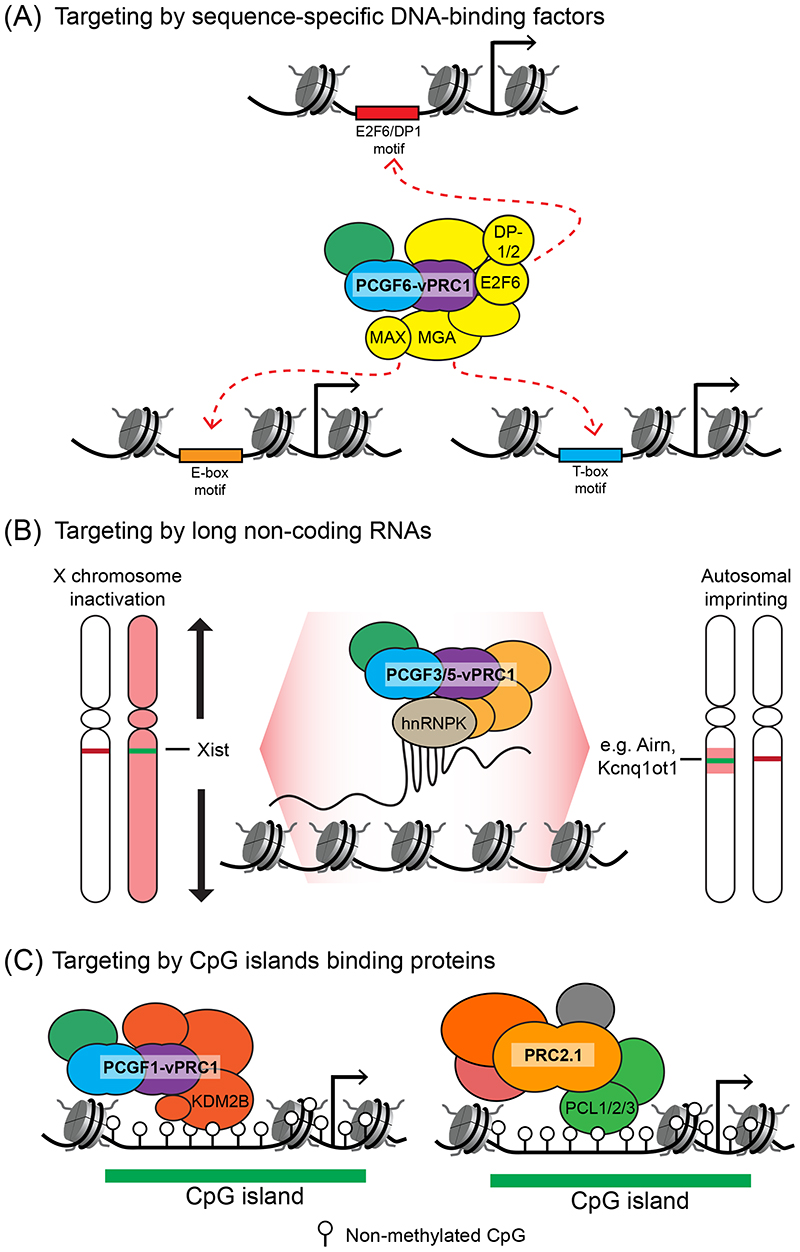
(A) Sequence-specific DNA-binding factors in the Polycomb group RING finger 6 (PCGF6)-containing variant Polycomb repressive complex 1 (vPRC1) complex recognise DNA sequence motifs at target sites. These DNA-binding factors include MAX gene-associated (MGA)–MYC-associated factor X (MAX) and E2F6–dimerization partner 1 or 2 (DP-1/2) dimers, which bind to different DNA sequence motifs and contribute to sequence-specific PCGF6-vPRC1 targeting in different contexts. (B) Polycomb complexes can identify chromosomal binding sites during X chromosome inactivation through the long-noncoding RNA (lncRNA) X inactivation specific transcript (XIST); in autosomal imprinted regions mono-allelic gene repression is achieved through the lncRNAs Airn and Kcnq1ot1. In these regulatory contexts, the adaptor protein heterogeneous nuclear ribonucleoprotein K (hnRNPK) is thought to interact with the lncRNA and recruit the PCGF3/5-vPRC1 complex. These mono-allelic targeting cases are atypical in that they nucleate the binding of Polycomb complexes at large chromosomal regions, whereas Polycomb complex targeting to the majority of genomic sites is more punctate and associated with gene regulatory elements (see parts A and C). (C) Both PCGF1-vPRC1 and PRC2.1 are targeted to CpG islands. The lysine-specific demethylase 2B (KDM2B) subunit of PCGF1-vPRC1 contains a zinc finger-CxxC (ZF-CxxC) domain that binds specifically to non-methylated CpG dinucleotides. In PRC2.1, the Polycomb-like 1 (PCL1), PCL2 or PCL3 subunit contains a winged-helix domain that binds non-methylated CpG dinucleotides in certain sequence-contexts.
Figure 3
Figure 3. Formation and spreading of Polycomb chromatin domains
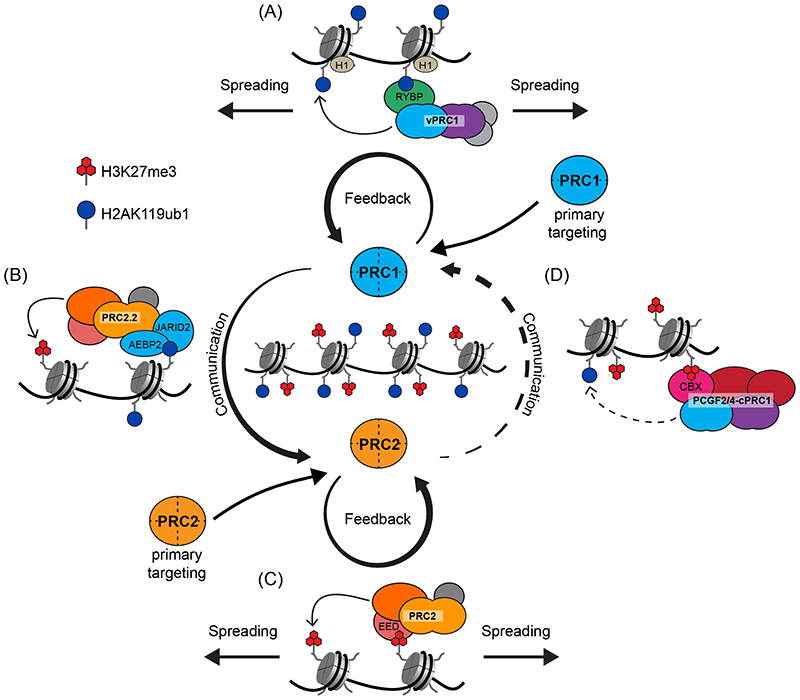
Primary targeting of Polycomb repressive complex 1 (PRC1) and PRC2 is followed by feedback and communication mechanisms that enable the formation and spreading of Polycomb chromatin domains, which are characterised by elevated Polycomb complex occupancy and high levels of mono-ubiquitylated histone H2A Lys119 (H2AK119ub1) and tri-methylated histone H3 Lys27 (H3K27me3). (A) H2AK119ub1 is recognised by the RING and YY1 binding protein (RYBP) subunit (or by the YY1-associated factor 2 (YAF2) subunit; not shown) of variant PRC1 (vPRC1) complexes. This creates a feedback mechanism, supported by histone H1, that reinforces vPRC1 binding and amplifies H2AK119 ubiquitylation, thereby enabling spreading of vPRC1 and H2AK119ub1 away from the primary vPRC1 targeting site. (B) PRC1 complexes ubiquitylate H2AK119, which is recognised by the Jumanji and AT-rich interaction domain containing 2 (JARID2) and adipocyte enhancer binding protein 2 (AEBP2) subunits of PRC2.2. This causes elevated PRC2 occupancy and stimulates the tri-methylation of H3K27. Therefore, H2AK119ub1 facilitates communication between PRC1 and PRC2 in Polycomb chromatin domains. (C) H3K27me3 is recognised by the embryonic ectoderm development (EED) subunit of PRC2, which allosterically activates its methyltransferase activity. H3K27me3 creates a feedback mechanism that reinforces PRC2 binding and amplifies H3K27 tri-methylation, thereby enabling spreading of PRC2 and H3K27me3 away from the primary targeting site. (D) H3K27me3 is also recognised by the chromobox (CBX) subunit (CBX2, 4, 6, 7 or 8) of canonical PRC1 (cPRC1) complexes. Although cPRC1 complexes are less catalytically active than vPRC1 complexes (as indicated by the dotted arrow), in some contexts their activity may lead to H2AK119 ubiquitylation. Therefore, H3K27me3 can facilitate communication between PRC2 and PRC1 in Polycomb chromatin domains.
Figure 4
Figure 4. Polycomb bodies, long-range interactions, and phase separation.
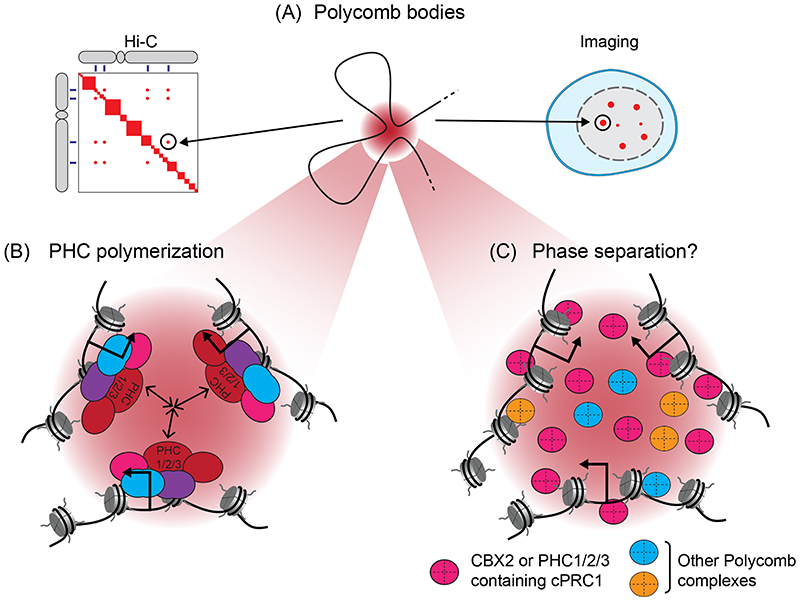
(A) Distinct Polycomb chromatin domains can interact in three dimensional space, even when separated by very large distances across the genome. In high-throughput chromosome conformation capture (Hi-C), these interactions correspond to regions of high contact frequency (left). In imaging experiments, they correspond to foci of Polycomb complex components, mono-ubiquitylated histone H2A Lys119 (H2AK119ub1) and tri-methylated histone H3 Lys27 (H3K27me3), which are often referred to as Polycomb bodies (right). (B) Long-range interactions between Polycomb chromatin domains require the Polyhomeotic (PHC) subunit (PHC1, 2 or 3) of canonical Polycomb repressive complex 1 (cPRC1), which can polymerise through its sterile alpha motif (SAM). (C) Components of cPRC1, including chromobox 2 (CBX2) and the SAM domain of PHC1, 2 or 3, can undergo liquid–liquid phase separation in vitro and form nuclear condensates in vivo, which share similarities with Polycomb bodies. These condensates could possibly augment Polycomb complex activities and may reinforce long-range interactions between Polycomb chromatin domains.
Figure 5
Figure 5. Models of Polycomb chromatin domain formation and gene regulation
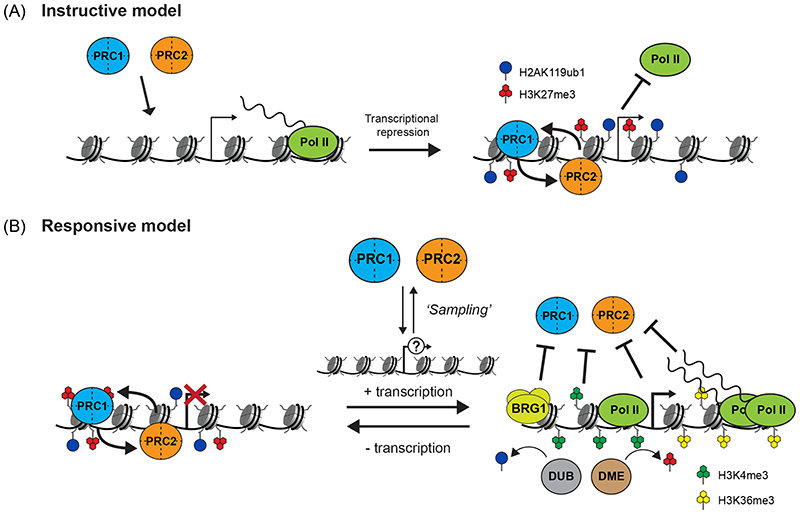
(A) An instructive model, in which Polycomb complexes are recruited to target sites (left), where they initiate the formation of Polycomb chromatin domains (right) and drive the repression of transcribed genes. (B) A responsive model, in which Polycomb complexes dynamically ‘sample’ potential target sites for susceptibility to Polycomb chromatin domain formation. In particular, the Polycomb group RING finger 1 (PCGF1)-containing variant Polycomb repressive complex 1 (vPRC1) and PRC2.2 complex, through their capacity to bind CpG islands (not shown), could dynamically engage with approximately 70% of gene promoters. At lowly or untranscribed genes (left), these complexes could potentially sense and respond to the (near) absence of transcription by ubiquitylating histone H2A Lys119 (H2AK119ub1) and tri-methylating histone H3 Lys27 (H3K27me3) to initiate the formation and spreading of Polycomb chromatin domains, which could help counteract low-level or inappropriate transcription and maintain an inactive chromatin state to protect cell identity. However, at expressed genes (right), transcription-associated features including H3K4me3 and H3K36me3, high levels of nascent transcripts, BRG1-mediated chromatin remodelling, and deubiquitylase (DUB) and demethylase (DME) activities, counteract H2AK119 and H3K27 modification, thereby blocking Polycomb chromatin domain formation and limiting Polycomb function at these genes. Pol II, RNA polymerase II.
Figure 6
Figure 6. Mechanisms of Polycomb-mediated gene regulation
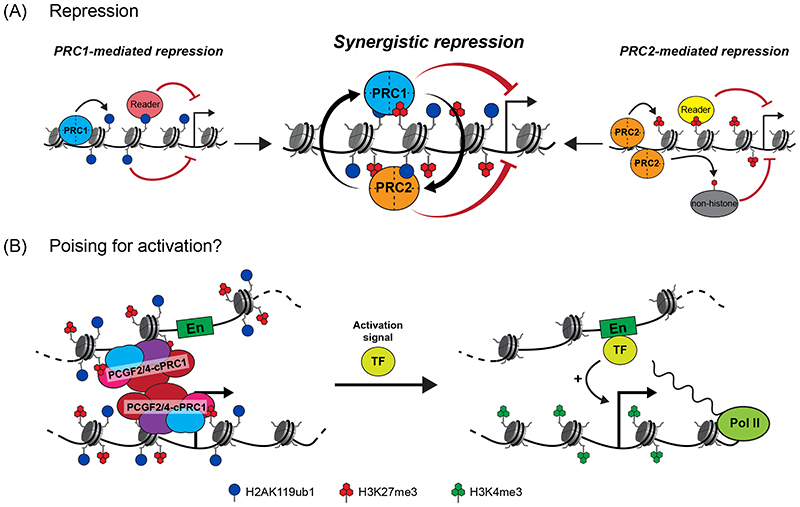
(A) Despite the integration of their activities in Polycomb chromatin domains, the mechanisms that enable Polycomb repressive complex 1 (PRC1) and PRC2 to counteract transcription appear to be distinct. PRC1-mediated gene repression is driven by ubiquitylation of histone H2A Lys119 (H2AK119ub1), possibly mediated by the activity of H2AK119ub1-reader proteins or, more directly, by the installation of the bulky ubiquitin moiety into chromatin and thus antagonising some aspect of transcription (left). PRC2-mediated repression appears to involve readers of tri-methylated histone H3 Lys27 (H3K27me3) or methylation of non-histone substrates (right). Importantly, although PRC1 and PRC2 can independently counteract transcription, the communication and feedback between PRC1 and PRC2, which support the formation of Polycomb chromatin domains, appear in some contexts to synergise the repressive activities of PRC1 and PRC2 at target genes (centre), thereby providing a robust barrier against inappropriate gene expression. (B) In some contexts, Polycomb complexes can activate genes. Canonical PRC1 (cPRC1) mediates the formation of chromatin topologies that can bring poised enhancers (En) and their target promoters into close proximity (left). Once activation signals are received at the enhancer through transcription factor (TF) binding, this could support rapid induction of transcription (right). PCGF2/4, Polycomb group ring finger 2 or 4; Pol II, RNA polymerase II.
Figure 7
Figure 7. CpG islands and chromatin bistability
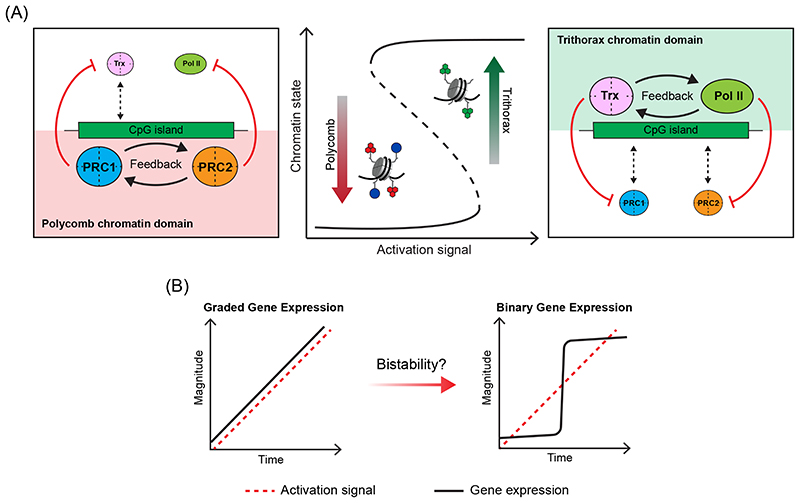
(A) A schematic illustrating how chromatin bistablity could form at CpG islands (CGIs). When transcription activation signals are low or absent, communication and feedback between Polycomb repressive complex 1 (PRC1) and PRC2 could drive the formation of repressive Polycomb chromatin domains that antagonise Trithorax (Trx) complexes and RNA polymerase II (Pol II) activity (left). When activation signals are high and persistent, communication and feedback between Trithorax complexes and Pol II could drive the formation of transcription-permissive Trithorax chromatin domains that antagonise PRC1 and PRC2 (right). The capacity of both Polycomb and Trithorax systems to sample CGIs coupled with the feedback and antagonistic mechanisms inherent to the formation of each chromatin state, would provide the opportunity to switch between predominantly Polycomb or predominantly Trithorax chromatin states as gene activation signals increase or decrease. We speculate that this mode of gene regulation could help to shape gene expression transitions (see part B) and also provide a chromatin-encoded hysteresis of the current transcriptional state of the gene in the face of inherently stochastic and pulsatile transcription initiation induced from single gene promoters. (B) If transitions between gene expression states, for example gene induction during cellular differentiation, scaled linearly with its activation signal, then one would predict graded expression output (left). However, if CGIs help to create bistable chromatin at gene promoters, this could shape binary, switch-like, gene expression transitions in which Polycomb chromatin domains constrain activation signals until appropriate activation thresholds are reached, at which point transcription initiation would precipitate a rapid switch into a Trithorax chromatin state and potentiate transcription. In the context of such a system, one might predict CGIs could help to convert graded gene activation signals into binary switch-like gene expression outputs through chromatin bistability. This could be particularly useful in supporting decisive gene expression transitions during development. Adapted with permission from REF. 290, Elsevier.

References

    1. Haberle V, Stark A. Eukaryotic core promoters and the functional basis of transcription initiation. Nat Rev Mol Cell Biol. 2018;19:621–637. - PMC - PubMed
    1. Kassis JA, Kennison JA, Tamkun JW. Polycomb and Trithorax Group Genes in Drosophila. Genetics. 2017;206:1699–1725. - PMC - PubMed
    1. Schuettengruber B, Bourbon HM, Di Croce L, Cavalli G. Genome Regulation by Polycomb and Trithorax: 70 Years and Counting. Cell. 2017;171:34–57. - PubMed
    1. de Napoles M, et al. Polycomb group proteins Ring1A/B link ubiquitylation of histone H2A to heritable gene silencing and X inactivation. Dev Cell. 2004;7:663–676. - PubMed
    1. Wang H, et al. Role of histone H2A ubiquitination in Polycomb silencing. Nature. 2004;431:873–878. - PubMed

Publication types

MeSH terms