


Priorities for sexually transmitted infection vaccine research and development: Results from a survey of global leaders and representatives
- PMID: 34401741
- PMCID: PMC8356130
- DOI: 10.1016/j.jvacx.2021.100107
Priorities for sexually transmitted infection vaccine research and development: Results from a survey of global leaders and representatives
Abstract
Objective: To determine the sexually transmitted infection (STI) vaccine research priorities of global leaders in STI vaccine research, development, and service provision.
Methods: Global representatives attending the STI Vaccines: Opportunities for Research, Development, and Implementation symposium preceding the STI & HIV World Congress in 2019 were invited to complete an electronic survey. We asked participants to rank items by importance/priority for STI vaccine development for the following areas of focus: specific STIs (gonorrhea, chlamydia, syphilis, herpes, and trichomoniasis), broad research domains (basic science, funding, communication, program planning, and vaccine hesitancy), and specific research activities related to these domains. We calculated weighted value scores based on the ranking (e.g., first, second, third) and the total number of responses in order to produce a ranked list of the priorities.
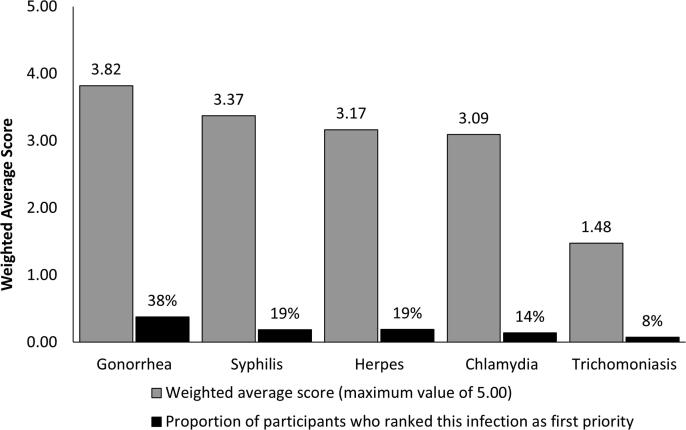
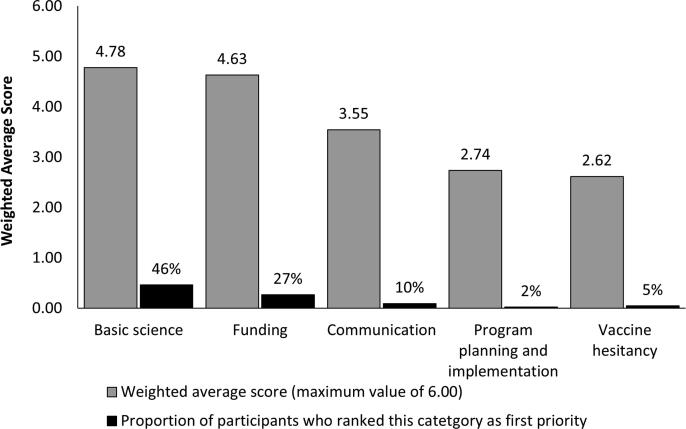
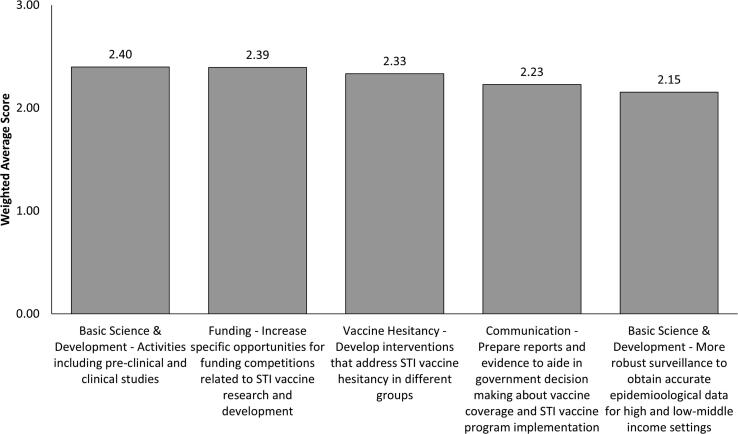
Results: A total of 46 out of 97 (44%) symposium attendees responded to the survey. Gonorrhea was identified as the STI that should be prioritized for vaccine development, followed by syphilis with weighted value scores of 3.82 and 3.37, respectively, out of a maximum of five. Basic science (and vaccine development) was the domain ranked with the highest priority with a weighted value score of 4.78 out of six. Research activities related to basic science and vaccine development (including pre-clinical and clinical trials, and surveillance measures) and increased funding opportunities were the most highly ranked activities in the "STI vaccine development" and "research domains and activities" categories.
Conclusion: Global leaders in attendance at the STI Vaccines symposium prioritized continued scientific work in vaccine development and program planning. Gonorrhea was identified as the highest priority infection, followed by syphilis.
Keywords: Prevention; Priorities; Public health; Sexually transmitted infections; Vaccines.
© 2021 The Authors. Published by Elsevier Ltd.
Conflict of interest statement
The authors declare the following financial interests/personal relationships which may be considered as potential competing interests: GO, LWS, RD, CC, JAB, MS, CSR, TG, MN are members of the STRIVEBC consortium. The core team who completed the data analysis and interpretation of results (KP, RD, LS, GO) did not complete the survey. MS is supported via salary awards from the BC Children’s Hospital Foundation, the Canadian Child Health Clinician Scientist Program and the Michael Smith Foundation for Health Research. MS has been an investigator on projects funded by Pfizer, Merck, VBI Vaccines, Seqirus, Sanofi-Pasteur and GlaxoSmithKline. All funds have been paid to his institute, and he has not received any personal payments. RD has received fellowships from the Canadian Immunization Research Network and Michael Smith Foundation for Health Research. CSR received a fellowship from Michael Smith Foundation for Health Research. All other authors have no competing interests.
Figures
References
-
- Report on global sexually transmitted infection surveillance 2015. Geneva, Switzerland: World Health Organization; 2016.
-
- Global health sector strategy on sexually transmitted infections 2016-2021 - Towards ending STIs. Geneva, Switzerland: World Health Organization; 2016.
-
- Smylie L., Lau P., Lerch R., Kennedy C., Bennett R., Clarke B. The economic burden of chlamydia and gonorrhea in Canada. Sexually Transmitted Infect. 2011;87(1):A156.
Grants and funding
LinkOut - more resources
Full Text Sources
