Verbal Response Inhibition in Adults Who Stutter
- PMID: 34403265
- PMCID: PMC8642087
- DOI: 10.1044/2021_JSLHR-20-00739
Verbal Response Inhibition in Adults Who Stutter
Abstract
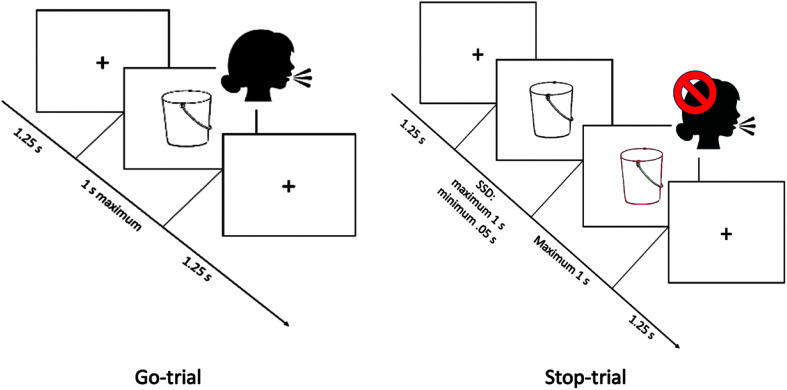
Purpose Adults who stutter (AWS) often attempt, with varying degrees of success, to suppress their stuttered speech. The ability to effectively suppress motoric behavior after initiation relies on executive functions such as nonselective inhibition. Although previous studies found that AWS were slower to inhibit manual, button-press response than adults who do not stutter (AWNS), research has yet to confirm a consistent relationship between manual and verbal inhibition. No study has examined verbal inhibition ability in AWS. The purpose of this study, therefore, is to compare verbal response inhibition between AWS and AWNS, and compare verbal response inhibition to both the overt stuttering and the lived experience of stuttering. Method Thirty-four adults (17 AWNS, 17 AWS) completed one manual and three verbal stop-signal tasks. AWS were assessed for stuttering severity (Stuttering Severity Instrument-Fourth Edition: SSI-4) and experience with stuttering (Overall Assessment of the Speaker's Experience With Stuttering [OASES]). Results Results indicate no correlation between manual and verbal inhibition for either group. Generalized linear mixed-model analyses suggested no significant group differences in manual or verbal inhibition. Manual and verbal inhibition did not predict SSI-4 in AWS. However, verbal inhibition was uniquely associated with OASES scores. Conclusion Although underlying manual and verbal inhibition was comparable between AWS and AWNS, verbal inhibition may be linked to the adverse experience of stuttering rather than the overt symptoms of stuttering severity. Supplemental Material https://doi.org/10.23641/asha.15145185.
Figures
References
-
- Alm, P. A. , & Risberg, J. (2007). Stuttering in adults: The acoustic startle response, temperamental traits, and biological factors. Journal of Communication Disorders, 40(1), 1–41. https://doi.org/10.1016/j.jcomdis.2006.04.001 - PubMed
-
- Anderson, J. D. , & Bates, J. E. (2007). Temperament, parenting styles, and childhood stuttering. In Au-Yeung J. & Leahy M. (Eds.), Proceedings of the fifth world congress on fluency disorders: Research, treatment, and self-help in fluency disorders: New horizons (pp. 179–185). International Fluency Association.
-
- Anderson, J. D. , & Wagovich, S. A. (2010). Relationships among linguistic processing speed, phonological working memory, and attention in children who stutter. Journal of Fluency Disorders, 35(3), 216–234. https://doi.org/10.1016/j.jfludis.2010.04.003 - PMC - PubMed
-
- Barkley, R. A. (1997). Behavioral inhibition, sustained attention, and executive functions: Constructing a unifying theory of ADHD. Psychological Bulletin, 121(1), 65–94. https://doi.org/10.1037/0033-2909.121.1.65 - PubMed
-
- Bialystok, E. (2001). Bilingualism in development: Language, literacy, and cognition. Cambridge University Press. https://doi.org/10.1017/CBO9780511605963
Publication types
MeSH terms
Grants and funding
LinkOut - more resources
Full Text Sources
Medical