. 2022 Jul;26(5):1056-1069.
doi: 10.1177/13623613211039673. Epub 2021 Aug 18.

Differentiation of autism spectrum disorder and mood or anxiety disorder

Affiliations

Differentiation of autism spectrum disorder and mood or anxiety disorder

Sarah Wittkopf et al. Autism. 2022 Jul.

Abstract

Symptoms of mood and anxiety disorders overlap with symptoms of autism spectrum disorder, making the diagnostic process challenging. This study found that a combination of communicational deficits and unusual and/or inappropriate social overtures facilitates differentiation between autism spectrum disorder and mood and anxiety disorders. Furthermore, the results confirm the essential need of a behavioral observation with the Autism Diagnostic Observation Schedule in combination with a full Autism Diagnostic Interview-Revised to support diagnostic decisions.

Keywords: Autism Diagnostic Interview–Revised; Autism Diagnostic Observation Schedule; anxiety disorders; autism spectrum disorder; mood disorder.


Conflict of interest statement

Declaration of conflicting interests: The author(s) declared the following potential conflicts of interest with respect to the research, authorship, and/or publication of this article: L.P. has received conference attendance support or speaking fees from Shire. She receives research funding by the German Federal Ministry of Education and Research (BMBF), German Research Foundation (DFG), and European Union (EU) and royalties from Hogrefe, Kohlhammer, and Schattauer. V.R. has received payment for consulting and writing activities from Lilly, Novartis, and Shire Pharmaceuticals; lecture honoraria from Lilly, Novartis, Shire Pharmaceuticals, and Medice Pharma; and support for research from Shire Pharmaceuticals and Novartis. He has carried out clinical trials in cooperation with the Novartis, Shire, Servier, and Otsuka companies. The remaining authors declare no potential conflict of interest.

Figures

Figure 1.
Figure 1.
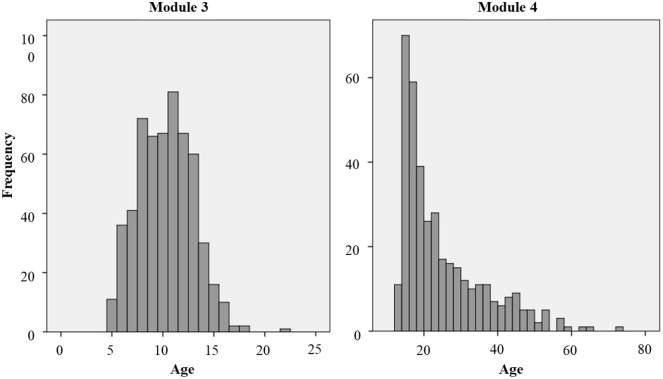
Distribution of age. The histogram shows the frequencies of ages included in the samples of Modules 3 and 4.
Figure 2.
Figure 2.
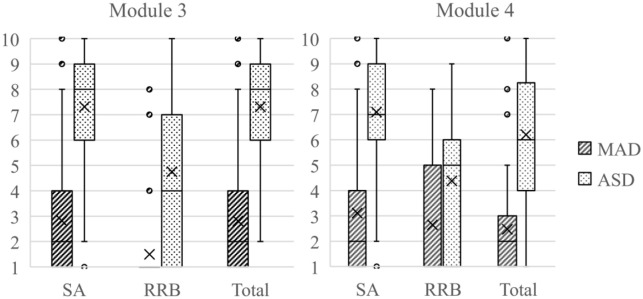
Boxplot for CSS scores of the ADOS. The boxplot shows quartile range. Middle lines indicate medians. An X indicates the group’s mean. Dots indicate outliers. SA: social affect; RRB: restricted, repetitive behavior; total: total score (sum of SA + RRB); CSS: calibrated severity score; ADOS: Autism Diagnostic Observation Schedule.
Figure 3.
Figure 3.
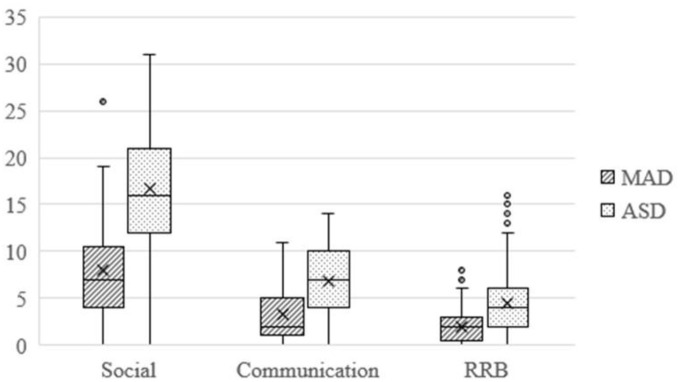
Boxplot for algorithm scores of ADI-R. It shows quartile range. Middle lines indicate medians. An X indicates the group’s mean. Dots indicate outliers. Social: social domain score; communication: communication domain score; RRB: restricted, repetitive behavior domain score; ADI-R: Autism Diagnostic Interview–Revised.
Figure 4.
Figure 4.
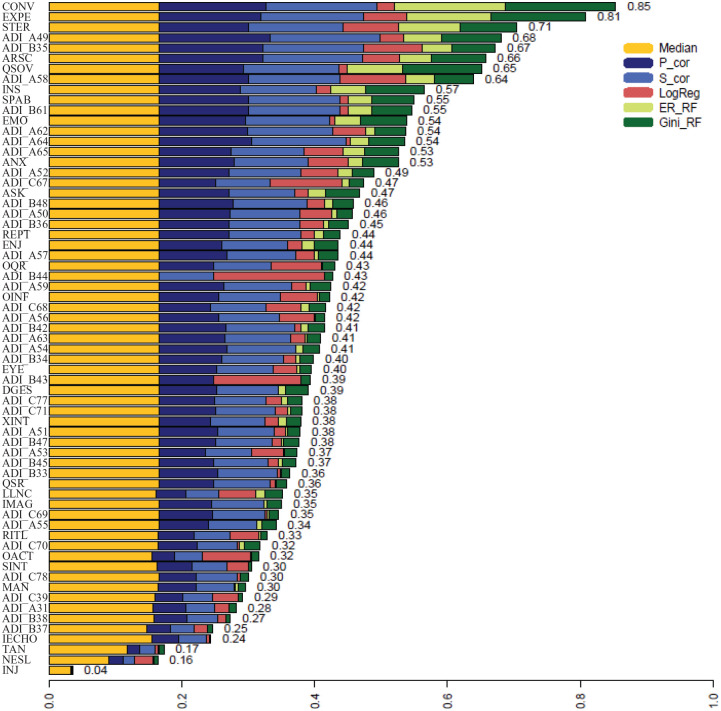
Results of ensemble feature selection. Values report item importance with higher values indicating higher importance for classification. Median: p-values from Wilcoxon signed-rank test; P_cor: Pearson product-moment correlation; S_cor: Spearman rank correlation; LogReg: β-values of logistic regression; ER_RF: error-rate based on random Forest analysis; Gini_RF: Gini-index based on random Forest analysis; ANX: anxiety; ARSC: amount of reciprocal social communication; ASK: asks for information; CONV: conversation; DGES: descriptive, conventional, instrumental, or informational gestures; EMO: empathy/comments on other’s emotions; ENJ: shared enjoyment in interaction; EXPE: facial expressions directed to examiner; EYE: unusual eye contact; IECHO: immediate echolalia; IMAG: imagination/creativity; INJ: self-injurious behavior; INS: insight; LLNC: language production and linked nonverbal communication; MAN: hand and finger and other complex mannerisms; NESL: overall level of nonechoed language; OACT: overactivity; OINF: offers information; OQR: overall quality of rapport; QSOV: quality of social overtures; QSR: quality of social response; REPT: reporting of events; RITL: compulsions or rituals; SINT: unusual sensory interest in play material/person; SPAB: speech abnormalities associated with autism; STER: stereotyped/idiosyncratic use of words or phrases; TAN: tantrums, aggression, negative or disruptive behavior; XINT: excessive interest in or references to unusual or highly specific topics or objects or repetitive behaviors; ADI_A31: use of other’s body to communicate; ADI_A49: imaginative play with peers; ADI_A50: direct gaze; ADI_A51: social smiling; ADI_A52: showing and directing attention; ADI_A53: offering to share; ADI_A54: seeking to share enjoyment with others; ADI_A55: offering comfort; ADI_A56: quality of social overtures; ADI_A57: range of facial expressions used to communicate; ADI_A58: inappropriate facial expressions; ADI_A59: appropriateness of social response; ADI_A62: interest in children; ADI_A63: response to approaches of other children; ADI_A64: group play with peers; ADI_A65: friendships; ADI_B33: stereotyped utterances and delayed echolalia; ADI_B34: social verbalization/chat; ADI_B35: reciprocal conversation; ADI_B36: inappropriate questions of statements; ADI_B37: pronominal reversal; ADI_B38: neologism/idiosyncratic language; ADI_B42: pointing to express interest; ADI_B43: nodding; ADI_B44: head shaking; ADI_B45: conventional/instrumental gestures; ADI_B47: spontaneous imitation of actions; ADI_B48: imaginative play; ADI_B61: imitative social play; ADI_C39: verbal rituals; ADI_C67: unusual preoccupations; ADI_C68: circumscribed interests; ADI_C69: repetitive use of objects or interest in parts of objects; ADI_C70: compulsions/rituals; ADI_C71: unusual sensory interests; ADI_C77: hand and finger mannerisms; ADI_C78: other complex mannerisms or stereotyped body movements.

References

    1. Avni E., Ben-Itzchak E., Zachor D. A. (2018). The presence of comorbid ADHD and anxiety symptoms in autism spectrum disorder: Clinical presentation and predictors. Frontiers in Psychiatry, 9, Article 717. 10.3389/fpsyt.2018.00717 - DOI - PMC - PubMed
    1. Ben-Itzchak E., Koller J., Zachor D. A. (2020). Characterization and prediction of anxiety in adolescents with autism spectrum disorder: A longitudinal study. Journal of Abnormal Child Psychology, 48(9), 1239–1249. 10.1007/s10802-020-00673-0 - DOI - PubMed
    1. Bölte S., Rühl D., Schmötzer G., Poustka F. (2006). ADI-R: Diagnostisches Interview für Autismus—Revidiert [ADI-R: Autism Diagnostic Interview - Revised]. Huber.
    1. Cai R. Y., Richdale A. L., Dissanayake C., Uljarevic M. (2018). Brief report: Inter-relationship between emotion regulation, intolerance of uncertainty, anxiety, and depression in youth with autism spectrum disorder. Journal of Autism & Developmental Disorders, 48(1), 316–325. 10.1007/s10803-017-3318-7 - DOI - PubMed
    1. Cath D. C., Ran N., Smit J. H., van Balkom A. J. L. M., Comijs H. C. (2008). Symptom overlap between autism spectrum disorder, generalized social anxiety disorder and obsessive-compulsive disorder in adults: A preliminary case-controlled study. Psychopathology, 41(2), 101–110. - PubMed

Publication types